
Savage Model 334: New Calibers and Compact Rifle Buyer Checks
October 2, 2026
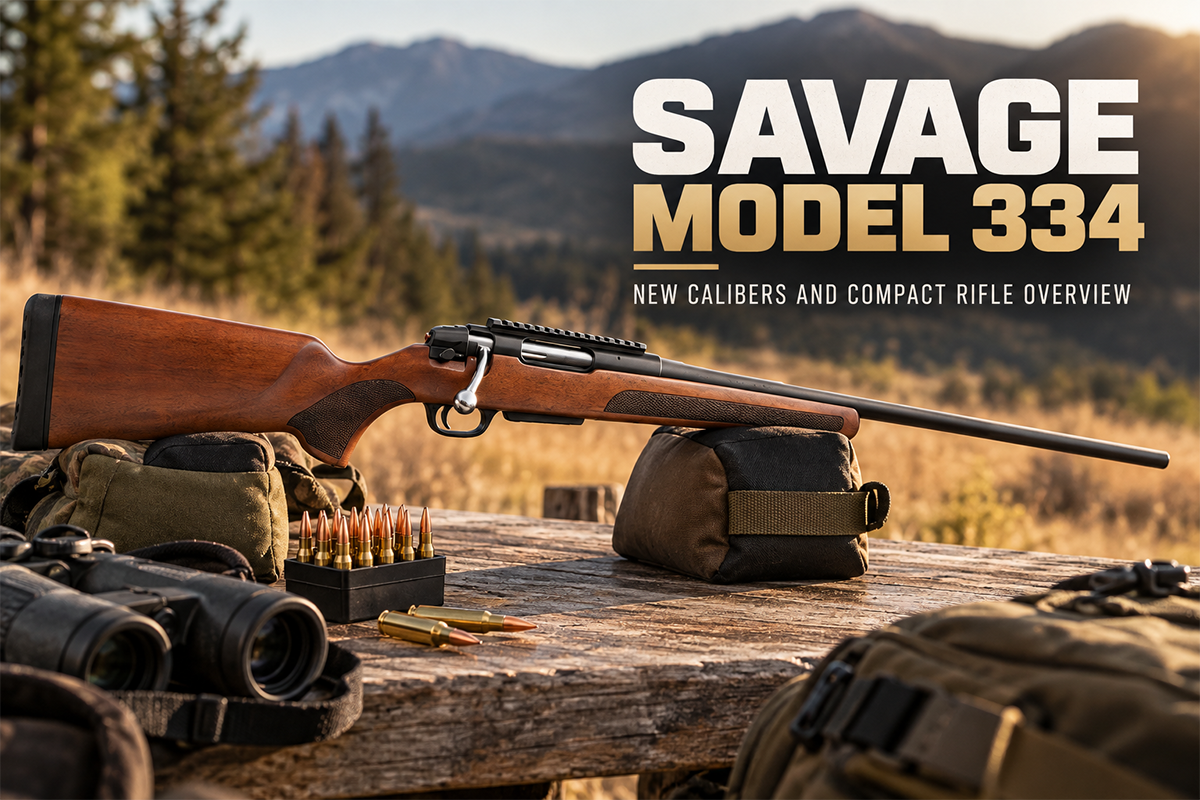
The Savage Model 334 lineup gained new chamberings and compact walnut configurations on September 22, 2026. The update gives budget-minded hunters more choices in stock material, barrel length, and cartridge. This guide explains what changed, which version fits each use, and what to verify before choosing a listing.
Quick answer: The new synthetic rifles add .223 Remington and .350 Legend at a $459 MSRP. Walnut versions of those chamberings list for $629. Five Walnut Compact models use an 18- or 18.5-inch barrel and share the same $629 MSRP. The compact options favor easier handling, but cartridge choice still matters more than stock length alone.
What changed in the Savage Model 334 lineup?
Savage added standard-length .223 Remington and .350 Legend rifles in both synthetic and walnut stocks. The larger news is the Walnut Compact family. It covers .223 Remington, .243 Winchester, 6.5 Creedmoor, .308 Winchester, and .350 Legend.
The company says the new models are available to order and ready to ship. Its official announcement lists each barrel length, twist rate, and MSRP. Buyers should still confirm the exact SKU because several versions look similar in retailer photos.
| Platform | Action | Caliber | Barrel/Weight | Capacity | OAL | MSRP/Street |
|---|---|---|---|---|---|---|
| Black Synthetic | Bolt, 60-degree lift | .223 Rem. | 20 in. / not announced | 3-round magazine | Not announced | $459 / varies |
| Black Synthetic | Bolt, 60-degree lift | .350 Legend | 18 in. / not announced | 3-round magazine | Not announced | $459 / varies |
| Walnut | Bolt, 60-degree lift | .223 Rem. | 20 in. / not announced | 3-round magazine | Not announced | $629 / varies |
| Walnut | Bolt, 60-degree lift | .350 Legend | 18 in. / not announced | 3-round magazine | Not announced | $629 / varies |
| Walnut Compact | Bolt, 60-degree lift | .223 Rem., .243 Win., 6.5 Creedmoor, .308 Win. | 18.5 in. / not announced | 3-round magazine | Not announced | $629 / varies |
| Walnut Compact | Bolt, 60-degree lift | .350 Legend | 18 in. / not announced | 3-round magazine | Not announced | $629 / varies |
The .223 versions use a 1:9 twist. The .350 Legend rifles use a 1:16 twist. Compact .243, 6.5 Creedmoor, and .308 versions use 1:10, 1:8, and 1:11 twists, respectively.
Which new chambering fits your use?
.223 Remington for practice and light-recoil utility
The .223 Remington option fills an obvious gap in the prior Model 334 range. It offers widely available practice ammunition and mild recoil. That combination can make range sessions less expensive and more comfortable than sessions with larger centerfire cartridges.
Its best fit is target practice, varmint work where lawful, and general ranch use. Hunters must check local game laws and use ammunition suited to the intended quarry. A cartridge being available in a rifle does not make it appropriate for every animal or location.
.350 Legend for straight-wall hunting zones
The .350 Legend models target hunters who want a short, handy rifle with a straight-wall cartridge. Several states allow straight-wall cartridges during seasons or in areas that restrict traditional bottleneck rifle rounds. Rules vary, so confirm current regulations before making a purchase decision.
Both standard and compact .350 Legend versions use an 18-inch barrel. That keeps the package short without creating a barrel-length difference between the two stock configurations. Fit, length of pull, and stock preference become the deciding factors.
.243 Winchester, 6.5 Creedmoor, or .308 Winchester
These three Walnut Compact choices cover different recoil and ammunition priorities. The .243 Winchester generally offers the softest recoil of the group. It can suit smaller-framed hunters when paired with a properly fitted stock and suitable hunting load.
The 6.5 Creedmoor brings broad factory-load support and a reputation for efficient longer-range performance. The .308 Winchester offers extensive ammunition selection and flexible bullet weights. Neither label replaces a fit test, recoil check, or realistic assessment of likely shooting distance.
Compact walnut or standard stock?
A compact stock is useful only when it improves the shooter’s position. A shorter length of pull can help someone place the butt correctly while keeping a relaxed firing-hand grip. It may also make a rifle easier to mount while wearing heavy layers.
Do not assume “compact” means “youth only.” Many adults with shorter arms prefer compact stocks. Taller shooters may feel cramped, especially from field positions. Shoulder the rifle with the planned clothing and optic before deciding.
The 18.5-inch compact barrel saves 1.5 inches compared with the 20-inch .223 standard models. That can help in blinds, vehicles, and thick cover. The tradeoff may include more muzzle blast and some velocity loss, depending on the cartridge and load.
Shared Model 334 features and tradeoffs
Across the family, the action uses three locking lugs and a 60-degree bolt lift. The shorter lift helps the bolt handle clear a mounted scope. A free-floating, button-rifled carbon-steel barrel ends in an 11-degree target crown.
Other shared features include a three-position safety, a three-round detachable box magazine, and an integrated recoil lug. A one-piece steel Picatinny rail is included for mounting an optic. The walnut models pair a traditional stock with a silver bolt, while synthetic models use a matte black treatment.
Independent testing of an earlier walnut .308 found reliable feeding and ejection, plus a smooth bolt. That test also noted a heavy trigger and accuracy that varied by load. New configurations should be judged on their own results, since barrel length and chambering can change performance.
The strongest reason to choose this platform is practical value, not a promise that every rifle and ammunition combination will perform the same.
Savage Model 334 buyer checklist
- Confirm the stock. Verify synthetic, full-size walnut, or Walnut Compact on the box and SKU.
- Match the chambering to the task. Consider recoil, local hunting rules, typical distance, and ammunition cost.
- Check barrel details. Confirm the listed length and twist rate instead of relying on a retailer image.
- Test the fit. Shoulder the rifle with the optic and clothing you expect to use.
- Budget for the full setup. Add rings, scope, sling, case, ammunition, and any transfer fees.
- Inspect controls. Work the safety, magazine, and bolt before accepting the firearm through the seller and transfer dealer.
- Test several loads. Accuracy can vary, so compare suitable factory loads before settling on one.
GunGenius readers can compare more bolt-action rifles and review the broader Savage catalog. Those pages help place the new models beside alternatives with different stocks, triggers, barrel lengths, and price points.
Who should shortlist the expanded lineup?
The synthetic .223 is the clearest choice for a lower-cost range and utility rifle. The synthetic .350 Legend makes sense for hunters who need that cartridge and prefer a weather-resistant stock. Walnut buyers pay more for traditional appearance and feel, not a different basic action.
The Walnut Compact models deserve attention from smaller-framed adults, younger supervised shooters, and hunters working in tight cover. They also suit anyone who has confirmed that a shorter stock improves alignment. A full-size stock remains the safer default when several adults will share one rifle.
Bottom line
The expanded Savage Model 334 family turns one value-priced bolt action into a more flexible set of choices. The .223 and .350 Legend additions address clear use cases. The compact walnut rifles add fit options across five popular chamberings.
Choose by fit and intended use before choosing by finish. Verify the exact SKU, test the controls, and reserve part of the budget for a dependable optic and suitable ammunition. That process matters more than a small difference in advertised price.