
Beretta 1526 Parallelo: Design, Specs, and Collector Context
October 6, 2026
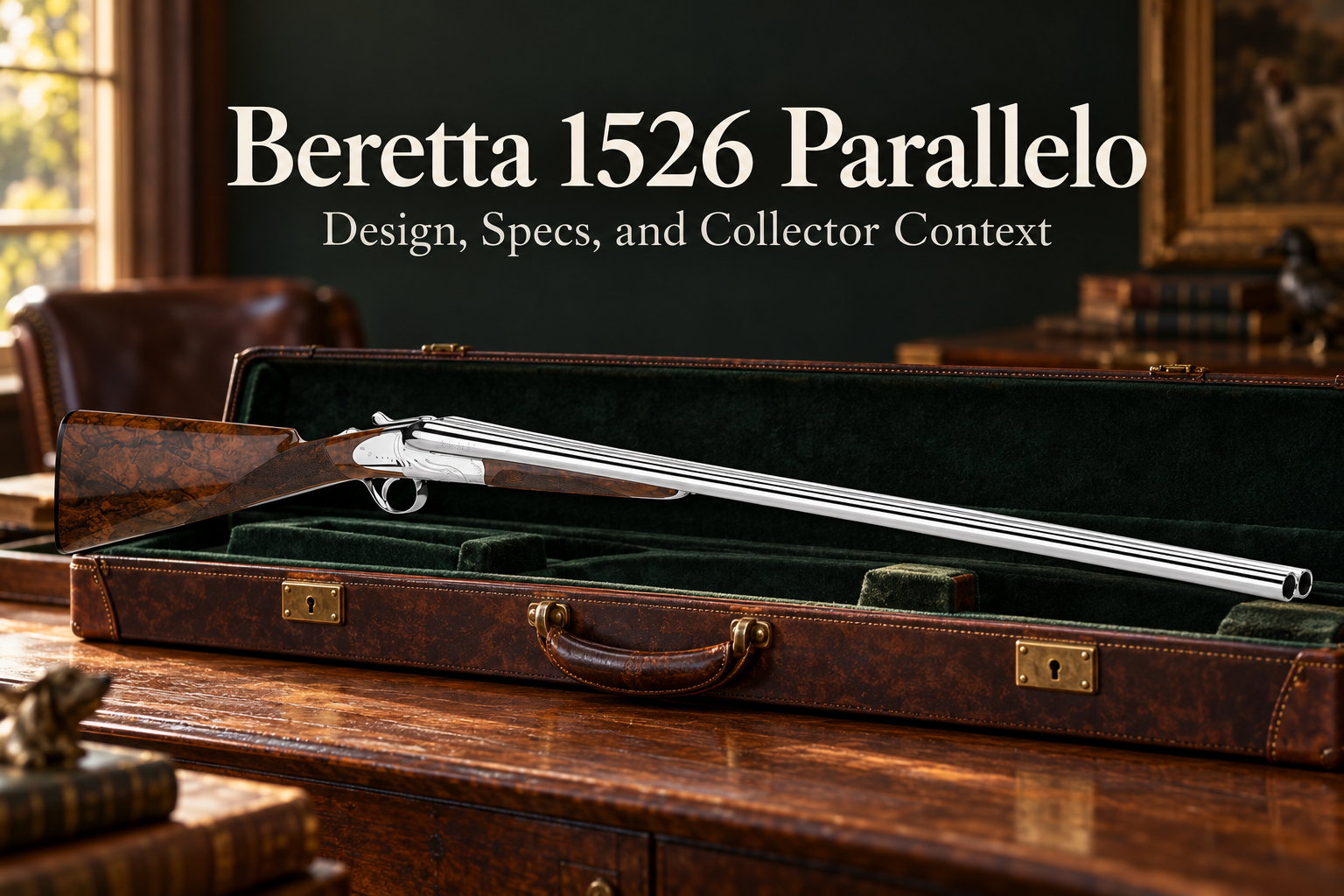
The Beretta 1526 Parallelo is a one-off matched pair of 12-gauge side-by-side shotguns created for Beretta’s 500th anniversary. It combines the smooth shape of the 486 by Marc Newson with a true sidelock action influenced by the SO10. This is not a newly announced production shotgun. It is a demonstration of design, engineering, and hand finishing that helps collectors understand where Beretta’s fine-gun work may be heading.
The short answer: the 1526 Parallelo is a unique presentation pair, not a catalog model with a published retail price.
What Is the Beretta 1526 Parallelo?
“Parallelo” refers to a side-by-side barrel arrangement. The barrels sit on the same horizontal plane, unlike an over-under shotgun. Readers can compare the broader format in the GunGenius side-by-side shotgun catalog.
Beretta calls the 1526 project a unique pair. Both guns are 12-gauge, self-opening side-by-sides with sidelock actions. A sidelock places much of the firing mechanism on removable side plates. That layout is associated with premium double guns because it permits refined trigger work, careful finishing, and extensive hand fitting.
Self-opening means the action uses stored spring force to help open the gun after the top lever is moved. It is different from an assisted-opening or conventional action. The feature matters most in the fine-gun world, where smooth operation and mechanical feel carry as much weight as basic function.
| Category | Confirmed detail | Why it matters |
|---|---|---|
| Configuration | Unique matched pair | Not a normal retail model |
| Type | Side-by-side shotgun | Horizontal two-barrel layout |
| Gauge | 12 gauge | Common sporting gauge |
| Action | True sidelock, self-opening | Premium traditional mechanism |
| Stock | Selected grade 5 walnut | Matched for appearance and weight |
| Receiver | Round-body, mirror-polished | Supports the seamless design |
| Price | Not published | Avoid treating estimates as fact |
How the 486 and SO10 Influenced the Design
The visual starting point is the 486 Parallelo created with industrial designer Marc Newson. Its rounded receiver and uninterrupted lines moved away from the boxier profile of many traditional doubles. The 1526 project keeps that flowing shape while adding a true sidelock mechanism.
That combination required more than decorative side plates. Beretta says its engineers reworked the action to house the sidelocks while preserving a slim cross-section. They also removed the visual interruption of traditional hinge pins and a lower plate. The opening lever draws from the palmette form used on the SO10.
The result links a modern industrial-design study with Beretta’s high-grade mechanical tradition. Researchers can use the Beretta brand catalog to compare more obtainable models. The 486 family remains the most direct visual reference, while the SO10 provides context for the sidelock construction.
Why the Water-Ripple Finish Matters
The receiver’s engraving begins at Beretta’s anniversary emblem and spreads outward in concentric ripples. Its mirror polish changes with the viewing angle, so the pattern depends on reflected light rather than deep relief alone. Beretta extended the clean surface treatment across the trigger guard, trigger, monoblock sleeve, and opening lever.
This treatment is more than ornament. A mirror finish exposes small surface flaws that a textured or heavily engraved finish can hide. Maintaining uninterrupted curves around a sidelock action also places tight demands on machining and hand polishing. The design turns manufacturing precision into part of the visual theme.
The stocks provide a warm contrast. Beretta selected grade 5 walnut and applied more than 80 coats of Tru-Oil by hand. The two stocks were matched to a maximum weight difference of one gram. That tolerance reinforces the idea that the guns form one set rather than two separate commissions.
What Beretta Has Not Published
Several practical specifications remain unconfirmed. The official Beretta project page identifies the gauge, action type, materials, and design influences. It does not list barrel length, chamber length, choke configuration, overall weight, or a suggested price.
No normal dealer release or production quantity beyond the single matched pair was announced. Price estimates found in forums are comparisons with other bespoke Beretta projects, not verified pricing. Treat them as conversation, not purchase guidance.
Specifications That Would Matter in a Production Gun
Barrel length would help predict swing and balance. Chamber length and proof markings would define the appropriate 12-gauge loads. Fixed or interchangeable choke details would also shape the gun’s practical role. None of those choices should be inferred from photographs.
Stock dimensions are just as important on a double gun. Length of pull, drop at comb, drop at heel, cast, pitch, and grip shape determine how naturally the barrels align with the shooter’s eye. Bespoke stocks can be built for one owner, so their dimensions may not transfer well to another shooter even when the workmanship is exceptional.
Barrel regulation is another key term. It describes how the two barrels are aligned so their patterns relate predictably at useful distances. A collector evaluating any working double should ask for inspection records and pattern-testing information. The 1526 project’s public presentation focuses on construction and art, not a field-test report.
Service planning matters too. A true sidelock contains precisely fitted parts that deserve a qualified gunsmith. Buyers comparing regular production doubles should confirm parts support, warranty terms, and access to factory-authorized service before assigning value to mechanical complexity.
That distinction prevents a common research error. A high-profile reveal may look like a product launch even when the maker presents it as a singular design statement. Anyone seeking a field gun should compare current shotgun listings by fit, configuration, service support, and actual availability.
Collector Context Versus Field Use
A normal side-by-side buying decision centers on fit, balance, barrel regulation, chambering, chokes, condition, and access to service. Those questions still describe how the gun would function. They do not explain the 1526 pair’s primary value.
Its importance comes from rarity, documented purpose, craftsmanship, and its place in Beretta history. The matched execution also matters. A collector would want provenance for both guns, their presentation case, factory records, and any anniversary documentation to remain together.
For a shooter, the project offers a useful design lesson. Modern exterior forms do not require abandoning a traditional lock. The receiver shows how advanced machining can conceal structural transitions while keeping a recognizable double-gun layout. That idea may influence later custom commissions or production engineering, but Beretta has not promised a retail derivative.
Beretta 1526 Parallelo Research Checklist
- Confirm that a claim describes the one-off pair, not the standard 486 Parallelo.
- Separate published facts from price estimates and availability guesses.
- Look for factory documentation covering the actions, barrels, stocks, and presentation case.
- Verify whether photos show both guns in the pair or only one side of one gun.
- Compare the rounded 486-style body with the sidelock arrangement and SO10-inspired lever.
- Use current production models when researching fit, service, or a shotgun intended for regular field use.
What the Project Tells Buyers
The Beretta 1526 Parallelo does not create a new shopping category. Instead, it shows how a maker can use a commemorative project to test the limits of its design language. Its seamless body, hidden transitions, sidelock mechanism, and tightly matched stocks are the real story.
Most readers should view it as a reference point rather than a purchase target. Compare available Beretta side-by-sides with the same discipline used for any fine shotgun. Check fit first, verify the exact model and specifications, and value documented condition over a name alone.