
Beretta Titan: One-Off Rifle Specs and What They Mean
September 30, 2026
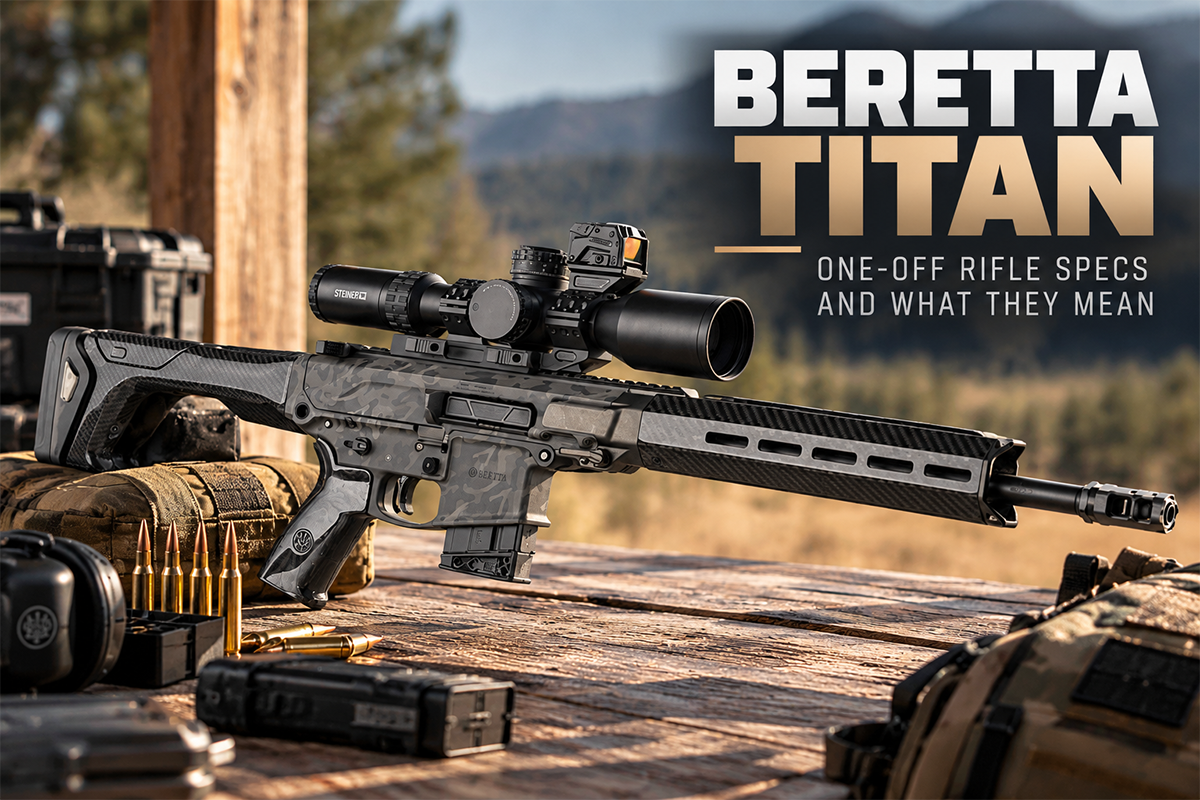
The Beretta Titan is a one-off 6.5 Grendel modern sporting rifle built to mark Beretta’s 500th anniversary. It combines an adjustable short-stroke piston with magnesium, titanium, and carbon-fiber components. That description sounds like a production launch, but Beretta presents this example as a singular technical showcase. Researchers should treat it as a preview of engineering ideas, not a normal rifle with a catalog price and dealer inventory.
Short answer: the Titan is a commemorative one-off. Beretta has not announced a standard production model, U.S. retail price, or dealer release schedule.
What Is the Beretta Titan?
Beretta introduced the rifle on May 12, 2026, as the first one-off project tied to its quincentennial. The company calls it a modern sporting rifle and emphasizes modularity, precision, and advanced materials. Its basic layout uses a semi-automatic, short-stroke piston action chambered in 6.5 Grendel.
A short-stroke piston uses a separate piston to start the operating cycle. The piston moves only a short distance before transferring energy to the action. This differs from the direct-gas systems common in many AR-pattern rifles. An adjustable setting can help tune operation for different ammunition or equipment, although Beretta has not published the Titan’s adjustment range.
The rifle belongs in a different research bucket from ordinary semi-auto rifles. It demonstrates what Beretta can build when cost and volume are not the main limits. Readers can also use the Beretta catalog page to compare the company’s established commercial products with this experimental showcase.
Confirmed Beretta Titan Specifications
The confirmed specification list is shorter than many retellings suggest. The official Beretta Titan page identifies the following features. It does not list several dimensions that buyers normally expect.
| Platform | Action | Caliber | Barrel/Weight | Capacity | OAL | Price |
|---|---|---|---|---|---|---|
| Modern sporting rifle | Adjustable short-stroke piston | 6.5 Grendel | Not published | Not published | Not published | Not announced |
- Beretta identifies magnesium components in the lower receiver area.
- Titanium is used in the upper receiver assembly.
- Carbon fiber forms the stock and forend.
- A two-stage design handles trigger duties.
- Steiner Optics ready describes the optic interface.
- 6.5 Grendel is the confirmed chambering.
Beretta has not published the rifle’s unloaded weight, barrel length, overall length, magazine type, accuracy standard, or suggested retail price. Those omissions matter. A product photo can show general proportions, but it cannot support a reliable measurement or compatibility claim.
Why Use Magnesium, Titanium, and Carbon Fiber?
The material mix is the Titan’s central idea. Magnesium alloys can reduce mass in suitable structures. Titanium offers high strength and corrosion resistance for its weight. Carbon fiber can provide a stiff shell without the mass of a comparable solid metal part.
Those benefits do not make every part automatically better. Each material changes manufacturing, heat management, surface protection, joining methods, and repair options. A durable production rifle also needs repeatable tolerances and a supply chain that can make replacement parts. Beretta says it used simulation and physical testing, but it has not released public test protocols or round-count results.
The engineering question is therefore larger than total weight. Designers must decide where low mass helps and where added material improves durability or balance. A very light front end may handle quickly. It can also change how the rifle settles on target. Without a published weight and balance point, readers should not assume the final handling character.
Why 6.5 Grendel Fits the Project
6.5 Grendel was designed to offer useful external ballistics from a compact rifle platform. External ballistics describes what a bullet does after it leaves the barrel. The cartridge generally offers better retained velocity and wind performance than common 5.56 NATO loads, while fitting a shorter action than full-power rifle cartridges.
That makes the chambering a logical match for a rifle focused on material efficiency and extended-range performance. It also brings tradeoffs. Ammunition selection, magazine geometry, bolt design, and barrel length can affect reliability and performance. Beretta has not disclosed enough detail to compare the Titan with a specific commercial 6.5 Grendel rifle.
Is the Beretta Titan for Sale?
No standard retail release has been announced. Beretta labels this rifle “One-Off,” and its anniversary material treats the project as a unique creation. That means readers should be cautious with listings, prices, or claims that imply normal dealer availability.
A future commercial rifle could borrow the Titan’s action, materials, or styling. That would still be a different product until Beretta publishes a model name, specifications, markets, and release plan. Similar appearance alone would not establish shared components or compatibility.
What Researchers Should Not Assume
First, one-off status does not tell us how Beretta would price a related production rifle. Prototype materials and labor do not map cleanly to a retail bill of materials. A production design might use different alloys, simplify decorative work, or change carbon-fiber components to control cost.
Second, the anniversary rifle should not be treated as a published performance benchmark. Beretta describes precision, rigidity, and durability goals, but it provides no group size, test distance, ammunition lot, environmental procedure, or endurance total. Those details would be necessary for a useful comparison with a commercial rifle.
Finally, visual similarity to an AR-style platform does not confirm parts interchangeability. Controls, magazines, trigger components, bolt parts, handguards, and stocks may use proprietary dimensions. Even familiar shapes can hide a different attachment system. Future documentation must answer those questions.
This distinction protects buyers from two opposite errors. One is dismissing the Titan as decoration when it contains real engineering work. The other is assuming every showcased feature is ready for normal ownership, service, and replacement.
What the Titan May Signal for Future Rifles
The safest conclusion is that Beretta is demonstrating manufacturing capability. The project shows interest in piston operation, reduced-mass structures, mixed-material receivers, and integrated optic planning. It does not prove that all of those features will reach a consumer rifle.
Production decisions involve price, serviceability, parts supply, regulatory requirements, and demand. Magnesium and titanium can be practical, but they may add cost or require specialized processes. Carbon-fiber furniture can save weight, yet users still need attachment points, impact resistance, and predictable heat behavior.
The optic language also deserves restraint. “Steiner Optics ready” confirms an intended relationship with Steiner equipment. It does not identify a universal footprint, included optic, mount height, or accessory package. A buyer should wait for drawings or a production manual before inferring compatibility.
Research Checklist for Any Production Descendant
- Confirm the exact model and market. A commemorative prototype is not a retail SKU.
- Check barrel length, twist rate, muzzle thread, and tested ammunition.
- Verify magazine pattern, capacity, bolt parts, and replacement availability.
- Ask for unloaded weight, balance point, and overall length with the stock adjusted.
- Identify every gas setting and the maker’s intended use for each one.
- Confirm optic interface dimensions instead of relying on “ready” language.
- Review warranty coverage for mixed-material receiver and furniture components.
- Compare price and support with established 6.5 Grendel semi-auto rifles.
This checklist separates an interesting concept from a supportable ownership decision. It also prevents a rare anniversary piece from setting unrealistic expectations for a future production model.
The Practical Takeaway
The Beretta Titan matters as a design study. Its adjustable piston, 6.5 Grendel chambering, and advanced material mix show a serious effort to rethink a semi-auto rifle around stiffness and mass. The project is also deliberately ceremonial.
Researchers should enjoy the engineering while keeping the evidence in bounds. There is no announced production schedule, retail price, or complete specification sheet. If Beretta turns these ideas into a commercial rifle, the final model deserves a fresh evaluation based on published dimensions, support, compatibility, and field testing.