
Taurus GX4 Carry .380: Buyer Fit, Specs, and Checks
August 25, 2026
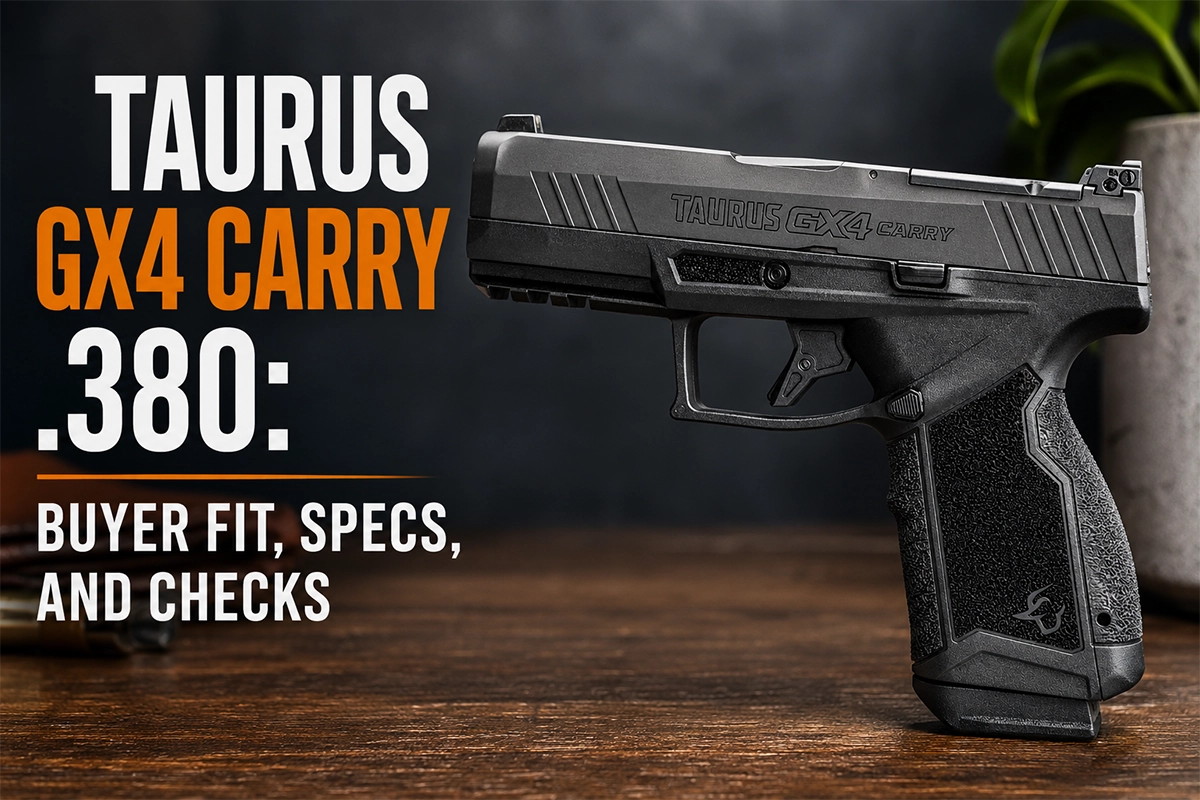
The Taurus GX4 Carry .380 gives buyers a full-grip, 15-round .380 Auto pistol instead of another tiny pocket gun. Announced for U.S. dealers on August 13, 2026, it pairs a 3.70-inch barrel with an optics-ready slide, an accessory rail, and three backstraps. The main question is simple: does lower recoil matter enough to choose it over the nearly identical 9mm version?
For recoil-sensitive shooters who still want a substantial grip and modern controls, the answer may be yes. Buyers seeking minimum size or the lowest ammunition cost may prefer a different format. This guide explains the tradeoffs before you compare listings or visit a range.
Taurus GX4 Carry .380 Specs at a Glance
| Platform | Action | Caliber | Barrel/Weight | Capacity | OAL | MSRP |
|---|---|---|---|---|---|---|
| Carry-size semi-auto pistol | Striker-fired | .380 Auto | 3.70 in. / 21 oz. | 15+1 | 6.56 in. | $340.99 |
The pistol measures 5.16 inches high and about one inch wide. It ships with two 15-round magazines, while a 10-round version is available for restricted markets. A fixed white-dot front sight works with an adjustable rear sight. Taurus also specifies a T.O.R.O. optic cut for K-series-pattern optics and a MIL-STD-1913 rail.
Those dimensions put the pistol closer to a slim carry gun than a true pocket .380. Its longer grip supports the 15-round magazine and gives the firing hand more surface area. The 21-ounce unloaded weight can also help moderate movement during firing, though it adds weight on the belt.
What the .380 Auto Version Changes
The chambering is the meaningful change. The new model keeps the general GX4 Carry shape and features but substitutes .380 Auto for 9mm Luger. In pistols of similar weight, .380 Auto generally produces less recoil. That can make practice more comfortable and may help a shooter restore the sights between shots.
Lower recoil is useful only if the shooter can operate the pistol reliably and place accurate shots. It does not make the gun automatically easy for every hand. Slide force, trigger reach, grip circumference, and magazine loading effort should all be tested in person. A rental session is more informative than choosing from a specification sheet alone.
The tradeoff is cartridge performance and cost. Modern .380 Auto loads can be practical in compact pistols, but 9mm usually offers more energy and a wider selection of affordable practice loads. Ammunition performance also varies by barrel length and bullet design. Buyers should favor dependable function and consistent placement over claims based on one advertised velocity.
Carry-Size .380 or Pocket Pistol?
The GX4 Carry .380 is not trying to disappear like the smallest pocket pistols. Its 6.56-inch length and full-height grip are intended for controllability and capacity. That makes it more suitable for a proper belt holster than loose pocket carry. Always use a holster that covers the trigger guard and fits the exact pistol and accessory configuration.
A larger .380 can make sense for someone who finds very light pistols abrupt or difficult to grip. It can also suit a shooter who wants common carry-pistol controls without stepping up to 9mm recoil. The downside is that its footprint overlaps many slim 9mm pistols. Buyers who shoot both comfortably should compare the caliber benefit against ammunition price and availability.
The useful comparison is not simply .380 versus 9mm. It is which complete pistol lets the individual shooter operate the controls, practice regularly, and make accurate hits.
Optic, Sight, and Accessory Compatibility
T.O.R.O. means Taurus Optic Ready Option. On this model, published information identifies a K-series footprint. Do not assume that every optic described as RMSc-size will fit without a plate or hardware change. Confirm the optic footprint, screw length, and torque instructions with both manufacturers before installation.
The adjustable rear sight is useful for correcting point of impact with a preferred load. Before buying a replacement sight, verify the exact dovetail and front-sight attachment. Product-family names do not guarantee parts compatibility across every GX4 slide.
The rail accepts compatible compact lights and other lawful accessories, but rail fit is only half the decision. Adding a light changes holster requirements, balance, and concealment. Choose the holster around the completed setup, and confirm that no control or mounting screw interferes with normal operation.
Magazine and Parts Checks
The .380 model uses caliber-specific magazines. A magazine that fits the grip is not necessarily safe or functional with a different chambering. Check the caliber marking and factory part number before ordering spares. The same rule applies to barrels, recoil assemblies, and slides. Similar exterior dimensions do not prove interchangeability.
Test every magazine intended for use. Confirm that it locks in, drops free when appropriate, feeds the chosen ammunition, and locks the slide open after the last round. Numbering magazines helps isolate a problem. If a malfunction repeats with one magazine, stop and inspect the setup rather than assuming the pistol is at fault.
How to Check a Taurus GX4 Carry .380 Listing
- Confirm the listing states .380 Auto and shows the correct caliber marking.
- Verify whether it is the 15-round or restricted-capacity model.
- Ask whether both factory magazines, backstraps, and the optic cover plate are included.
- Check the optic footprint before buying a red dot.
- Inspect the rail, sights, controls, feed area, and crown for damage or unusual wear.
- For any GX4-family pistol, enter the serial number at the official Taurus GX4 safety-notice site.
- Confirm transfer, possession, magazine, and carry requirements with current official sources in your jurisdiction.
The serial-number check deserves special attention on used listings. Taurus issued a safety notice for certain earlier GX4 pistols. A current .380 listing should be identified by its own model and caliber, but checking the actual serial number is more dependable than relying on a seller’s description or a product photo.
Who Should Research This Pistol?
The GX4 Carry .380 is most relevant to shooters who want less recoil but dislike the short grip and light weight of a pocket pistol. Its backstraps offer some grip adjustment, its 15+1 capacity matches many slim 9mm carry pistols, and its optic cut avoids starting with a plain slide.
It is less compelling for someone whose first priority is pocket-size concealment. It may also be a weak fit for a buyer who already handles a similar 9mm comfortably and values lower practice-ammunition cost. The right choice depends on measured shooting performance, not caliber loyalty.
Start by comparing the GX4 Carry with other semi-auto pistols. Then review the broader Taurus catalog to understand how the Carry frame differs from shorter GX4 configurations. Treat online dimensions as a filter, not a substitute for checking reach, grip, and control effort.
Taurus GX4 Carry .380 Research Checklist
- Handle or rent the pistol with each backstrap that fits your hand.
- Compare recoil and accuracy against a similar-size 9mm and a lighter pocket .380.
- Price several months of practice ammunition, not just the pistol.
- Confirm magazine availability and caliber markings.
- Verify the optic footprint, rail accessory, and exact holster combination.
- Run the serial-number safety check before accepting a used GX4-family pistol.
- Read the owner’s manual and follow all manufacturer safety instructions.
The new model fills a clear niche: softer-shooting .380 Auto in a grip and feature set that feels more like a modern carry pistol. That niche will be valuable for some shooters and unnecessary for others. Compare it based on control, fit, reliable function, total setup cost, and realistic concealment before deciding.