
Steiner MPS 2.0: Buyer Fit, Upgrades, and Mounting Checks
September 2, 2026
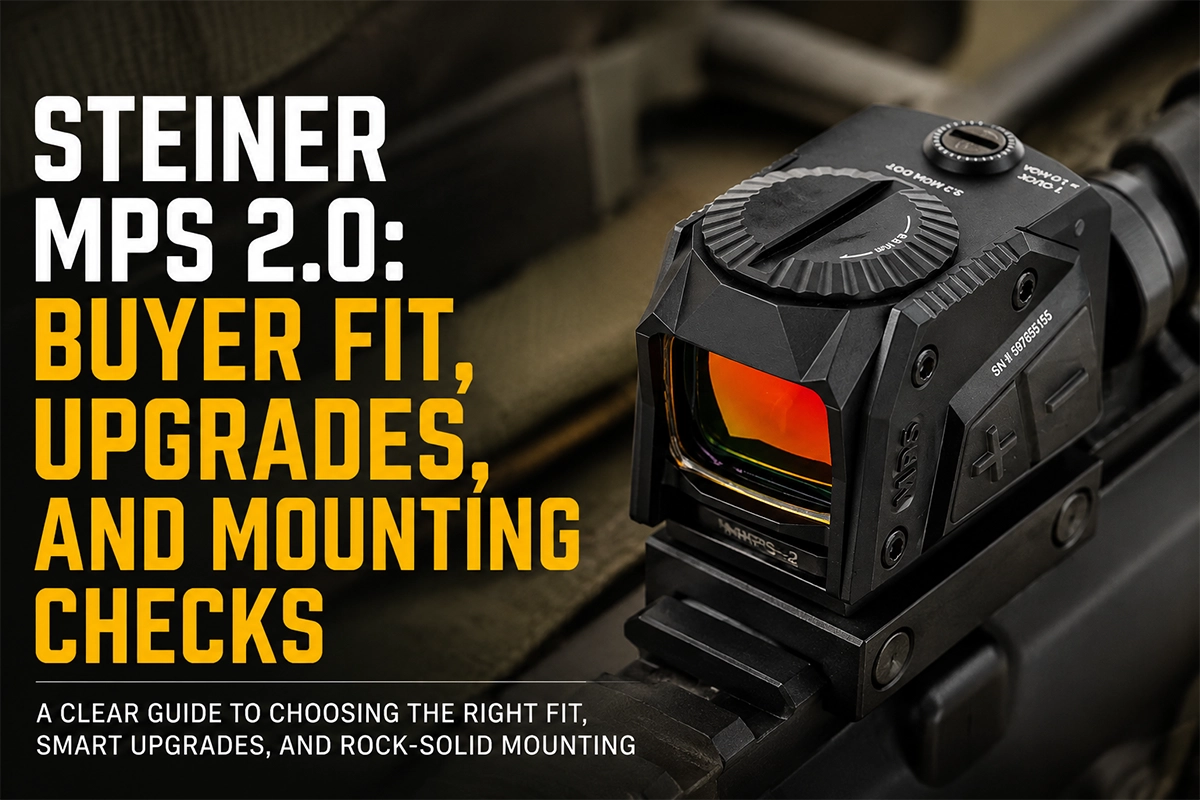
The Steiner MPS 2.0 is a full-size enclosed pistol red dot for buyers who prioritize a protected emitter, long battery life, and the ACRO mounting interface. Its main upgrades address practical complaints about the original MPS: battery runtime, control size, and battery installation. Before buying, confirm the host pistol, plate, sight height, and intended role because this rugged optic is larger and heavier than many slim carry dots.
Steiner announced the updated optic in August 2026. The company lists two red-dot choices, 2 MOA and 3.3 MOA, with the same housing and $631.99 starting MSRP. Both versions use a common CR2032 battery and retain an enclosed aluminum body. That package suits duty-size and compact handguns, but it will not fit every optics-ready slide without an adapter.
What Changed on the Steiner MPS 2.0?
The largest change is the move from a CR1632 battery in the original MPS to a CR2032. Steiner rates the new model for up to 90,000 hours at brightness level four and 27,000 hours at maximum brightness. Those are laboratory claims, so a routine replacement schedule still makes sense for an optic used defensively.
Larger side buttons make brightness changes easier by touch or while wearing gloves. A redesigned magnetic battery cover holds the cell during installation, reducing the chance of dropping it. The top-access battery location also means the optic can stay mounted during replacement, which helps preserve the existing zero.
The MPS 2.0 keeps the enclosed-emitter layout. Its front and rear lenses seal the light source away from lint, rain, and debris. That does not make maintenance unnecessary, but the outside glass is easier to wipe than an open cavity. Steiner also retains manual brightness control and a selectable 13-hour automatic shutoff.
| Type | Magnification | Objective | Reticle | Battery | Weight | Mount | MSRP |
|---|---|---|---|---|---|---|---|
| Enclosed red dot | 1x | 21 x 16 mm | 2 or 3.3 MOA red dot | CR2032 | 2.32 oz | ACRO platform | $631.99 |
Steiner lists 90 MOA of windage adjustment and 90 MOA of elevation adjustment, with 1 MOA clicks. The housing has eight manual settings, including two night-vision-compatible levels. Published waterproof depth is 20 meters on the current U.S. product page. Buyers should use the manufacturer page and manual for final specifications because early reports can reflect preproduction data.
ACRO Footprint and Pistol Compatibility
The MPS 2.0 uses the Aimpoint ACRO footprint, a cross-bolt clamping interface rather than the two vertical screws found on many compact optics. A direct ACRO cut offers the simplest arrangement. Pistols with modular plate systems need an ACRO-compatible plate made for that exact slide.
Do not assume that an RMR, RMSc, DeltaPoint Pro, or Holosun K cut accepts this sight. Those interfaces differ in dimensions and fastener layout. For a Glock MOS, SIG Sauer optics-ready pistol, or Walther PDP, identify the specific slide generation and plate system before ordering. A plate maker’s current fit chart should name both the pistol and the ACRO interface.
Plate thickness affects the optical center and backup-sight picture. The 2.32-ounce body also adds reciprocating mass to a pistol slide. A properly sprung, reliable host will often run normally, but function should be confirmed with the actual plate, fasteners, and ammunition after installation. Follow the optic, plate, and pistol makers’ torque guidance instead of borrowing a number from another setup.
2 MOA vs 3.3 MOA Dot Choice
A minute of angle, or MOA, is an angular measurement. One MOA covers about one inch at 100 yards. At 25 yards, a 2 MOA dot covers roughly half an inch, while a 3.3 MOA dot covers about 0.8 inch. Brightness and eyesight can make either dot appear larger than that mathematical size.
The 2 MOA version favors a finer aiming reference for deliberate shots, zeroing, or use as an offset sight on a carbine. The 3.3 MOA version may appear easier to find quickly on a pistol while remaining precise enough for common handgun distances. Neither choice fixes poor presentation or an uncorrected vision issue, so viewing both reticles in person is useful.
Choose the dot that looks clean to your eye at usable brightness, then confirm the mounting system before comparing smaller features.
Original MPS vs MPS 2.0
The original MPS remains relevant when its lower market price outweighs the battery improvement. It uses a smaller CR1632 cell and carries a 13,000-hour published runtime at medium brightness. The newer optic’s CR2032 rating is the clearer advantage for users who leave a sight on for long periods.
Both generations share the basic enclosed format, ACRO interface, top battery access, and duty-oriented shape. The second generation adds the larger buttons and magnetic cover without changing the central mounting decision. Someone who already owns the correct plate can compare total cost directly. A buyer starting fresh should include the plate, possible sight replacement, and installation tools in the budget.
The MPS-C is a separate compact product, not merely a smaller MPS 2.0. It uses the RMSc footprint and targets slim pistols. Mixing up those names can produce an expensive compatibility mistake, so verify the full model designation and item number on any listing.
Who Is the Steiner MPS 2.0 For?
This optic makes the most sense on a full-size or compact host where environmental sealing and a strong clamping interface rank above minimum size. Duty users, outdoor users, and concealed carriers in wet or dusty conditions may value the enclosed design. Carbine and shotgun users can also mount it on a suitable ACRO-pattern riser.
It is less compelling for a very narrow slide, a strict weight target, or a pistol already cut for another footprint with excellent optic choices. The suggested retail price also places it in premium territory. Compare the complete installed setup, not only the sight price, and avoid treating an advertised battery figure as a substitute for periodic inspection.
Steiner MPS 2.0 Research Checklist
- Confirm whether the slide has a direct ACRO cut or needs a model-specific plate.
- Choose between the 2 MOA and 3.3 MOA versions after viewing each at normal brightness.
- Check plate thickness and backup-sight height before ordering new iron sights.
- Include the plate, fasteners, thread preparation, and installation cost in the total.
- Verify function and zero with the intended ammunition after installation.
- Record a battery replacement and inspection schedule even if the optic remains on.
The official Steiner MPS 2.0 product page is the best place to confirm current item numbers, specifications, and manual revisions. Retail listings may combine images or descriptions from the original MPS, MPS-C, and MPS 2.0. Check the battery type, reticle size, and item number before relying on a product title alone.
Bottom Line
The Steiner MPS 2.0 fixes the original model’s most visible battery-life limitation while preserving its enclosed housing and ACRO mount. Its larger controls and easier battery handling are useful refinements. The deciding questions are still physical fit, plate quality, dot preference, and total installed cost. Buyers who resolve those details first can judge the optic on its actual role instead of headline specifications.