
Smith & Wesson M&P15 AXE 300 Blackout: Buyer Fit and Model Comparison
August 7, 2026
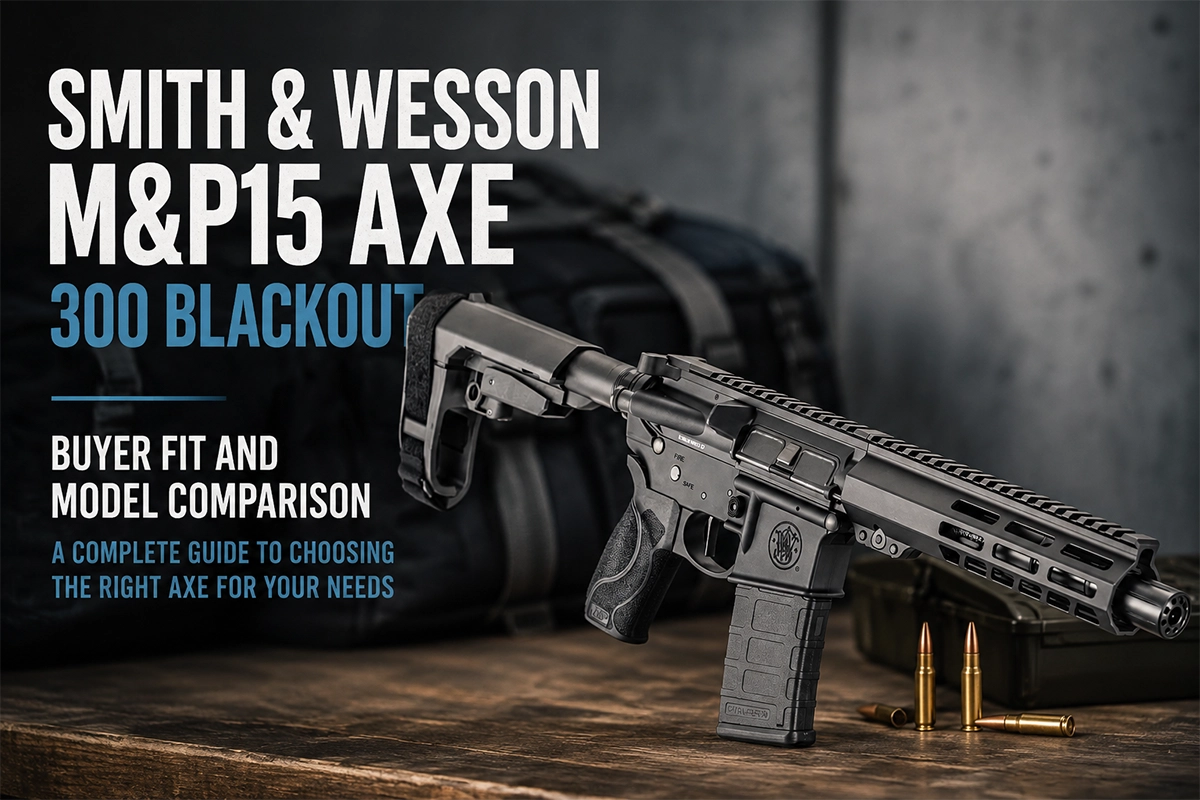
The Smith & Wesson M&P15 AXE 300 Blackout family gives researchers two compact factory configurations built around the same eight-inch barrel and suppressor-focused gas system. The main choice is not about basic hardware. It is about the pistol’s brace, the SBR’s stock, the buyer’s intended use, and the rules that apply where the firearm will be owned.
Smith & Wesson announced both versions on July 22, 2026. This guide compares confirmed launch specifications, explains the practical tradeoffs, and lists the questions worth answering before comparing current listings.
Smith & Wesson M&P15 AXE 300 Blackout at a Glance
| Model | Action | Caliber | Barrel/Weight | Capacity | Rear Support | Launch MSRP |
|---|---|---|---|---|---|---|
| AXE Pistol | Gas-operated semi-auto | 300 BLK | 8 in. / about 5.44 lb. | 30 rounds where lawful | Magpul BTR brace | $1,479 |
| AXE SBR | Gas-operated semi-auto | 300 BLK | 8 in. / about 5.65 lb. | 30 rounds where lawful | Magpul CTR stock | $1,499 |
These are launch figures, not a promise about every dealer listing. Confirm the SKU, included magazine, sights, measured weight, and current price before making a decision. Configurations and availability can change after an announcement.
What the AXE Pistol and SBR Share
The common core is the stronger reason to consider either model. Both have an eight-inch barrel with 5R rifling, a 1:7.5 twist, an Armornite finish, and 5/8×24 muzzle threads. A seven-inch Midwest Industries Combat M-LOK free-float handguard leaves the muzzle area accessible while providing mounting space.
Both models also use Gemtech’s GVAC direct-impingement gas system. Smith & Wesson describes it as a gas-management design intended to reduce excess gas reaching the shooter during suppressed use. That is a useful goal, but launch language is not a substitute for independent testing across several loads and suppressors.
An enhanced bolt carrier group, Radian Raptor ambidextrous charging handle, and ambidextrous controls round out the shared package. Left-handed buyers should still handle the controls if possible. A control can be present on both sides without feeling equally natural to every hand.
AXE Pistol vs SBR: The Meaningful Difference
The AXE Pistol comes with a Magpul BTR arm brace. The AXE SBR uses a Magpul CTR adjustable stock and is presented as a short-barreled rifle. Their announced price gap is only $20, so price alone should not decide the configuration.
Classification, transfer requirements, possession rules, and permitted configurations can vary by jurisdiction and can change. This article is not legal advice. Check current federal, state, and local requirements with authoritative sources before ordering, transferring, traveling with, or changing either firearm.
Practical fit matters too. A stock and a brace are different components designed for different classifications and uses. Buyers should compare adjustment range, cheek contact, storage length, and how the selected optic works with their normal head position.
Why an Eight-Inch 300 Blackout Platform?
300 AAC Blackout, abbreviated 300 BLK, was designed for the AR platform and is offered in both supersonic and subsonic factory loads. The current SAAMI centerfire rifle standard is the right reference for standardized cartridge naming and dimensions. Always match the barrel marking and ammunition box before loading.
A compact barrel is central to the AXE concept. The eight-inch tube keeps overall length down, especially when a suppressor is added. It also means velocity, trajectory, expansion, and point of impact can differ sharply among loads. Do not treat all 300 BLK ammunition as interchangeable in performance just because it fits the same chamber.
Subsonic ammunition stays below the speed of sound under the conditions for which it was designed. Supersonic ammunition travels faster and generally follows a flatter short-range trajectory. Actual velocity depends on the load, barrel, temperature, and other variables. Use the ammunition maker’s published data as a starting point, then confirm performance safely at the range.
Suppressor-Ready Does Not Mean Suppressor-Included
The 5/8×24 threads and GVAC system make the intent clear, but the launch specifications do not list a suppressor as included. Buyers need to budget for the suppressor, compatible muzzle device or direct-thread interface, required transfer costs, suitable ammunition, and any tools or professional installation.
Check suppressor diameter against the handguard and verify that the mount can be installed and removed without interference. Confirm the maker’s minimum barrel and caliber ratings. Alignment should be checked according to the suppressor manufacturer’s instructions before live fire.
Gas management is only one part of reliability. Magazine geometry, buffer setup, ammunition pressure, suppressor backpressure, cleanliness, and lubrication can all affect cycling. The factory configuration reduces guesswork, but a new owner should still test the exact magazines and loads intended for regular use.
Who Is the M&P15 AXE Built For?
The AXE makes the most sense for a buyer who wants a compact, factory-assembled 300 BLK platform and values suppressor-oriented features. It may also appeal to someone who prefers a named component package instead of researching a barrel, handguard, charging handle, controls, and gas system separately.
It is a weaker fit for a first-time AR owner who mainly wants inexpensive practice ammunition or a general-purpose unsuppressed rifle. A conventional 16-inch 5.56 rifle often offers cheaper ammunition, wider parts familiarity, and fewer configuration questions. That does not make the AXE poor. It means the AXE solves a narrower problem.
Researchers can compare other semi-auto pistol options and browse the Smith & Wesson catalog to understand how this compact platform fits beside more conventional models.
First-Batch Questions That Still Need Testing
- Does the GVAC system cycle a representative mix of subsonic and supersonic factory ammunition, both suppressed and unsuppressed?
- How much gas reaches right- and left-handed shooters with common suppressor designs?
- What buffer and spring are installed, and does Smith & Wesson recommend any load-specific changes?
- Do the included sights and selected optic clear the suppressor in the sight picture?
- What accuracy do independent reviewers record with multiple factory loads?
- Are the announced weight and accessories identical on the exact dealer SKU?
These are open buyer questions, not reported defects. New releases need field time before broad conclusions are reasonable. A detailed listing, current manual, and independent range reports should carry more weight than a launch photo.
M&P15 AXE 300 Blackout Research Checklist
- Confirm whether the listing is the pistol or SBR configuration.
- Match the SKU, barrel marking, muzzle thread, brace or stock, sights, magazine, and included accessories.
- Check current transfer, possession, transport, and configuration requirements for every relevant jurisdiction.
- Price the complete system, including optic, suppressor interface, hearing protection, magazines, ammunition, and secure storage.
- Choose a few factory loads that match the intended use and eight-inch barrel.
- Inspect ammunition markings carefully and keep 300 BLK separate from visually similar cartridges.
- Review the current owner’s manual and follow the maker’s maintenance schedule.
- Confirm zero and reliable cycling with the exact final setup before relying on it.
The best AXE choice is the configuration you can lawfully own, feed, maintain, and verify with your actual suppressor and ammunition.
Bottom Line
The Smith & Wesson M&P15 AXE 300 Blackout combines an eight-inch barrel, common suppressor threads, ambidextrous controls, and a suppressor-focused gas system in a complete factory package. The pistol and SBR share most of what matters mechanically, so classification, rear support, local rules, and intended use should drive the decision.
Treat early specifications as a screening tool. Verify the exact listing, wait for independent testing, and calculate the cost of the full system. That approach will show whether the AXE’s factory package offers real value for your needs or whether a more conventional AR remains the better research target.