
EAA Blue Label Youth Shotgun: Fit and Buyer Checks
August 5, 2026
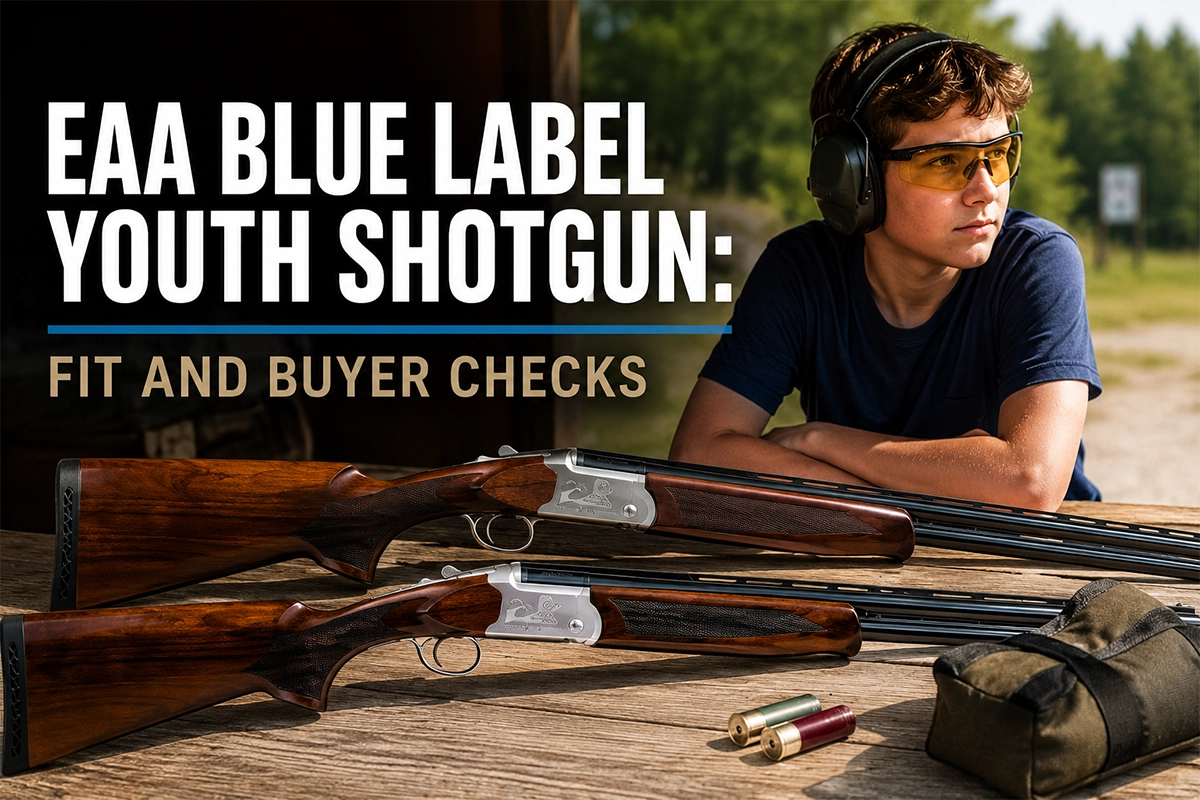
The EAA Blue Label Youth shotgun is a compact .410-bore over-under made for shooters who cannot comfortably mount a full-size shotgun. Its 18.5-inch barrels, 11-inch starting length of pull, and 4.6-pound weight address a real fit problem. Those dimensions also create tradeoffs in swing, recoil feel, and pattern density that families should understand before choosing it.
This is a buyer-fit analysis, not a claim that one model suits every beginner. A responsible adult should supervise all handling, storage, and range use. New shooters also benefit from qualified instruction and a chance to test fit before anyone orders a firearm.
What is the EAA Blue Label Youth shotgun?
The EAA Blue Label Youth shotgun is the compact member of Balikli’s Blue Label O/U line. O/U means over-under, with one barrel stacked above the other. The youth model is currently offered only in .410 bore. It uses two 3-inch chambers, a lightweight aluminum receiver, an adjustable walnut stock, and interchangeable Mobil-pattern choke tubes.
EAA’s March 17 announcement lists an $519 MSRP and says the model is shipping through distributors. Price and availability can change, so compare the exact SKU and current listing rather than relying on an announcement alone.
| Category | Compatibility | Materials | Weight | Dimensions | Features | MSRP |
|---|---|---|---|---|---|---|
| Youth over-under shotgun | .410 bore, 3-inch chambers | Aluminum receiver, Turkish walnut stock | 4.6 lbs. | 18.5-inch barrels; 11 to 11.75-inch LOP | Five Mobil chokes, extractor, manual safety | $519 at announcement |
Length of pull, or LOP, is the distance from the trigger to the center of the butt. EAA includes spacers that extend the stock from 11 inches to 11.75 inches. That small adjustment range may help during a growth period, but it does not turn the compact stock into an adult-length stock.
Why shotgun fit matters more than the youth label
A short stock can help a smaller shooter place the butt firmly in the shoulder while keeping the head upright. If the stock is too long, the shooter may stretch for the trigger, roll the shoulder forward, or lean backward to support the muzzle. Those positions make consistent mounting harder.
The Blue Label’s short barrels reduce forward weight and make the firearm easier to hold. They can also produce a quicker, less stable swing than longer field barrels. That may be useful for very small frames, but clay targets often reward a smooth follow-through. Compact is not automatically better once a shooter can safely manage a longer, heavier model.
Check fit with the firearm unloaded and under direct, qualified supervision. The shooter’s finger should remain outside the trigger guard. Look for a natural head position, comfortable reach, secure shoulder contact, and enough strength to keep the muzzle controlled. A coach or experienced range staff member can spot problems that a catalog measurement misses.
Does .410 bore mean very low recoil?
The .410 bore usually fires a lighter shot charge than common 12- or 20-gauge loads. That can reduce recoil energy. Felt recoil still depends on ammunition, firearm weight, stock fit, mounting technique, and the shooter’s build. At only 4.6 pounds, this Blue Label has less mass to absorb movement than many full-size shotguns.
Do not choose ammunition by the word “youth” on the firearm alone. Compare the shell length, shot weight, and velocity shown by the ammunition maker. Use only loads that match the owner’s manual and chamber marking. A qualified instructor can help select an appropriate training load without turning the first session into a recoil test.
The smaller bore also carries fewer pellets than a larger-gauge target load. That creates a less forgiving pattern when the target is moving. A .410 may feel manageable, yet it can demand precise pointing and careful distance selection. Beginners should hear both sides of that tradeoff.
Blue Label Youth controls and included equipment
The action uses an extractor rather than automatic ejectors. When the shotgun opens, the extractor lifts the shells for manual removal. This keeps empties together and makes the action simple to inspect. It is slower than ejectors for a fast reload, which is rarely the main concern in introductory target shooting.
EAA specifies a manual safety. Buyers should not assume it resets itself when the action opens. The safety is only a mechanical aid, not a replacement for muzzle control, an unloaded condition during transport, secure storage, or adult supervision.
Five choke tubes come with the firearm: skeet, improved cylinder, modified, improved modified, and full. A choke changes the pattern’s spread, not the shell’s power. Have an experienced adult confirm that the correct tube is installed properly and approved for the chosen ammunition before a range session.
Where this compact .410 fits in the market
The clearest advantage is proportion. Few traditional over-under shotguns combine an 11-inch LOP with 18.5-inch barrels. Buyers researching EAA firearms now have a factory compact option instead of immediately considering a cut stock.
Its limits are equally clear. The spacer kit adds only three-quarters of an inch. Growing shooters may outgrow that range. The light action can move abruptly during a swing, and the .410 pattern gives less margin for pointing error. Families focused on long-term clay use should also compare adjustable 20-gauge or soft-shooting gas-operated models that fit properly.
The $519 announced MSRP places the Blue Label Youth below many established over-under designs. Price alone does not reveal durability, warranty turnaround, barrel regulation, or parts support. Inspect the exact gun for smooth opening, even wood-to-metal fit, an undamaged rib, complete choke tubes, and clear documentation before accepting a transfer.
EAA Blue Label Youth shotgun research checklist
- Confirm the listing is the .410 youth SKU with 18.5-inch barrels.
- Measure the shooter’s comfortable LOP instead of buying by age or height.
- Check whether 11 to 11.75 inches provides a natural mount now and room to adjust.
- Compare total weight and balance with at least one longer firearm.
- Verify both 3-inch chamber markings and the ammunition maker’s specifications.
- Account for the .410’s smaller shot payload when choosing target distance and instruction.
- Confirm all five choke tubes, stock spacers, manual, and warranty information are present.
- Plan supervised instruction, eye and ear protection, transport, and locked storage before the first session.
Who should put it on the shortlist?
This model deserves consideration when a standard stock is plainly too long and forward weight prevents safe muzzle control. It may also suit a small adult who prefers a very short field gun. The deciding factor should be repeatable fit under supervision, not the youth label or the assumption that every .410 is effortless.
Choose another format if the shooter already fits a longer stock, needs more adjustment for growth, or primarily wants a steady clay gun. A properly fitted 20 gauge can be easier to hit with, while a gas-operated action may soften recoil. Ammunition cost and local availability also deserve a check because .410 target shells can be less common.
The best first shotgun is one the new shooter can control safely, mount consistently, and practice with comfortably.
The EAA Blue Label Youth shotgun solves a specific sizing problem with unusually compact dimensions. Its adjustable stock, complete choke set, and simple break action make a useful package. Its light weight, short swing, limited growth range, and .410 pattern still require honest evaluation. Treat the specification sheet as a starting point, then let safe fit and qualified instruction guide the decision.