
Rifle Scope Parallax: How to Adjust It and Avoid Aiming Error
August 19, 2026
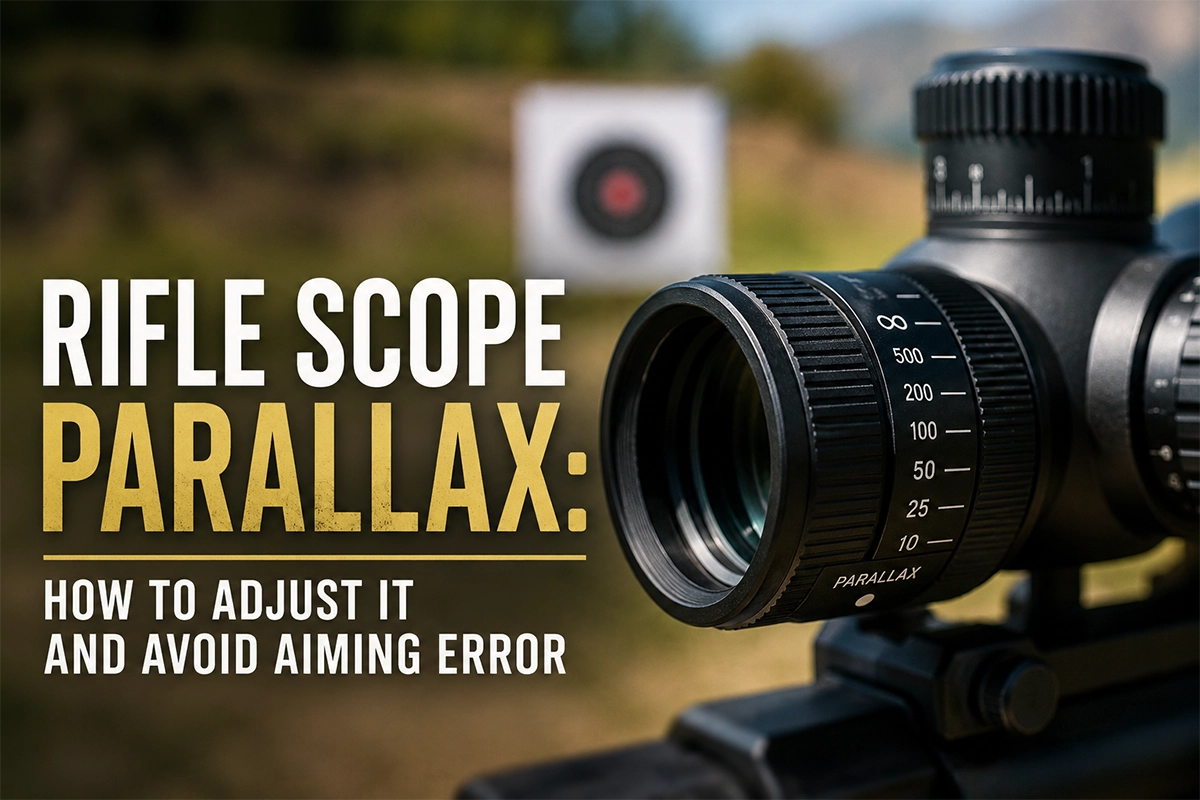
Rifle scope parallax can shift the apparent relationship between a reticle and target when your eye moves behind the scope. That shift can create aiming error even when the rifle itself stays still. This guide explains how to recognize parallax, adjust it correctly, and decide when an adjustable scope is useful.
The short answer is simple. Rest the rifle securely, aim at the target, and move your eye slightly without moving the rifle. If the reticle appears to slide across the target, adjust the side-focus or objective control until that movement is minimized.
What Is Rifle Scope Parallax?
Parallax occurs when the target image and reticle do not appear on the same optical plane. Your eye can then see the reticle from a slightly different angle as your head position changes. The apparent point of aim moves, although the scope and rifle have not moved.
This differs from ordinary blur. A target may look sharp while some parallax remains. It may also look slightly soft when reticle movement is nearly gone. The practical test is reticle movement against the target, not the printed number on the dial or image sharpness alone.
A parallax dial is an aiming-error control that also affects target focus. Treat the yardage marks as starting points, not exact measurements.
How to Adjust Rifle Scope Parallax
- Set the eyepiece first. Point the unloaded, securely supported rifle toward a plain, bright background. Look briefly through the scope and adjust the ocular diopter until the reticle appears crisp. Do not stare while adjusting because your eye will compensate for a poor setting.
- Place the target at the intended distance. Use a high-contrast aiming point. Begin with the parallax control near the target distance shown on its scale.
- Use enough magnification to see movement. Higher power makes parallax easier to detect. Stay within a magnification that gives a usable exit pupil and comfortable eye position.
- Keep the rifle still. Support it on a stable rest and center the reticle on the aiming point. Follow all range rules and keep the muzzle in a safe direction.
- Move your eye slightly. Without touching the rifle, shift your eye a little up, down, left, and right. Watch whether the reticle seems to move over the target.
- Turn the parallax control in small steps. Repeat the eye-movement test after each change. Stop when apparent reticle movement is minimized.
- Recheck your position. Settle into a natural cheek weld, confirm a full sight picture, and verify the reticle remains sharp before firing a careful group.
This process follows the same optical principle described in the Burris explanation of parallax: apparent reticle movement reveals that the image and reticle are not aligned for the viewer.
Parallax Adjustment Is Not the Same as Diopter Focus
| Control | Main job | When to set it | Practical check |
|---|---|---|---|
| Ocular diopter | Makes the reticle sharp for your eye | During initial setup, then rarely | Reticle looks crisp against a plain background |
| Side focus or adjustable objective | Reduces parallax at the target distance | When distance changes enough to matter | Reticle stays on the target as the eye shifts |
| Magnification ring | Changes apparent target size | As the shot and field of view require | Target is large enough without losing a stable position |
| Elevation and windage turrets | Move the reticle’s zero or correction | During zeroing or a planned correction | Point of impact matches the intended adjustment |
Mixing these controls causes frustration. The diopter should make the reticle sharp, while the parallax control should reduce apparent movement. Turning the side-focus knob until the target looks prettiest is a useful starting point, but the head-movement test is the better final check.
Why the Yardage Marks May Not Match
Numbers on a parallax knob are approximate. Eyesight, temperature, magnification, manufacturing tolerances, and the target’s actual distance can affect where the best setting appears. A scope marked 200 yards may show minimum movement slightly above or below that mark.
Do not force the control to match a number. Start near the marked distance, test for reticle movement, and refine the setting. Markings help you return to a useful neighborhood quickly. They are not a substitute for observation.
When Does Parallax Matter Most?
- High magnification: Small position changes become easier to see, and precision expectations are usually tighter.
- Small targets: A slight apparent shift matters more on a tiny aiming point than on a large close-range target.
- Long distance: Shooters often demand smaller angular errors as range grows, even though the exact effect depends on the optic and eye position.
- Rimfire and airgun use: Targets may sit much closer than the fixed-parallax distance of a typical centerfire hunting scope.
- Changing positions: Prone, bench, barricade, and field positions can alter cheek weld and eye alignment.
Consistent head placement reduces the practical effect because the eye returns to the same place. That is valuable with every optic. It does not prove that parallax is absent, and it should not replace proper adjustment when the scope provides one.
Fixed Parallax vs Side Focus vs Adjustable Objective
A fixed-parallax scope is factory-set for a selected distance. It keeps controls simple and can suit ordinary hunting where shots occur near that design range. Check the manual because the corrected distance varies by product and intended use.
Side focus places the control on the turret housing, where it is easy to reach from the shooting position. An adjustable objective places a rotating adjustment near the front lens. Both move optical elements to address the same basic issue. Ergonomics, minimum focus distance, and adjustment range can matter more than the label.
Researchers comparing scoped rifles should match the optic to realistic target distances. A close-focusing optic can help a rimfire trainer. A simple fixed-parallax hunting scope may be completely adequate for a big-game rifle used within familiar ranges.
Common Rifle Scope Parallax Mistakes
- Using side focus to fix a blurry reticle: Set the ocular diopter for the reticle before evaluating the target image.
- Trusting the dial exactly: Use the printed range as an initial estimate, then test.
- Moving the rifle during the test: Support the firearm so any apparent shift comes from eye movement.
- Testing with a poor aiming point: Fine lines or a small contrasting square make movement easier to see.
- Ignoring eye position: A repeatable cheek weld improves speed and consistency after adjustment.
- Buying more adjustment than needed: Extra controls add complexity and sometimes cost or weight. Choose them for a real use case.
Rifle Optics Research Checklist
- Confirm whether parallax is fixed, side-adjustable, or objective-adjustable.
- Check the minimum adjustment distance, especially for rimfire or short-range practice.
- Compare reticle visibility at the lowest and highest useful magnification.
- Verify eye relief across the magnification range.
- Read the manual for the factory parallax distance and diopter procedure.
- Consider total mounted weight and whether controls clear the rifle and rings.
- Test the actual scope before relying on its printed yardage marks.
Brand pages can help organize the rifle side of that comparison. For example, researchers can browse Ruger and Savage platforms, then evaluate scope features against each rifle’s intended range and use.
The Practical Bottom Line
Correct rifle scope parallax by testing for apparent reticle movement, not by chasing perfect target sharpness or an exact dial number. Set the diopter first, support the rifle, move your eye slightly, and refine the parallax control until the reticle remains stable against the target.
An adjustable system is most useful when distances vary widely, targets are small, or magnification is high. A fixed system can still work well when the scope’s design distance matches the job and the shooter maintains a repeatable position. The right choice is the one that solves the actual aiming problem without adding needless complexity.