
Pistol Red Dot MOA Size: 2 vs 3.25 vs 6 MOA
August 18, 2026
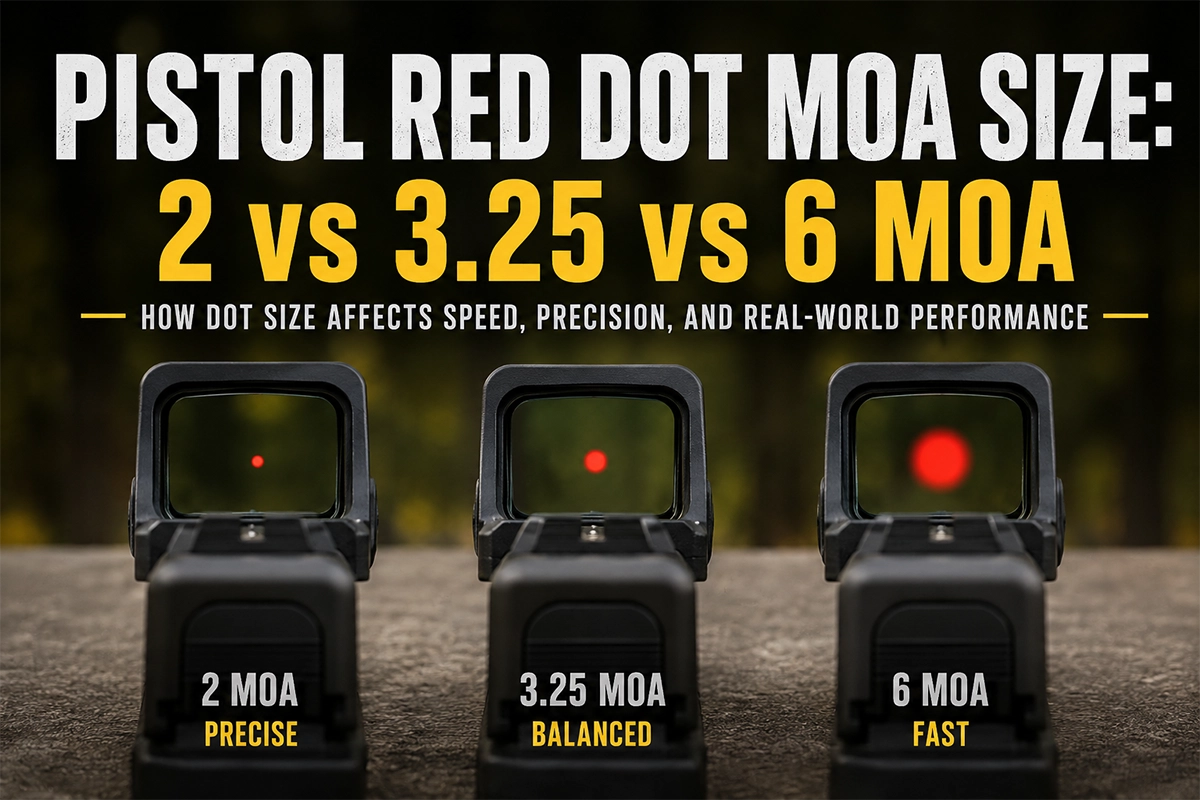
Choosing a pistol red dot MOA size is a balance between a clean aiming point and a dot you can see quickly. A 2 MOA dot covers less of the target. The 6 MOA option looks larger and may be easier to track. A 3 or 3.25 MOA dot splits the difference. Your eyes, typical distance, brightness setting, and shooting goal matter more than a universal ranking.
For many general-purpose pistols, 3 to 3.25 MOA is the safest starting point. Shooters focused on precise groups may prefer 2 MOA. People who value a bold aiming reference at common pistol distances may prefer 6 MOA. That simple answer needs one warning: a brighter small dot can appear larger, while an oversized or starburst-shaped dot may point to eyesight or brightness issues rather than the advertised size.
What Does Pistol Red Dot MOA Size Mean?
MOA means minute of angle, an angular measurement. One MOA spans about 1.047 inches at 100 yards, usually rounded to one inch for quick estimates. Dot coverage scales with distance. A 6 MOA dot covers roughly 1.5 inches at 25 yards, not six inches. That is why a large pistol dot can still support careful shooting at ordinary handgun distances.
| Dot size | Approx. coverage at 10 yards | Approx. coverage at 25 yards | Best starting fit |
|---|---|---|---|
| 2 MOA | 0.2 inch | 0.5 inch | Fine aiming point, smaller targets |
| 3.25 MOA | 0.3 inch | 0.8 inch | Balanced general use |
| 6 MOA | 0.6 inch | 1.5 inches | Bold reference, close targets |
These numbers describe apparent coverage, not mechanical accuracy. The pistol, ammunition, mount, zero, grip, and trigger control still determine where shots land. The dot only gives the eye a reference. A smaller reference can reveal movement more clearly, but it does not make the handgun shoot a tighter group by itself.
2 MOA vs 6 MOA: The Real Tradeoff
A 2 MOA dot preserves more of a small target at distance. It also lets a careful shooter hold on a narrow scoring area without covering it. The tradeoff is visibility. Some users increase brightness to find the dot faster, which can make the dot bloom and erase part of the precision benefit.
A 6 MOA dot provides a stronger visual cue at sensible brightness. It can be useful on a carry pistol or action-shooting setup where target transitions are common. Yet presentation skill still controls how quickly the dot enters the window. A larger dot cannot fix an inconsistent draw, though it may make the error easier to diagnose.
Current product guidance supports that distinction. SIG Sauer’s MOA explanation describes the larger option as easier to find and the smaller option as a finer aiming reference. Treat that as a starting framework, then confirm the choice with your own vision and range conditions.
When 3.25 MOA Is the Practical Middle
A 3 or 3.25 MOA dot is popular because it avoids the extremes. It stays relatively fine at 25 yards while remaining visible at a moderate brightness level. That makes it a sensible choice for a pistol that serves several roles, including practice, competition, and lawful carry.
The middle option also reduces decision pressure for a first optic. You can learn a consistent target-focused presentation before deciding that you need a finer or bolder dot. Browse compatible semi-auto pistols by slide cut and intended role, not by reticle size alone.
Eyesight, Astigmatism, and Brightness Matter
Astigmatism can make an illuminated dot look like a comma, cluster, or starburst. Dot color and size affect people differently, so there is no guaranteed astigmatism setting. Before buying, look through the optic at indoor and outdoor targets. Keep the target in focus rather than staring at the emitter image.
Brightness deserves equal attention. Set it only high enough to remain distinct against the target. Too much intensity creates glare and makes any dot look larger. Automatic-brightness systems can help, but test them from a darker firing position toward a brighter target. That lighting transition exposes weak settings quickly.
If every dot looks distorted, compare optics in person before blaming the MOA number. Your prescription, lens tint, emitter quality, and brightness may be shaping what you see.
Window Size and Reticle Design Change the Experience
Dot size is only one specification. A larger window can make the reticle easier to recover during recoil, but it can add bulk to a concealed setup. An enclosed emitter protects the light path from debris, while an open emitter may offer a slimmer package. Neither housing style dictates the ideal MOA.
Circle-dot reticles add another option. A large outer circle can help a new user understand where the dot went after an imperfect presentation. The center dot remains available for a precise hold. The extra visual information may feel busy, so test the reticle against both plain paper and detailed backgrounds.
How to Choose the Best Red Dot Size for a Pistol
- Define the main use. Decide whether the pistol is mainly for deliberate range groups, action competition, general practice, or lawful concealed carry.
- Check your common distance. Use the coverage table to see how much target the dot hides at 10, 15, and 25 yards.
- View several sizes. Compare 2, 3 to 3.25, and 6 MOA at the lowest usable brightness in realistic light.
- Confirm the mounting system. Match the footprint, plate, screw length, and slide cut. Verify torque guidance from the optic and pistol makers.
- Test from the draw. Use an unloaded pistol under safe dry-practice conditions, then confirm at a supervised range. Judge repeatable presentation before raw speed.
Brand ecosystems can narrow the search. Review Glock options for the relevant slide configuration, then compare them with cataloged SIG Sauer pistols. Confirm the exact optic footprint for the individual model and generation. Brand name alone does not establish compatibility.
A Simple Range Comparison
If possible, borrow or rent optics with different reticles. Use the same target design and similar pistols. Fire slow groups at 15 and 25 yards, then run controlled pairs on a larger target at a shorter distance. Record group size, time, and how often you lose the dot during recoil.
Do not change brightness between runs unless lighting requires it. A fair comparison separates dot size from intensity. Repeat the test on another day because fatigue and lighting can shift the result. The winning setup should be repeatable, not merely impressive for one magazine.
Pistol Optic Research Checklist
- Dot size and available reticle modes
- Red or green visibility with your eyesight
- Manual and automatic brightness behavior
- Open or enclosed emitter housing
- Window dimensions and optic weight
- Battery type, access, and replacement schedule
- Footprint, plate, screws, and maker torque values
- Holster clearance and backup-sight visibility
- Warranty and documented service process
Final Answer: Which MOA Should You Pick?
Choose 2 MOA when preserving a fine aiming point is the top goal and your eyes can track it without excessive brightness. Select 6 MOA when you want a bold dot for common pistol distances. Pick 3 to 3.25 MOA when one handgun must handle mixed tasks and you want a balanced starting point.
The best pistol red dot MOA size is the one you can see cleanly, present consistently, and verify through careful practice. Compare the complete optic, not one number on the box. A good fit combines a usable reticle with sound mounting, suitable brightness, and a window that works with your pistol and holster.