
NFA Registration Rules for Suppressors, SBRs, and SBSs
October 14, 2026
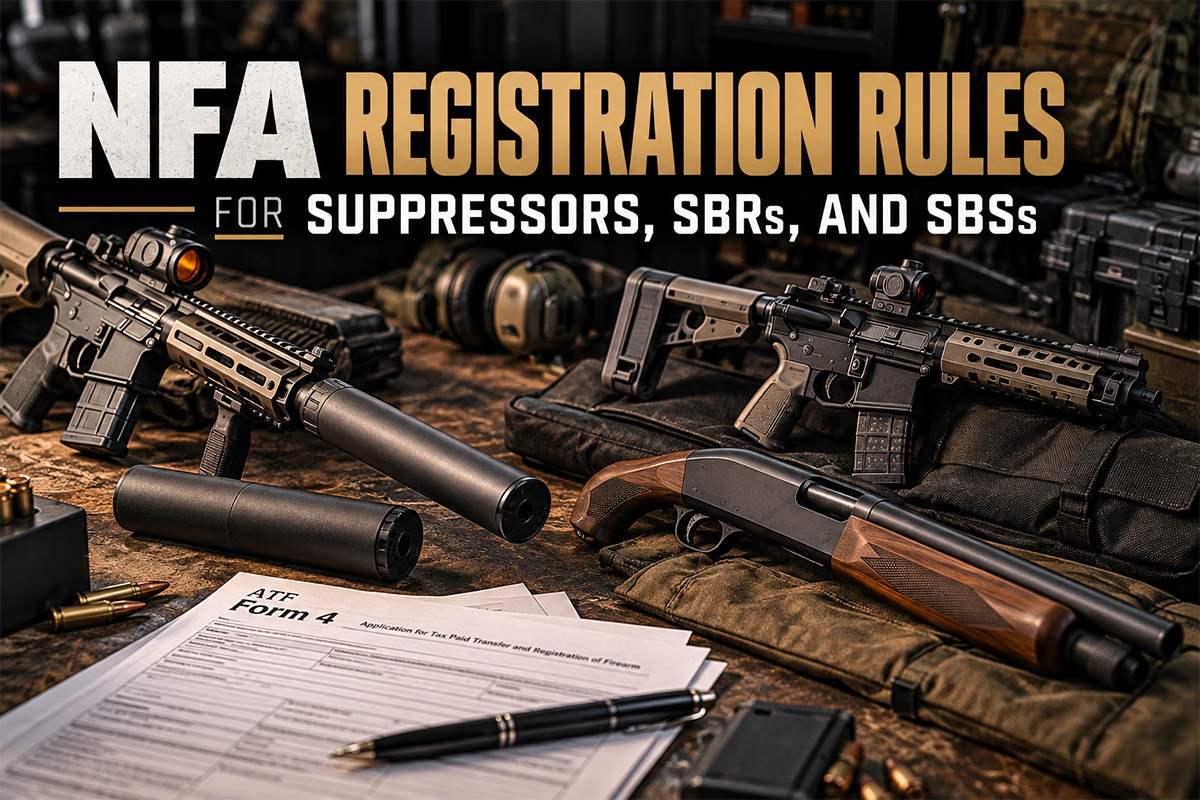
NFA registration rules changed sharply on October 9, 2026. The Bureau of Alcohol, Tobacco, Firearms and Explosives (ATF) said it will stop enforcing federal approval and registration requirements for suppressors, short-barreled rifles (SBRs), and short-barreled shotguns (SBSs). The policy also covers certain “any other weapons” (AOWs). It does not erase every firearm rule, and it could change again. Here is what the agency says owners and buyers need to know.
The most useful distinction is between a court order and ATF policy. A federal district court blocked several National Firearms Act (NFA) provisions for the parties in one case. ATF then chose a broader nonenforcement policy for everyone. That nationwide policy is an agency decision, not a nationwide court injunction or a repeal of the NFA. Read the ATF guidance and frequently asked questions before relying on any summary, including this one.
NFA registration rules: what changed on October 9?
Congress had already reduced the NFA making and transfer tax to $0 for suppressors, SBRs, SBSs, and AOWs. The October 9 announcement addresses a separate question: whether ATF will enforce the approval and registration provisions for those items. ATF says it will not enforce those provisions for domestic making, possession, and transfer. Its list also includes the NFA marking rule and the ban on interstate movement of unregistered items under 26 U.S.C. § 5861(j).
- Making: An unlicensed person does not need prior NFA Form 1 approval for a covered item under ATF’s current policy.
- Transfer: ATF says it will not require prior NFA transfer approval or registration for covered items.
- Registration: ATF will still accept voluntary forms and maintain the federal registry.
- Taxes: The making and transfer tax is $0 for covered items. Machine guns and destructive devices remain subject to the $200 tax and full NFA requirements.
The distinction matters because older explainers often say the tax fell to zero but Form 1 or Form 4 approval remained mandatory. That was a useful description of the period before this guidance. It is incomplete for the policy ATF announced on October 9. Equally, calling all NFA items “unregulated” goes too far.
Are suppressors, SBRs, and SBSs now unregulated?
No. ATF says these items remain firearms under the Gun Control Act (GCA). A federally licensed dealer must still complete Form 4473 and, unless an exception applies, a National Instant Criminal Background Check System (NICS) check before transferring a covered item to an unlicensed person. Dealers must keep transaction records. Federal restrictions on prohibited possessors and unlawful transfers still apply.
NFA registration rules do not override state and local law. ATF warns that an unregistered item held under its federal nonenforcement policy may still create a state-law problem. Some states ban particular items. A dealer also may not transfer a firearm in violation of applicable state or local law. Check the law where the item will be possessed and where any transfer occurs.
For business activity, ATF says the special occupational tax remains. A person who deals in, imports, or manufactures these items as a business still needs the relevant licensing and tax treatment. The new policy is no general permission for an unlicensed person to run a firearms business.
How do dealer transfers work now?
For suppressors and AOWs, ATF tells federal firearm licensees (FFLs) to process transfers under the GCA as they would other statutory firearms. That includes dealer records, Form 4473, and a NICS check unless exempt. The dealer must also follow residency rules and state or local restrictions. ATF says an NFA Form 3 for a transfer between qualifying dealers may be submitted voluntarily, but it is not required under the current policy.
SBR and SBS dealer transfers have an additional wrinkle. The GCA separately requires Attorney General authorization for an FFL to sell or deliver a short-barreled rifle or shotgun. ATF says it is developing a process outside the NFA system. Meanwhile, the agency says it will not enforce that GCA authorization provision until regulations exist. This is an interim enforcement position, so dealers should confirm the current process before a transaction.
Can an owner still register voluntarily?
Yes. ATF says it will continue accepting and approving voluntary NFA forms. For an individual who wants a federal registry record, voluntary registration remains an option. It may matter where state law refers to NFA registration, though the effect of any particular state statute needs a state-specific answer. ATF says it cannot promise that an unregistered item will count as lawfully held under every state’s rules.
If an application is already pending, do not assume it has disappeared. ATF tells people who want to withdraw an application, or remove a previously registered item, to contact its NFA Division. It also warns that once an item is removed, it generally cannot be registered later unless the Attorney General declares an amnesty. Get specific advice before asking to remove an existing registration.
What about crossing state lines with an SBR or SBS?
ATF says a person must continue to file a Form 20 before transporting an SBR or SBS in interstate commerce, even if the firearm is unregistered under the current policy. That requirement comes from the GCA. The agency separately says it will not enforce the NFA prohibition on interstate movement of an unregistered covered item. These two statements concern different laws.
The ATF FAQ treats unregistered suppressors and AOWs differently for the cited NFA interstate provision. Still, destination-state law can restrict possession or transport. Check the rules of every state involved in a planned trip. If the trip involves an SBR or SBS, confirm the Form 20 process before travel.
Could NFA enforcement return?
Yes. NFA registration rules could change again. ATF expressly identifies several possibilities: Congress could enact a new tax, a court could overturn or dissolve the injunction, or the Department of Justice could rescind its guidance. The district court order binds only specified parties. ATF’s broader policy is an exercise of enforcement discretion, which means it can be revised.
ATF warns there is no automatic grandfathering for an unregistered NFA item if the legal setting changes. Federal law generally does not allow later registration of an unregistered item. The Attorney General has limited authority to announce an amnesty, but is not required to do so. This risk deserves attention before someone decides to rely on nonregistration.
The guidance also leaves some NFA provisions in force. ATF specifically excludes offenses involving obliterated serial numbers and illegally imported firearms from its nonenforcement list. Machine guns and destructive devices remain fully subject to the NFA. The rule for a covered item should never be generalized to every firearm in the statute.
Practical research checklist
- Identify the exact item and confirm that ATF places it in a covered category. Do not rely only on a product nickname.
- Read the current ATF guidance, its effective date, and any newer updates before acting.
- Check state and local law for possession, transfer, and any federal-registration condition.
- For a dealer transfer, confirm Form 4473, the background-check path, residency rules, and any state requirements.
- For interstate SBR or SBS travel, confirm the Form 20 requirement and destination-state rules.
- Decide whether voluntary registration fits your circumstances after considering state law and future policy risk.
GunGenius can help with product research after the legal questions are settled. Browse the rifles catalog or shotguns catalog to compare listings and specifications. A Q LLC brand page can help identify a manufacturer while you verify the exact product and its legal classification. A catalog listing does not establish that an item is lawful in a given location.
Frequently asked questions
Do I still have to pay a $200 tax stamp for a suppressor? No federal making or transfer tax applies to the covered suppressors under the current $0 rate. ATF also says it will not enforce the related approval and registration requirements under its October 9 policy. Dealer and state requirements still need checking.
Did the court strike down the NFA nationwide? No. ATF says the district court injunction benefits specified parties. The agency extended a separate nonenforcement policy nationally. Other courts could reach different conclusions.
Can I skip a background check at a gun store? No. An FFL generally must complete Form 4473 and a NICS check before transferring these items to an unlicensed buyer, unless a recognized exception applies.
Is an existing registration canceled? No. ATF says it still maintains the registry and processes voluntary forms. Removing an item requires contacting the NFA Division, and later registration may be unavailable.
This article describes ATF’s public guidance as of October 14, 2026. It is general information, not a state-specific legal determination. Rules and enforcement positions may change. Review current ATF material and applicable state law before a purchase, transfer, making decision, or interstate trip.