
Maverick SA vs 940 Pro Waterfowl: Which Fits Your Hunt?
October 15, 2026
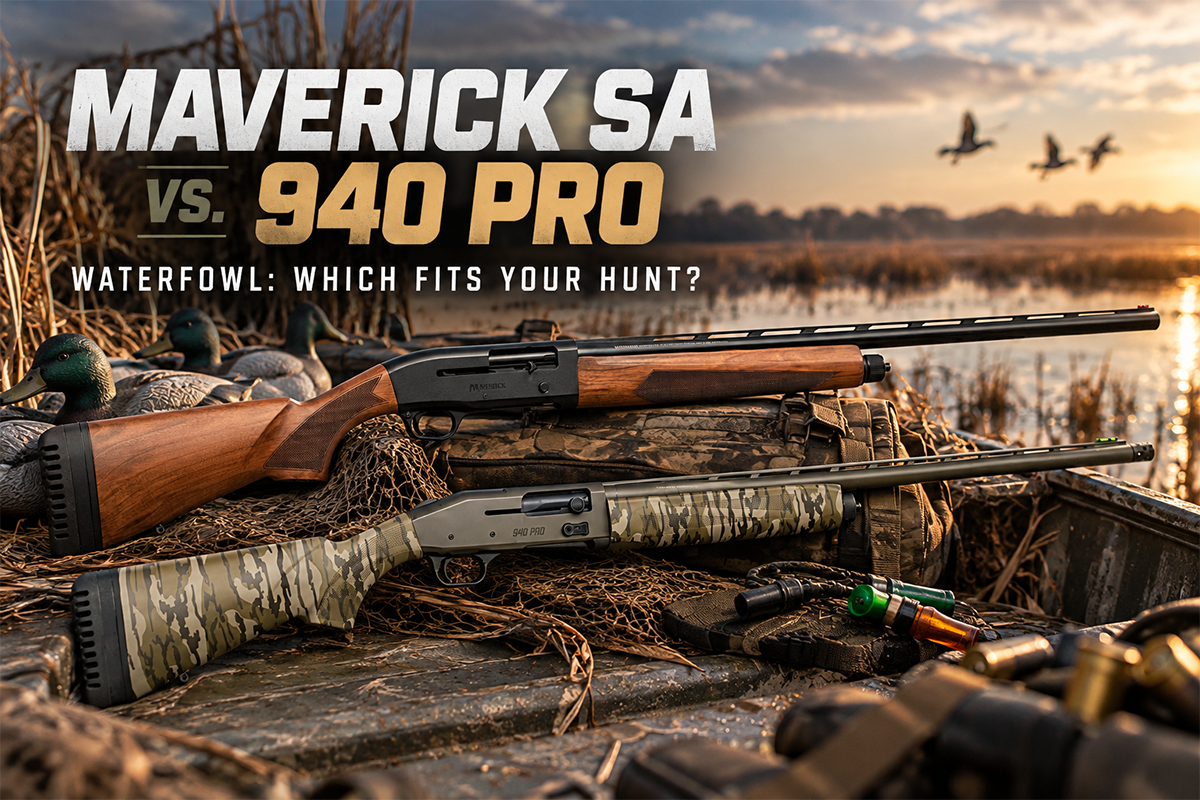
The Maverick SA vs 940 Pro Waterfowl choice starts with the job you expect the shotgun to do. Both are gas-operated, 12-gauge semi-autos with 3-inch chambers and 28-inch barrels in the configurations compared here. The Maverick SA costs less and weighs less. The 940 Pro Waterfowl adds weather-focused finishes, more stock adjustments, and larger controls. This comparison uses Mossberg’s published specifications, not a claim that either gun will perform the same with every load or shooter.
Maverick SA vs 940 Pro Waterfowl at a glance
The table compares the black synthetic Maverick SA, item 33002, with the Realtree Legacy 940 Pro Waterfowl, item 85186. Details can change by stock, finish, or later SKU. Check the exact item number on the box before treating a feature as standard.
| Feature | Maverick SA 33002 | 940 Pro Waterfowl 85186 |
|---|---|---|
| Action / chamber | Gas semi-auto / 12 gauge, 3 in | Gas semi-auto / 12 gauge, 3 in |
| Barrel / overall length | 28 in / 48.75 in | 28 in / 48.75 in |
| Listed weight | 6 lb | 7.75 lb |
| Stock adjustment | Length of pull: 12.5-14.25 in | Length of pull: 13-14.25 in; cast and drop shims |
| Finish and furniture | Matte blue / black synthetic | Realtree Legacy camo; weather-focused finish |
| Published MSRP | $623 at launch | $1,141 for this SKU |
Those numbers come from Mossberg’s Maverick SA announcement and its published 940 Pro Waterfowl specifications. They are manufacturer figures, so actual store prices and individual gun weights may differ. The table also shows why a generic ‘Maverick versus 940’ comparison can mislead: the answer depends on which versions you put side by side.
What does the extra money buy?
The 940’s main value is a package designed around repeated wet-weather use. Mossberg lists coated internal parts, a chrome-lined barrel, synthetic furniture that drains, and a protective exterior finish. The Legacy version also has a receiver cut for a compatible micro red dot. Those features have a clear purpose if your shotgun spends cold mornings in a muddy blind.
The Maverick SA takes a simpler approach. It has a gas-vent system, synthetic furniture on item 33002, a fiber-optic front sight, and an Accu-Choke set. Mossberg describes it as a multi-season field gun. It does not list the same full set of 940-specific coatings or the Legacy model’s optic cut. A buyer who mainly shoots occasional clays and fair-weather hunts may value the price difference more than those extras.
Fit can matter more than the feature count
Length of pull is the distance from trigger to butt. It affects how naturally a shotgun mounts to your shoulder. The Maverick SA’s spacer system covers a published 12.5 to 14.25 inches. That lower end may help a shooter who needs a shorter stock. The Legacy 940 lists 13 to 14.25 inches, plus shims for cast and drop. Those shims change the stock’s side-to-side and vertical relationship to the shooter’s eye.
A listed range is only a starting point. Clothing layers can change the fit you feel in a store. Mount each unloaded shotgun with the same sort of coat you expect to wear outside. Check whether your eye lines up naturally, whether the controls are comfortable, and whether the stock catches on heavy clothing. Ask a qualified instructor or fitter to confirm fit if you are unsure.
The Maverick is listed at 6 pounds, while the cited 940 weighs 7.75 pounds. Less weight can ease a long carry, but more weight may feel steadier to some shooters. Perceived recoil also depends on fit, load, and technique. The specifications alone do not establish which gun you will shoot better.
Controls, sights, and field handling
The Maverick SA uses a cross-bolt safety behind the trigger assembly and a quick-empty bolt release. Its front sight is fiber optic. The 940 Pro Waterfowl has an enlarged loading port, larger charging handle and bolt release, and a fiber-optic front sight. The Legacy model’s optic-ready cut can matter if you plan to research a compatible sight, but confirm the mounting pattern and any included hardware for the exact SKU.
Control placement is personal. A shooter accustomed to a tang safety should not assume either layout feels familiar. Try the controls on unloaded display guns with a salesperson present. You should be able to reach them without changing your grip awkwardly. This is a fit check, not a reason to rush a buying decision.
Both compared guns have 28-inch barrels and published overall lengths of 48.75 inches. That does not mean they swing identically. Their weight, balance, stock shape, and fore-end design differ. A few deliberate mounts at a shop can tell you more about handling than the overall-length figure alone.
How should you compare maintenance and reliability?
Both are gas-operated. Gas systems use energy from a fired shell to cycle the action, and both still need care. Mossberg says the 940 Pro’s revised system can run up to 1,500 rounds between cleanings under its stated conditions. Treat that as a manufacturer claim, not a promise for every load and weather pattern. The Maverick SA announcement does not publish an equivalent interval.
Before buying, compare each owner’s manual for cleaning access, approved ammunition, and service steps. Mossberg lists manuals for both models on its support site. Ask the dealer about spare choke tubes, replacement parts, and warranty service. If you use a shotgun in rain or salt air, clean and dry it according to the manual after the trip rather than relying on a headline round count.
Which gun fits a waterfowl budget?
The Maverick SA vs 940 Pro Waterfowl MSRPs differ by $518 for these two SKUs. MSRP is not a current street-price quote. The less costly Maverick leaves room in a fixed budget for fit adjustments, protective gear, range time, and upkeep. The 940 concentrates more of the budget in its weather-focused finish, controls, and stock tuning.
Think about where the gun will spend most of its life. For frequent wet-weather hunting, the 940’s finish and stock details have a direct use case. For occasional field days plus clays, the Maverick’s lighter listed weight and simpler package can be appealing. If the Maverick does not fit your shoulder, though, the savings may not help. Compare handling first, then compare price.
Shop the exact configuration, not just the model name. The walnut Maverick SA weighs more and carries a different launch MSRP than the synthetic version in the table. The 940 Pro Waterfowl family also has multiple finishes and past model years. Inventory listings can mix those details, so confirm the item number and manufacturer’s current page.
A practical research checklist
- Write down the full item number, chamber marking, included chokes, and listed stock-adjustment parts for each gun.
- Mount both unloaded guns in your hunting layers; compare eye alignment, control reach, balance, and how the butt clears your coat.
- Check the current owner manuals for approved ammunition, cleaning steps, and the exact parts included with each SKU.
- Compare the total cost of the gun, any needed fitting, storage, maintenance supplies, and range time.
- Confirm the rules that apply to your hunting area and season with the responsible wildlife agency before field use.
For a broader search, browse GunGenius’s semi-auto shotgun category and Mossberg brand page. Compare each listing against the maker’s current specifications. Listings may use older photos or shorthand names, so the item number remains the best way to keep comparisons fair.
Common questions
Is the Maverick SA a pump shotgun? No. The Maverick SA in this comparison is a gas-operated semi-auto. It is a different product from the Maverick 88 pump. Check the model name carefully when searching inventory or reviews.
Does a lighter shotgun always kick more? Weight affects recoil feel, but stock fit and the load also matter. The table’s weight difference is real on paper. It does not tell you how either gun will feel with your clothing and preferred factory ammunition.
Is the 940’s optic cut included on every 940 Pro Waterfowl? No assumption is safe across every model year and SKU. Mossberg specifically lists an optic-ready receiver cut for the cited Realtree Legacy configuration. Verify the exact gun’s receiver and mounting details before buying an optic.
The sensible choice
Choose the Maverick SA if it fits you well and its straightforward field features cover your use. Choose the 940 Pro Waterfowl if its stock tuning, wet-weather protection, and control layout justify the added cost to you. In the Maverick SA vs 940 Pro Waterfowl decision, the best answer comes from an exact-SKU comparison and a hands-on fit check, not the higher or lower price alone.