
AR-15 Bolt Carrier Group in 2026: Coatings, Staking, and How to Buy One You Can Trust
March 5, 2026
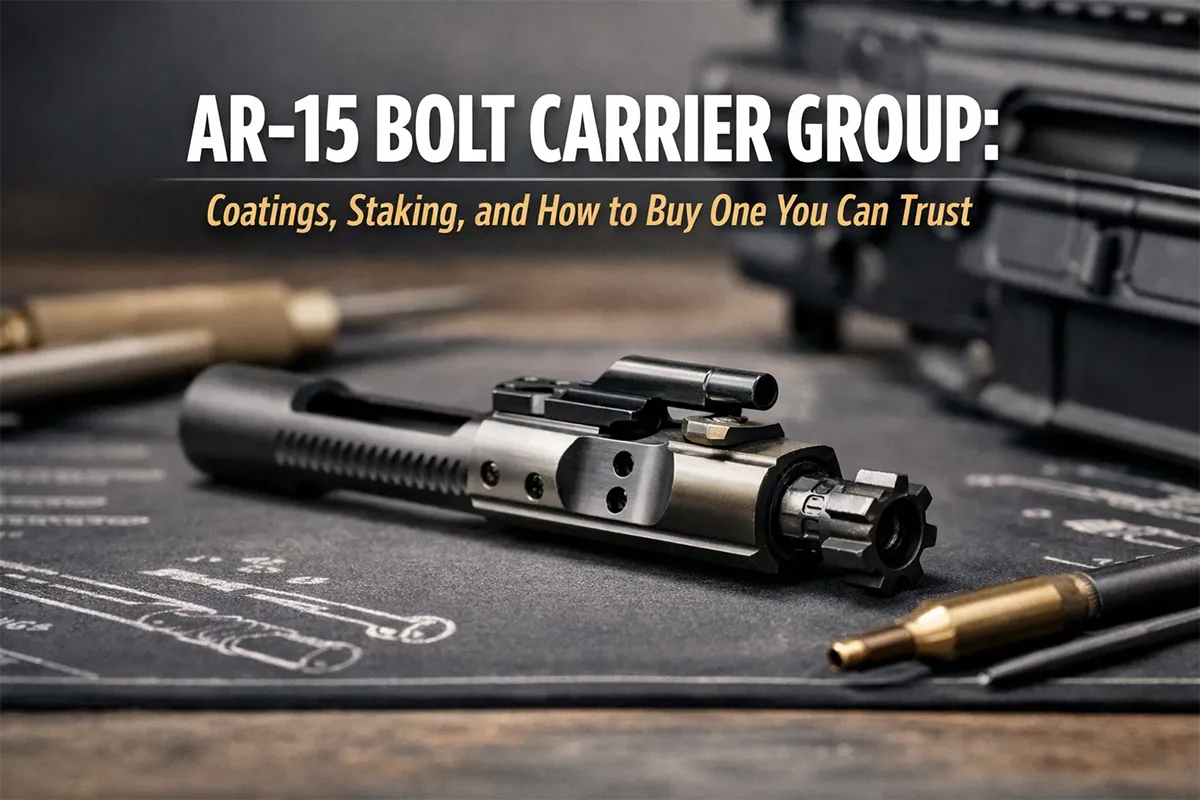
If your AR starts running “weird” or you’re planning a build, the AR-15 bolt carrier group (BCG) is one of the smartest parts to research carefully. It’s also one of the easiest parts to misunderstand, because marketing loves shiny coatings and dramatic claims. In reality, a great BCG is mostly about boring stuff: correct materials, good machining, proper gas key staking, and a bolt that was inspected and finished correctly.
This deep dive explains what actually matters in 2026, how to compare common coatings without getting distracted, and a practical checklist you can use to choose a BCG for a duty-style carbine, a range rifle, or a suppressed setup.
AR-15 Bolt Carrier Group: What It Does (and Why Small Details Matter)
The BCG is the moving “engine” of the AR. It strips a round from the magazine, chambers it, locks the bolt, contains pressure during firing, then unlocks and extracts/ejects the spent case. It also manages gas flow through the gas key and bolt carrier to cycle the action.
Because it’s doing high-stress work at speed, tiny details can have outsized effects. A loose gas key can cause short-stroking. A rough extractor setup can cause inconsistent ejection. A poorly finished bolt can wear faster or behave inconsistently. That’s why the best BCGs don’t “feel fancy”—they feel correct.
If you’re still choosing the host rifle, start broad and compare platforms first in Semi Auto Rifles, then drill down into parts choices once you’ve settled on the rifle’s role.
The 2026 Trap: Coatings Get All the Attention, but Staking and Specs Decide Reliability
Coatings matter, but they’re rarely the main reason a good rifle runs well. In 2026, most reputable BCGs—phosphate, nitride, chrome, DLC, NP3-style—can work great. The difference is that a “cool” coating won’t save a BCG with sloppy staking, questionable bolts, or inconsistent machining.
So, read this section with a simple filter: treat coatings as the last 20% decision. Treat mechanical quality as the first 80%.
Carrier Types: “Full-Auto” vs “Semi” (and Why Full-Auto Profile Is Common)
You’ll often see “full-auto BCG” listed even on civilian rifles. That language usually refers to the carrier’s external profile (more material at the rear) rather than anything magical. In many builds, the full-auto profile is preferred because:
- It can add a bit of mass that helps smooth cycling in some setups.
- It’s widely supported and common in quality manufacturers’ lineups.
- It tends to be a default “serious-use” pattern for many brands.
The more important point: whichever profile you choose, the carrier should be properly machined, the gas key should be properly installed and staked, and the bolt should be made from appropriate steel and inspected.
Gas Key Staking: The Non-Negotiable Reliability Check
If you only learn one BCG inspection skill, learn this one. The gas key is bolted to the top of the carrier. If those screws loosen, gas leaks and the rifle can start short-stroking (especially when dirty, underpowered, or suppressed).
Proper staking means the metal around the gas key screws has been displaced into the screw heads to mechanically resist loosening. You’re looking for staking that’s firm and clearly bites into both screws—not tiny cosmetic dimples that don’t actually engage the screw heads.
- Good: clear metal displacement into the screw heads on both sides, both screws secured.
- Questionable: shallow marks that don’t touch the screw heads, uneven staking, or “one screw looks staked, the other doesn’t.”
If you’re buying a BCG for a defensive carbine or a high-round-count training rifle, good gas key staking is table stakes. Everything else is debate; this isn’t.
Bolts: Materials, Testing, and the Parts That Actually Wear
The bolt takes a beating. It locks into the barrel extension, contains pressure, and cycles constantly. When people talk about BCG “quality,” they’re often really talking about bolt quality.
In practical terms, what you want to see is a bolt from a reputable maker that follows a consistent spec and performs appropriate inspection (often described as MPI/HPT, depending on the maker and product line). Rather than chasing buzzwords, focus on whether the manufacturer is known for consistency and whether the bolt/extractor setup is correctly assembled.
Also pay attention to the extractor system. Even without getting overly technical, you can keep it simple:
- Extractor should have positive tension and consistent bite on the case rim.
- Springs/inserts should be appropriate for the role (short barrels and suppressed guns often benefit from robust extraction).
- Ejector movement should feel smooth and springy, not gritty.
Coatings in 2026: Phosphate vs Nitride vs Chrome vs DLC (What Changes in Real Use)
Here’s a practical, no-hype view of common BCG finishes. None of these is “best” for everyone. They’re just different tradeoffs.
Phosphate (Parkerized)
Phosphate has been the standard for a long time. It can look “basic,” but it works. It tends to hold oil well, and it’s proven across countless rifles. If you want a safe, conventional choice with lots of track record, phosphate is hard to argue with.
Nitride (often called “Melonite” or “QPQ”)
Nitride finishes are popular because they’re slick, corrosion-resistant, and easy to wipe clean. The key is consistency: nitride is a process, and results depend on who’s doing it and how they prep the parts. A well-made nitride BCG can be excellent; a cheap one can be inconsistent.
Chrome
Chrome has a long reputation for durability and ease of cleaning. Many shooters like it for hard-use rifles because carbon tends not to “grab” as much. If you want a BCG that cleans up easily after high round counts, chrome is often on the short list.
DLC / Premium “slick” coatings
DLC-style and other premium coatings can be very slick and very corrosion-resistant. They can also be expensive, and they don’t automatically fix underlying quality issues. The right reason to buy a premium-coated BCG is: you’ve already decided on a reputable manufacturer and you want easier cleaning or specific performance preferences—not because the coating itself guarantees reliability.
Bottom line: pick a trustworthy manufacturer first, then choose the finish that matches how you maintain and shoot.
Suppressed and Short-Barrel Reality: Why the BCG Has a Harder Job
Suppressors and shorter barrels can increase gas, heat, and fouling in the system. That doesn’t mean “don’t do it”—it just means your parts choices should be more intentional.
- More gas and grime: Cleaning frequency and lubrication matter more.
- Extraction can get spicy: A good extractor setup becomes more important.
- Heat builds faster: Materials and finishing quality matter over high round counts.
If your rifle is a general-purpose 16″ setup, you can be less dramatic about it. If it’s a short, hard-running build (especially suppressed), it’s worth buying from a brand with a strong quality reputation and a history in hard-use ARs.
For brand research starting points, comparing BCG approaches from makers like Aero Precision (popular, widely supported AR ecosystem) and Colt (legacy AR baseline) can help you understand what “standard, proven” looks like before you chase boutique options.
Accessory Spec Table: AR-15 Bolt Carrier Groups
| Category | Compatibility | Materials | Weight | Dimensions | Features | MSRP |
|---|---|---|---|---|---|---|
| AR-15 BCG (standard) | AR-15 / 5.56 family; verify caliber-specific bolts for alternate cartridges | Varies by SKU (carrier steel + bolt steel varies by maker) | Varies by profile | Standard AR-15 carrier footprint | Proper gas key staking; consistent machining; inspected bolt; finish varies | Varies widely |
| AR-15 BCG (premium-coated) | AR-15 / 5.56 family; verify headspace and caliber match | Varies by SKU | Varies by profile | Standard AR-15 carrier footprint | Slick finish for easier cleaning; corrosion resistance; quality still depends on maker | Varies widely |
Practical Buying Checklist: How to Pick a BCG Without Overbuying
- Define the job: range rifle, defensive/training carbine, suppressed setup, or high-volume use.
- Pick a reputable maker first: consistency beats “cool finish” every time.
- Inspect gas key staking: real staking that bites into both screw heads.
- Confirm bolt quality signals: reputable inspection/testing practices and a solid track record.
- Think about maintenance style: if you hate scrubbing, lean toward easier-cleaning finishes—after quality is confirmed.
- Match the bolt to the caliber: don’t assume every “AR BCG” is correct for every AR cartridge.
- Buy for the system: a great BCG won’t compensate for a badly gassed rifle, weak mags, or inconsistent ammo.
The One “Feel” Test That Matters
Most people can’t “feel” bolt metallurgy. But you can feel assembly quality. When you hand-cycle and manipulate the carrier group (safely, in an unloaded rifle), you’re looking for smooth, consistent movement and parts that don’t feel gritty, loose, or oddly rough. A quality BCG tends to feel boring—in the best way.
And if you’re building a rifle that you want to trust, the smartest move is simple: buy a solid BCG once, then spend the rest of your budget on magazines, ammo, and practice.