
AICS Magazine vs Proprietary Bolt-Action Magazines: What to Buy (and Why) in 2026
February 13, 2026
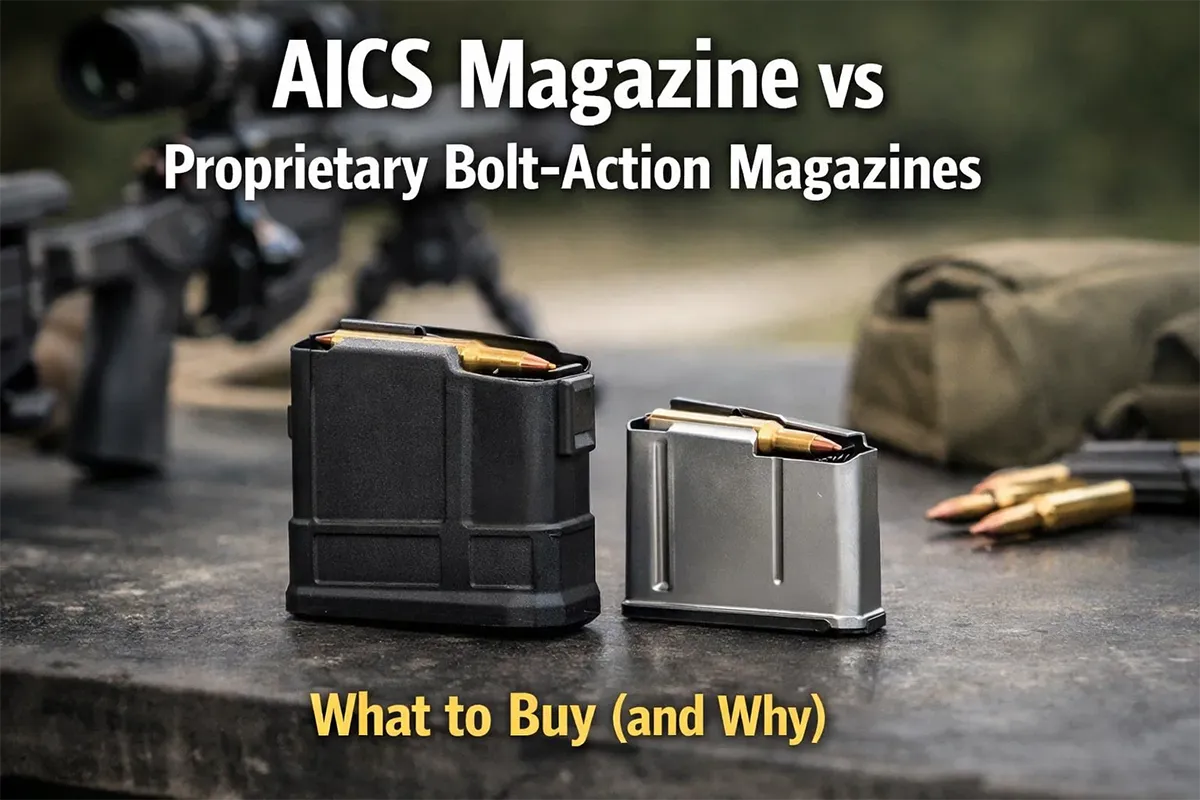
If you want the widest compatibility, easiest spares, and the most “mix-and-match” future upgrades, an AICS (Accuracy International Chassis System) pattern magazine setup is usually the safer bet. Proprietary mags can be lighter, cheaper, and sometimes feed better in a specific factory stock—but you’re buying into that rifle’s ecosystem.
If you’re researching bolt-action rifles in 2026, magazines are one of the most overlooked “quality of life” decisions. They affect how the rifle feeds, how you carry it, what it costs to keep running, and how annoying (or painless) it is to find spares later. The big fork in the road is simple: AICS-pattern magazines versus proprietary magazines made for a specific rifle family.
This deep dive helps you decide which system fits your use: hunting, range practice, precision matches, or “one rifle that does a bit of everything.” We’ll also cover the common gotchas—like short-action vs long-action fit, cartridge overall length limits, and why “it fits” doesn’t always mean “it feeds.”
What “AICS Magazine” Means (in Plain English)
AICS stands for Accuracy International Chassis System, and the “AICS pattern” magazine became a de facto standard for many short-action and long-action bolt guns—especially rifles aimed at precision shooting. Think of it like a common “magazine shape and latch geometry” that multiple brands design around. That standardization is the whole appeal: more options, more availability, and more rifles that can share mags.
Proprietary magazines, by contrast, are designed around one rifle family (or even one stock). They can work great—sometimes flawlessly—because everything is tuned to that exact setup. The tradeoff is that you’re dependent on that manufacturer (or a small aftermarket) for spares, extensions, and long-term support.
The Decision That Actually Matters: Your “Rifle Ecosystem”
Most magazine debates sound like “Which is better?” The better question is: Do you want a rifle that stays mostly factory, or a rifle you’ll evolve over time?
- Choose AICS if you expect to swap stocks/chassis later, experiment with bottom metal, run multiple rifles, or keep lots of spare mags for classes/competition.
- Choose proprietary if your rifle will stay in its factory stock, you only need 1–2 spares, and your priority is “feeds perfectly with minimal tinkering.”
For a lot of shooters, the tipping point is simple: if the rifle is already AICS-compatible from the factory (or can be converted cleanly), it’s hard to argue against the convenience—especially when you’re building a system you’ll live with for years.
Compatibility: Where People Get Burned
Here are the three common ways magazine compatibility goes sideways:
- Short action vs long action: A short-action .308-family rifle and a long-action .30-06-family rifle do not use the same length magazine. Sounds obvious—until someone buys “AICS” mags without checking action length.
- Cartridge overall length limits: Some cartridges (or specific long, high-BC bullets) can run into internal length limits depending on the mag. If you plan to handload or run long projectiles, this matters.
- Feed geometry and latch tolerance: Two mags can “lock in” and still feed differently. Spring rate, follower angle, and tiny latch differences can show up as nose-dives or bolt-over-base issues—especially when the rifle is dirty or you run the bolt slowly.
If you’re a hunter who loads a magazine once, shoots a few rounds a year, and cleans the rifle after each trip, you may never notice these edge cases. If you’re a high-round-count range shooter, you’ll notice quickly.
AICS vs Proprietary: Practical Pros and Cons
| Feature | AICS Pattern | Proprietary Magazine |
|---|---|---|
| Availability | Usually excellent; lots of makers | Depends on brand/model support |
| Cost over time | Often competitive; many options | Can be cheaper… or pricey if scarce |
| Upgradability | High (stocks/chassis/bottom metal) | Limited to that ecosystem |
| Feeding reliability | Very good when matched correctly; can vary by mag | Often excellent in the factory setup |
| Carry/field handling | Can protrude more; flush options exist but vary | Often designed to sit flush in factory stock |
| “One-mag-for-many-rifles” | Sometimes, yes (within action length & cartridge family) | Rarely |
Bottom line: AICS is about flexibility and long-term convenience. Proprietary mags are about tight integration and “factory harmony.” Neither is automatically “better.”
Real-World Setups: Three Common Paths
To make this concrete, here are three common approaches you’ll see in 2026 bolt-gun research:
1) The “Stay Factory” Hunting Rifle
If your rifle will stay in the factory stock, you mostly care about a magazine that sits nicely, doesn’t snag, and feeds reliably with your chosen hunting ammo. Proprietary mags can shine here because the stock, latch, and feed height were designed as a unit. You may only need one spare—and you may never care about cross-compatibility.
If you’re still deciding on the rifle category, start by browsing bolt-action rifles and narrowing by caliber and use case (whitetail, elk, range, etc.).
2) The “Upgradeable” Do-It-All Bolt Gun
This is the shooter who starts with a factory rifle, then adds an optic, then decides they want a better stock, then tries a chassis, then adds a bipod, then—inevitably—buys more mags. If that sounds like you, AICS compatibility is a feature, not a trivia detail.
Brands that commonly show up in this “upgradeable” lane include Bergara and Savage, where certain models and trims are frequently offered in configurations that either use AICS mags out of the box or convert cleanly with the right stock/bottom metal.
3) The “Precision/Training” Setup with Multiple Mags
If you’re doing high-rep range sessions, positional shooting, or any match-style practice, you’ll likely want multiple magazines. This is where AICS often wins by default: it’s easier to standardize, label mags for specific ammo, and find replacements without hunting the internet for discontinued parts.
Three Bolt-Action Examples Worth Comparing
Below are three popular “research staples” that illustrate how magazine ecosystems influence the ownership experience. The goal isn’t to crown a winner—it’s to show the kinds of tradeoffs you’ll see on the spec sheet and at the range.
- Bergara B-14 HMR — Often researched as a practical bridge between hunting and precision work. Many buyers care whether their exact SKU uses AICS mags or a proprietary system, because that affects chassis/stock swaps later.
- Savage 110 Tactical — Commonly cross-shopped for “ready to train” features. Savage’s ecosystem varies by model/trim, so confirming the magazine type is part of smart research.
- Ruger American Predator — Known for value. Ruger’s magazine setup can vary by generation and configuration, and that choice can affect how flush the mag sits and how easy spares are to find.
When you compare rifles, don’t just compare barrel length, twist rate, and weight. Add a line item: “How annoying will spares and upgrades be?” Magazines are a recurring cost and a recurring convenience factor.
Accessory Fit: Stocks, Bottom Metal, and “Drop-In” Myths
Magazine type is tightly tied to the bottom of the rifle—literally. The trigger guard/bottom metal (or chassis interface) sets magazine height and latch engagement. That’s why “drop-in” swaps can turn into troubleshooting:
- Stock inletting matters: Two stocks that both “fit the action” may be cut for different bottom metal patterns.
- Magazine height is critical: Too low and the bolt rides over rounds; too high and it drags, binds, or misfeeds.
- Aftermarket tolerances vary: A chassis might be perfect with one brand of AICS mag and fussy with another. That doesn’t mean the chassis is bad—just that the system is sensitive.
If you want the least drama, keep the factory stock/bottom metal and buy the magazine type the rifle was designed around. If you want the most flexibility, choose a rifle configuration that’s already proven in the AICS ecosystem (and plan to test mags before buying a pile of them).
Quick “What Should I Buy?” Guide
- If you’re a hunter who wants flush carry: Proprietary mags (or flush-fit options) may feel better in-hand and on a sling.
- If you want one standard across rifles: AICS pattern (within the same action length and cartridge family) is the closest thing to “universal” you’ll get.
- If you’ll run a class or shoot often: AICS makes it easier to keep 3–6 mags in rotation and replace one when it gets tired.
- If your rifle is already proprietary and runs perfectly: Don’t “fix” it unless you have a real goal (like a chassis upgrade) that requires the change.
Research Checklist (Save This)
- Confirm action length (short vs long) and the exact cartridge.
- Confirm whether your specific SKU uses AICS pattern or a proprietary magazine.
- Check the magazine’s internal length if you plan to run long bullets or handloads.
- Decide how many mags you realistically need (1 spare for hunting vs 3–6 for training).
- Look at how far the mag protrudes and whether that affects prone shooting or carry comfort.
- If upgrading stocks/chassis later, confirm what bottom metal/chassis interface is required.
If you want a simple next step, start by filtering within bolt-action rifles and then compare how each candidate handles magazines and upgrade paths. That one detail can quietly determine whether your rifle stays enjoyable—or becomes a scavenger hunt for parts.