
10mm Handgun in 2026: How to Choose a Woods-Capable Pistol Without Overbuying
February 12, 2026
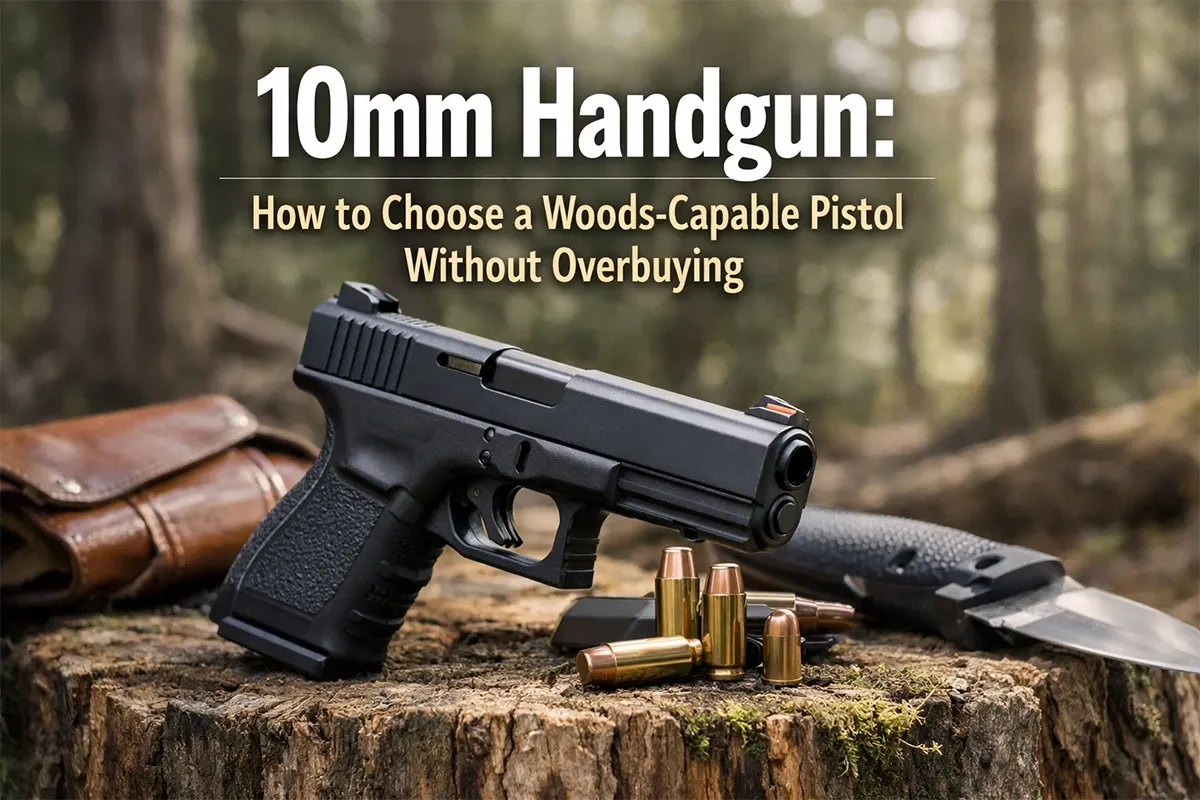
If you’re researching a 10mm handgun in 2026, you’re probably trying to solve one of two problems: (1) you want a semi-auto pistol with more “woods authority” than 9mm, or (2) you want a flatter-shooting, harder-hitting option for field carry that still gives you magazine capacity and fast follow-up shots. The good news: the 10mm market is mature now. The bad news: it’s easy to buy the wrong version of the right idea—too big to carry, too snappy to practice, or too ammo-picky to trust.
This deep dive focuses on practical decisions: what 10mm does well (and what it doesn’t), how to pick a pistol size you’ll actually carry, which features matter for reliability, and how to research ammo without falling into internet myths. For general browsing, start in semi auto pistols and filter by caliber and intended use.
What a 10mm handgun is really for
10mm Auto sits in a unique lane: it can push heavier bullets faster than most common service pistol calibers, and it can do it from a semi-auto platform with decent capacity. That makes it attractive for:
- Backcountry carry: A belt gun for hikes, fishing trips, remote work, or camping where wildlife concerns are real.
- Hogs and similar game: Within realistic handgun distances, with the right load and shot placement.
- “One pistol, multiple roles” research: A range gun that can double as a field gun—if you choose the right size and you’ll actually practice with it.
Where it’s not magic: it doesn’t turn a pistol into a rifle. Range is still limited by handgun accuracy and your ability to place shots under real conditions. Also, recoil and muzzle blast are part of the package—especially with full-power loads in lighter pistols. The best 10mm setup is the one you can carry comfortably and shoot enough to stay competent.
10mm handgun ammo: “full power” vs practice loads
A lot of confusion around 10mm comes from ammo variety. Some loads are essentially “mild 10mm” tuned for comfortable practice and broad reliability; others chase higher velocity and deeper penetration for field use. Instead of getting lost in marketing terms, think in two buckets:
- Practice ammo: Usually cheaper, softer shooting, and ideal for high-round-count training. Great for building skill.
- Field-focused ammo: Generally more expensive and more demanding. Chosen for consistent penetration and performance in tougher use cases.
The smart move is to pick a pistol that runs common practice ammo reliably, then select a field load that cycles consistently and prints close enough to your practice zero that you’re not guessing. If you jump straight to the hottest loads before you’ve proven reliability (and your own control), you’re more likely to waste money and confidence than gain “capability.”
Size matters more than caliber: choosing a frame you’ll carry
Most people end up choosing between three practical “sizes” of 10mm pistols. Each has a tradeoff that matters more than one extra round of capacity.
- Full-size: Easiest to shoot well, usually the most reliable with a wide range of loads, and generally the most comfortable for recoil. Downside: heavier and bulkier on the belt.
- Mid-size / duty-size: Often the sweet spot for belt carry. Still shootable, but more realistic to carry all day.
- Compact: Easiest to pack, hardest to shoot (and sometimes hardest to tune for full-power ammo). This is where people overbuy and underpractice.
If your primary use is woods carry on a sturdy belt, mid-size and full-size are where most “happy owners” land. If your primary use is concealed carry under light clothing, 10mm becomes harder to justify for many people because comfort and practice tend to suffer. (Not impossible—just more compromise.)
Reliability fundamentals: what to look for in a 10mm pistol
10mm runs at higher pressure than many common pistol calibers, so little details can matter more. The most common reliability themes are boring—but important:
- Spring system and slide mass: A well-balanced recoil system helps the pistol cycle across both practice and field loads.
- Magazine design and feed geometry: 10mm cartridges are longer than .40 S&W, and magazine/feed angle can matter.
- Chamber support and extraction: You want consistent extraction and ejection across your chosen loads.
- Grip and control: If recoil twists your grip every shot, your follow-ups and reliability can suffer (yes, shooter input matters).
Practical research tip: don’t just read “it runs great.” Look for comments that mention what ammo ran, how many rounds, and whether the owner changed springs or parts to get there. A 10mm that only loves one boutique load is less useful than a 10mm that runs boring, common ammo all day.
Features that actually help (and the ones that don’t)
It’s easy to get distracted by “tactical” features. For 10mm, these are the features most likely to improve real-world usability:
- Good sights: High-visibility irons are still valuable in the field. If your eyes struggle with irons, consider an optics-ready model.
- Optics-ready slide (optional but nice): A pistol dot can help with fast, precise aiming, especially in low light. It also adds complexity, so don’t treat it as mandatory.
- Useful grip texture: Enough texture to hold recoil without chewing your hands up during long practice sessions.
- Accessory rail (if you need it): For those researching a light for camp/utility use, a rail is the cleanest route.
Features that are often overvalued: super-light triggers (not ideal for a hard-recoiling field pistol), extreme porting (it changes blast and can complicate some setups), and “race gun” add-ons that reduce carry comfort. Keep it simple unless you have a clear reason.
Common 10mm handgun short list: how to think about the usual suspects
These models show up constantly in 10mm research because they represent common approaches: proven service-style frames, modular ergonomics, and field-friendly capacity. Use them as reference points—then compare exact SKUs and configurations.
Glock 20: the “baseline” full-size woods 10mm
The Glock 20 is a common baseline because it’s a full-size platform with a long track record in the caliber and a strong accessory/holster ecosystem. People who prioritize “simple, common, and widely supported” often start here. It’s not fancy, but many owners like that it feels like a tool rather than a project.
Explore: Glock
SIG Sauer P320-XTEN: modular ergonomics for different hands
The P320-XTEN appeals to shooters who want a 10mm that can be tuned for fit and feel. If you’re sensitive to grip shape or trigger reach, modularity can be a real advantage—especially in a caliber where control and comfort drive practice. For many people, “best” means “fits my hand without fighting it,” and that’s where this style can shine.
Explore: SIG Sauer
S&W M&P 10mm: familiar handling with modern features
Many shooters like the M&P feel in the hand, and the 10mm version often lands on short lists for that reason alone. If you want a modern, duty-style pistol that points naturally and has broad support, this is a common cross-shop against the usual Glock/SIG options.
Explore: Smith & Wesson
Springfield XD-M Elite 10mm: capacity and grip feel as the hook
Some shooters simply prefer the XD-M-style grip and controls, and the Elite 10mm variants are often researched for their capacity and “range-to-field” flexibility. If you’re the kind of buyer who wants a 10mm that doesn’t feel like a brick in the hand, it’s worth comparing side-by-side with the other major families.
Explore: Springfield
Research checklist: how to choose the right 10mm without guesswork
- Primary role: belt carry in the woods, range use, or mixed?
- Size tolerance: will you actually carry full-size, or do you need mid-size?
- Control: can you keep the sights (or dot) tracking predictably in fast pairs?
- Ammo plan: what practice load will you shoot often, and what field load will you confirm function with?
- Sight plan: irons only, or optics-ready for flexibility?
- Holster ecosystem: can you get a quality belt holster that fits the exact configuration?
- Proof standard: how many rounds will you run before you trust it for field carry?
A sensible goal is to verify reliability with your practice ammo and your chosen field ammo, then confirm point of impact at realistic distances. If you can do that—and you’ll actually carry it—you’ve built a useful system, not just bought a caliber.