
Smith & Wesson Model 22 of 1917 Classic: A WWI Revolver Returns
November 11, 2026
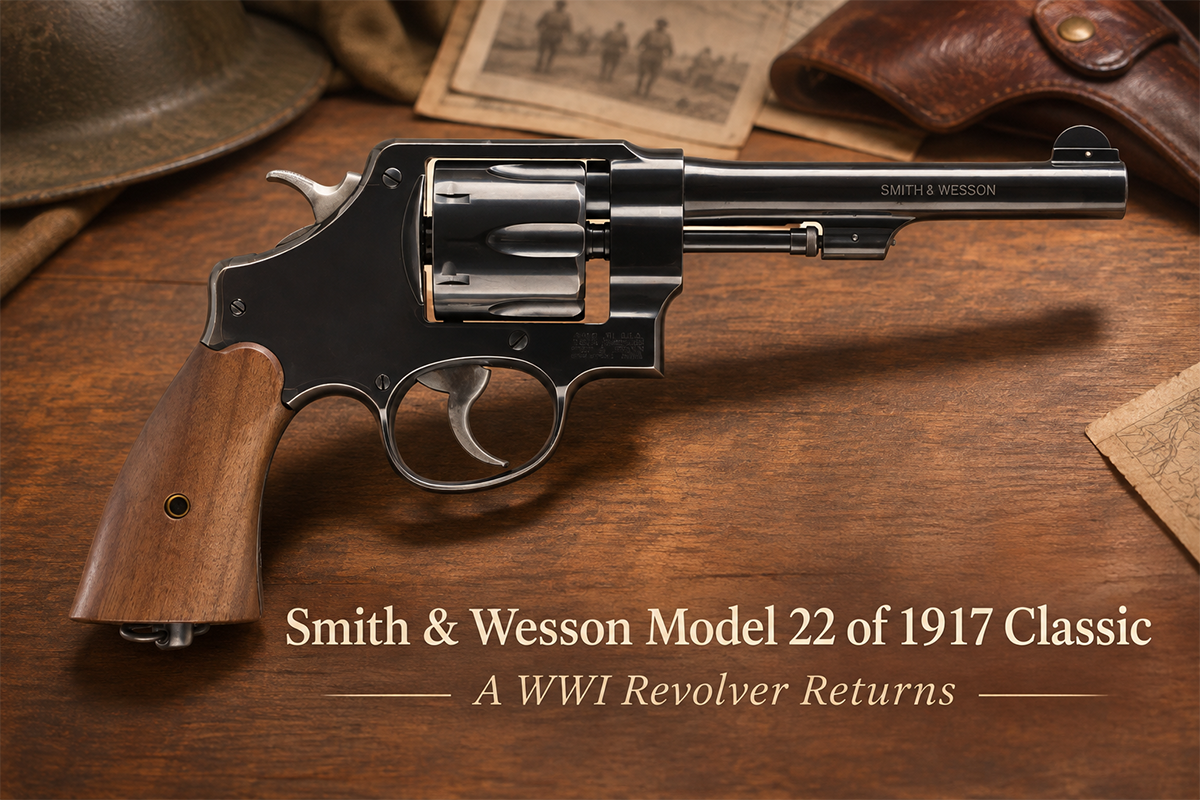
The Smith & Wesson Model 22 of 1917 Classic brings the look of a World War I U.S. service revolver back to the company’s catalog. Announced on October 27, 2026, it pairs a 5.5-inch barrel and period-style details with modern production. Its arrival just before Veterans Day gives readers a reason to revisit the original sidearm and the people who carried it. This guide covers the verified specifications, what moon clips do, how the new gun differs from its companion model, and what a collector should check.
What is the Smith & Wesson Model 22 of 1917 Classic?
It is a new, six-shot N-frame revolver chambered in .45 ACP. Smith & Wesson styled it after the military Model of 1917, including the long barrel, fixed half-moon front sight, walnut stocks, and lanyard loop. It is a modern tribute rather than a World War I military artifact. The cylinder accepts both three-round half-moon clips and six-round full-moon clips.
The formal name matters when researching this release. Smith & Wesson announced two revolvers together: the Model 22 of 1917 Classic and the shorter Model 22 Classic. Listings that shorten the first name to “Model 1917 Classic” can blur the difference. Check the model name and SKU before comparing photographs, specifications, or prices.
Model 22 of 1917 Classic specifications
The manufacturer’s launch announcement identifies the first model as a blued .45 ACP N-frame with a 5.5-inch barrel. The detailed figures below come from the October 27 product report by Shooting Sports USA. Treat MSRP as a launch figure, since retail prices and availability can change.
| Specification | Model 22 of 1917 Classic |
|---|---|
| SKU | 14057 |
| Action and capacity | Double action/single action; six rounds |
| Chambering | .45 ACP |
| Frame and finish | Blued carbon-steel N-frame |
| Barrel | 5.5 inches |
| Sights | Fixed half-moon front; frame trench rear |
| Grips and detail | Smooth walnut stocks; lanyard loop |
| Overall length and weight | 11 inches; 36.6 ounces |
| Moon clips | Half-moon and full-moon compatible; five included |
| Launch MSRP | $1,299 |
A full-size steel revolver at 36.6 ounces is a substantial object. The long sight radius and traditional profile are central to its appeal, but its dimensions also make it distinct from the compact handguns many buyers know. These numbers describe the current production model. They should not be used to authenticate or value an original military revolver.
Why the original Model of 1917 mattered
When the United States expanded its forces during World War I, the Army needed more .45-caliber sidearms than M1911 pistol production could supply. Smith & Wesson and Colt produced revolvers chambered for the same .45 ACP cartridge. The Model of 1917 was a practical answer to a wartime supply problem, not merely a styling exercise.
The original sidearm also shows how a small mechanical solution can shape a product’s identity. A revolver normally extracts cartridges by pushing against their rims. The .45 ACP cartridge has a small rim that does not provide the same purchase. Half-moon clips held three cartridges each, allowing the extractor to push on the clips. Two clips filled the six-shot cylinder.
The new release recalls that service pattern with its half-moon front sight and lanyard loop. Its walnut stocks and blued finish reinforce the resemblance. Still, a new Model 22 of 1917 Classic has current production materials and markings. A collector comparing it with a surviving wartime example should expect historical inspiration, not literal interchangeability or original military provenance.
How do moon clips work on this .45 ACP revolver?
A moon clip is a thin metal holder that grips several cartridges at their extraction grooves. A half-moon clip carries three .45 ACP rounds; a full-moon clip carries six. Smith & Wesson says the new 1917-style cylinder accepts both patterns. Five clips are included with the revolver, according to the product report.
For a prospective owner, clip fit is a practical question. Ask what clip pattern comes in the box and whether additional clips are readily available. Confirm that the ammunition and clips you plan to use are appropriate for this exact model. Follow the manufacturer’s manual for loading, unloading, and maintenance. The point here is to understand the design, rather than to assume that every .45-caliber cartridge or accessory is interchangeable.
The historic half-moon clip is part of the story. A modern full-moon clip fills the cylinder as one unit and may be more convenient for a range session. Both connect the new model to its original .45 ACP purpose. Buyers interested mainly in clip-free shooting should also examine the companion Model 22 Classic, whose approved chamberings differ.
Model 22 of 1917 Classic vs. Model 22 Classic
The two 2026 releases share a six-shot blued N-frame, walnut stocks, and a lanyard loop. They answer different interests. The 1917-style gun emphasizes the longer military profile and .45 ACP chambering. The shorter Model 22 Classic uses a four-inch barrel and a serrated ramp front sight. Smith & Wesson says that companion model is chambered for both .45 Auto and .45 Colt.
| Buyer question | Model 22 of 1917 Classic | Model 22 Classic |
|---|---|---|
| Closest WWI profile? | Yes: 5.5-inch barrel and half-moon sight | Shorter, updated profile |
| Chambering? | .45 ACP | .45 Auto and .45 Colt |
| Length and weight? | 11 inches; 36.6 ounces | 9.38 inches; 34.6 ounces |
| Launch MSRP? | $1,299 | $1,299 |
The distinction prevents a costly assumption: the 1917-style model is listed for .45 ACP, while the four-inch Model 22 Classic has the dual-chambering claim. Do not transfer the latter specification to the longer revolver. If a listing shows a different caliber, photograph, or SKU, verify it against the manufacturer’s current product information before deciding.
What makes this a collector’s release?
The Smith & Wesson Model 22 of 1917 Classic appeals through its recognizable service-revolver features and new production. A buyer can appreciate the shape and mechanical concept without looking for a century-old survivor. Smooth walnut, the lanyard loop, the fixed sight, and the long blued barrel all support the period impression. The absence of wartime provenance is also clear: this is a 2026 product.
That distinction matters for value. An original Model of 1917 may carry historical markings, wear, and documented service history. The new gun’s collector interest will depend on its own production, condition, packaging, and future demand. Neither a launch MSRP nor a resemblance to a military model establishes future resale value. Keep the box, paperwork, and model identification if collecting is the main goal.
Readers comparing current revolvers can browse GunGenius’s revolver category and Smith & Wesson brand page. Those pages provide broader context for frame size, chambering, and other models. Use the specific SKU and manufacturer documentation to confirm details on this new release.
A short research checklist
- Confirm the exact name and SKU: Model 22 of 1917 Classic, 14057, for the 5.5-inch .45 ACP version.
- Check current manufacturer specifications and the manual for chambering, supplied moon clips, and approved use.
- Compare the 5.5-inch profile with the four-inch Model 22 Classic if size or .45 Colt interest matters.
- Inspect the finish, stocks, sights, and lanyard loop on the exact example under consideration.
- Separate the price of a new tribute revolver from the appraisal of an original military artifact.
Availability can vary by dealer and location. A current listing may also use a shortened model name, so rely on the SKU and specifications. For an original 1917, condition and provenance require a different research process. Historical markings and documentation deserve careful review by someone qualified to assess them.
Why the Veterans Day connection is fitting
Veterans Day is observed on November 11 because fighting in World War I ceased under an armistice that took effect on November 11, 1918. The day was first commemorated as Armistice Day. In 1954, its name changed to honor American veterans of all wars, according to the U.S. Department of Veterans Affairs. The date is a remembrance of service, not a celebration of a piece of equipment.
The Model of 1917 provides a tangible entry point into that history. Its design reflects the urgent production needs of the First World War and the adaptation of an existing platform for military service. The 2026 revival invites collectors to learn those facts, while Veterans Day keeps the focus on the people whose service gives the date its meaning.
The takeaway
The Smith & Wesson Model 22 of 1917 Classic is a modern .45 ACP revolver with deliberate WWI styling: a 5.5-inch barrel, half-moon sight, walnut stocks, lanyard loop, and moon-clip compatibility. Its companion Model 22 Classic is shorter and has a different chambering claim. For history-minded readers, the stronger story is how a wartime solution became an enduring revolver design. This Veterans Day, that history deserves attention alongside the new specifications.