
Springfield Prodigy 3.5 AOS: Full-Grip Buyer Fit and Checks
August 26, 2026
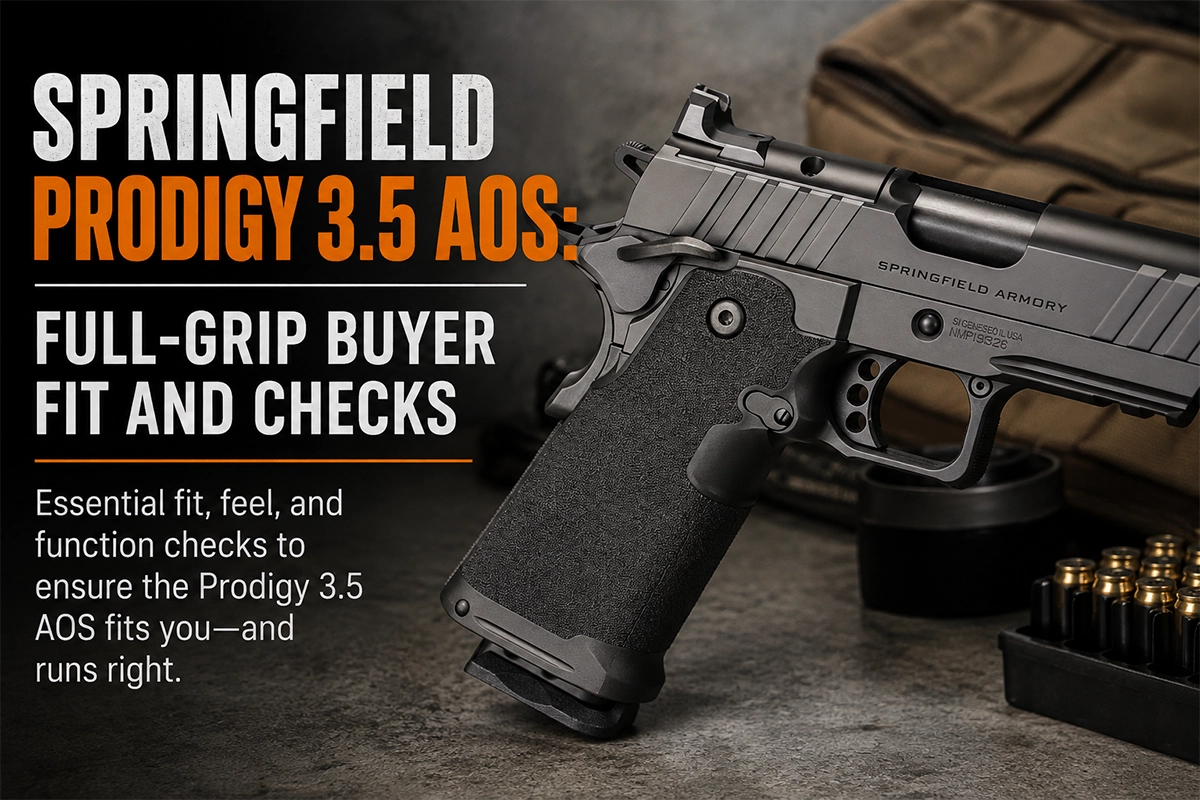
The Springfield Prodigy 3.5 AOS combines the shortest slide in the Prodigy family with a full-length grip and 18-round magazines. That mix creates a clear tradeoff. The short front end can feel easier when seated and may clear a holster sooner, while the taller grip offers more hand space and capacity but may be harder to conceal. This guide explains the confirmed specifications, model differences, optic questions, and listing checks that matter before you compare examples.
Springfield announced this specific configuration on August 18, 2026. It is model PH9114AOS, not the earlier 15-round Prodigy Compact. Buyers should use the SKU, magazine capacity, and grip height together to identify it. A title that says only “Prodigy 3.5” is not enough.
What Is the Springfield Prodigy 3.5 AOS?
The Springfield Prodigy 3.5 AOS is a 9mm, single-action, double-stack 1911-style pistol. It uses a 3.5-inch bull barrel and compact slide assembly above a full-length grip module. The standard model includes two 18-round magazines. Its central question is simple: do you want the shorter upper without giving up the hand space and capacity of the larger grip?
That question matters because shortening a pistol does not shrink every dimension. The slide and barrel affect front-to-back length. The grip height affects how much of the pistol can print through clothing. People who find compact grips cramped may value the full grip. People who prioritize minimum grip exposure may prefer the 15-round Compact instead.
| Platform | Action | Caliber | Barrel/Weight | Capacity | OAL | MSRP |
|---|---|---|---|---|---|---|
| Double-stack 1911-style pistol | Single action, semi-auto | 9mm | 3.5 in. / 29.3 oz. | 18+1 standard | 7 in. | $1,582 |
Springfield lists the pistol at 5.5 inches high. The manufacturer also identifies a billet 7075-T6 hardcoat-anodized aluminum frame, forged carbon-steel slide, DLC-finished bull barrel, captured guide rod, tritium front sight, and black serrated rear sight. Confirm current details on the official Springfield product page, since packages and prices can change.
Springfield Prodigy 3.5 AOS vs Prodigy Compact
The full-grip PH9114AOS and compact-grip PH9115AOS share the same general 3.5-inch concept, but they solve different fit problems. The new model carries two 18-round magazines and stands 5.5 inches high. The Compact uses a shorter grip and 15-round magazines. Both choices deserve an actual handling comparison instead of a decision based on barrel length alone.
| Model | SKU | Grip | Standard Magazine | Best Research Question |
|---|---|---|---|---|
| Prodigy 3.5 AOS | PH9114AOS | Full length | 18 rounds | Does the larger grip improve control enough to accept more printing? |
| Prodigy 3.5 Compact AOS | PH9115AOS | Compact | 15 rounds | Does the shorter grip fit the hand while reducing grip exposure? |
A longer grip usually gives the support hand more surface and can reduce the need to adjust the firing grip. It also adds magazine capacity. The downside is geometric, not mysterious: more grip height creates more material that clothing must cover. Body shape, holster position, belt stiffness, and cover garments can change the result, so generic concealment claims are limited.
Why the Short Slide Still Matters
A 3.5-inch slide reduces overall length and can reduce pressure below the belt when sitting. It may also give buyers more flexibility with compact weapon lights and holsters. Yet a shorter slide can provide less leverage below the belt to resist the grip tipping outward. Holster design and wedge placement may matter as much as the nominal barrel length.
The 29.3-ounce unloaded weight is another practical distinction. It is lighter than many steel-frame double-stack pistols but heavier than common polymer carry pistols. That mass may make recoil feel more manageable, though individual technique and ammunition remain important. It also asks more of the belt and holster during a full day.
AOS Optic Fit and Sight Checks
AOS stands for Agency Optic System. It uses interchangeable plates rather than committing the slide to one optic footprint. That flexibility is useful only when the plate, optic, screws, and sight height work together. Do not assume every optic attaches to the included plate.
- Identify the optic’s exact footprint, not just its brand or product family.
- Confirm which AOS plate is included and which plate must be purchased.
- Use the plate maker’s specified screws and torque values.
- Check that screw length does not interfere with internal parts.
- Verify the iron-sight picture after the optic and plate are installed.
- Confirm zero and fastener security with a supervised range session.
Co-witness means the iron sights remain visible through the optic window. It can provide a familiar visual reference, but the amount of visible iron sight depends on the optic body and plate thickness. Buyers who require a particular lower-third or absolute sight picture should verify the complete stack rather than relying on a photo.
Controls, Magazines, and Hand Fit
The pistol retains familiar 1911-style controls, including an ambidextrous thumb safety, grip safety, left-side slide stop, and single-action trigger. Those controls reward consistent handling. A prospective owner should be able to reach and operate them without shifting into an unstable grip. Left-handed users should also check magazine-release access because ambidextrous thumb safeties do not make every control bilateral.
Magazine identity deserves attention in used and dealer listings. The new full-grip model ships with two 18-round magazines, while restricted-capacity packages exist for some markets. Ask for the exact included magazine count, capacity, maker, and condition. Capacity rules vary by jurisdiction, so buyers must confirm the current requirements that apply to them through official local sources.
When comparing other handguns, note that a double-stack 1911 grip can feel wider or differently shaped than a striker-fired pistol with similar capacity. Handle both with an unloaded firearm under qualified supervision. Reach to the trigger, thumb safety, and magazine release matters more than a width number by itself.
Springfield Prodigy 3.5 AOS Buyer Checklist
- Verify PH9114AOS on the box or paperwork if you want the full-grip model.
- Confirm the 3.5-inch barrel, 5.5-inch height, and standard 18-round magazine configuration.
- List every included magazine and check local capacity restrictions.
- Inspect the slide, frame, controls, sights, feed area, and magazines for damage or unauthorized changes.
- Identify the included AOS plate and the plate required by your intended optic.
- Test hand fit, safety access, trigger reach, and magazine-release access.
- Compare holster availability before treating the short slide as a carry advantage.
- Budget for a suitable holster, belt, optic plate, magazines, and range verification.
- Compare the 15-round Compact if grip exposure matters more than maximum hand space.
The model number is the fastest way to separate the new full-grip pistol from the earlier Compact. Verify PH9114AOS before comparing price or accessories.
Who Is This Prodigy Configuration For?
The full-grip Prodigy 3.5 AOS makes the most sense for a buyer who likes the 1911 control layout, wants the shorter slide assembly, and places a high value on a complete firing grip and 18-round magazine. It also suits researchers who want one grip format across larger Prodigy models while reducing slide length.
It is a less obvious fit when minimum grip height, low unloaded weight, or the simplest direct-mount optic setup is the priority. The shorter Compact, a lighter polymer pistol, or a model cut for one preferred footprint may answer those needs more directly. Browse the Springfield brand catalog to compare related models and configurations.
The useful conclusion is not that one Prodigy is universally better. PH9114AOS trades a taller profile for hand space and capacity, while retaining the 3.5-inch upper. Verify the SKU, handle both grip sizes, map the optic plate, and price the complete setup. Those checks reveal whether the new combination solves your actual fit problem.