
Sightmark G-Shot: No-Cut Glock Red Dot Buyer Checks
August 20, 2026
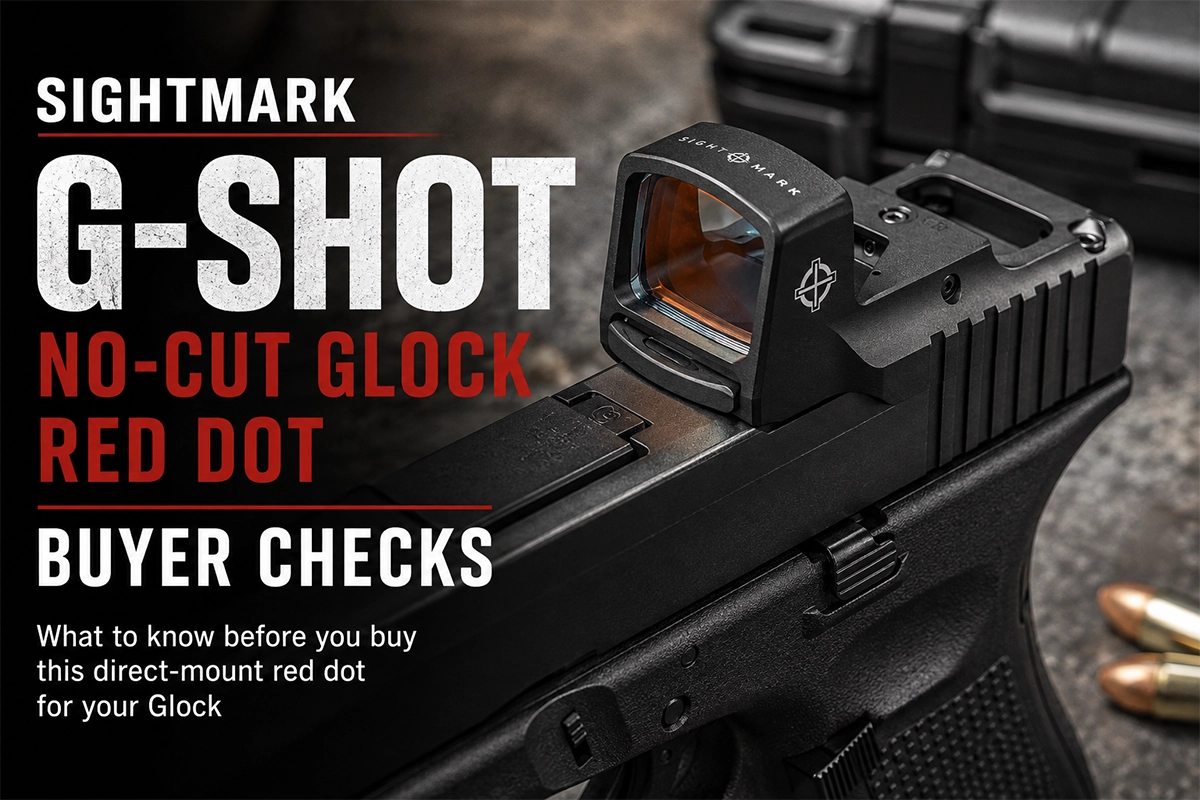
The Sightmark G-Shot is designed for Glock owners who want a red dot without slide milling, an adapter plate, or a separate optics-ready pistol. Sightmark says it fits most factory Gen 3, Gen 4, and Gen 5 Glock slides. Common examples include the G17, G19, and G26. That promise solves a real compatibility problem. Buyers should still confirm the exact pistol, mounting method, sight height, and holster clearance before ordering.
For readers comparing semi-auto pistols, the G-Shot offers a different route from an MOS slide or a permanent optic cut. It preserves the factory slide while adding a 3 MOA aiming point. The tradeoff is that a no-cut system may affect the rear-sight setup and optic height differently from a conventional direct cut.
What Is the Sightmark G-Shot?
The Sightmark G-Shot is a compact pistol red dot made to attach to compatible, unmodified factory Glock slides. Its key idea is simple: give owners of non-optics-ready pistols an electronic sight without machining the slide or stacking an adapter plate under a conventional optic. It uses a 3 MOA red dot and automatic brightness adjustment.
Sightmark announced the optic on July 29, 2026. The launch information lists a cast-aluminum housing, IP67 water-resistance rating, CR1632 battery, and up to 16,000 hours of continuous runtime. The published product announcement also names everyday carry, home defense, and range use as intended roles. Those are manufacturer claims, not a substitute for independent long-term testing.
| Type | Magnification | Objective | Reticle | Tube | Weight | Length | Mount | MSRP |
|---|---|---|---|---|---|---|---|---|
| Open pistol red dot | 1x | Not published | 3 MOA red dot | Open housing | Not published | Not published | No-cut factory Glock fit | Verify current listing |
Sightmark G-Shot Glock Compatibility Checks
Compatibility is the first decision, not a detail to handle after checkout. Sightmark says the G-Shot works with most Gen 3, 4, and 5 Glock pistols and specifically lists the G17, G19, and G26. The word “most” matters. Slide dimensions, rear-sight cuts, compact variants, and aftermarket parts can change fit.
- Record the exact model and generation stamped or documented for your pistol.
- Confirm that the slide is factory original and has not been milled, refinished, or fitted with a nonstandard rear sight.
- Match the model against Sightmark’s current compatibility list, not only a retailer headline.
- Ask whether installation removes or replaces the rear sight and what iron-sight picture remains.
- Check slide-to-holster clearance after adding the optic housing.
- Confirm the return policy before opening or installing model-specific hardware.
The Glock research catalog can help buyers compare the base models that Sightmark names. A G17, G19, and G26 differ in overall size and intended role even when the optic concept is similar. Do not assume a fit statement for one frame size automatically covers every slimline, long-slide, or caliber variant.
No-Cut Mount Versus MOS, Adapter Plate, and Milling
A no-cut optic is attractive because it avoids permanent machining. It may also let an owner use a pistol that predates the broad adoption of optics-ready slides. That can save the time and uncertainty of sending a slide to a machine shop. It also keeps the original slide available for a later return to a more traditional configuration.
An MOS or other factory optics-ready system offers wider optic choice through model-specific plates. A purpose-milled slide can place a selected optic low and remove an adapter interface, but the cut commits the slide to a footprint. The G-Shot takes a third path by packaging the sight and no-cut mount as one solution. Its value depends on how securely it fits, where it places the window, and whether the owner accepts its fixed feature set.
The best mounting system is the one that fits the exact slide, holds zero through normal use, and leaves the controls, holster, and backup-sight plan working as intended.
How the 3 MOA Dot and Auto Brightness Fit
A 3 MOA dot covers about three inches at 100 yards. It covers roughly three-quarters of an inch at 25 yards. That is small enough for deliberate range work while remaining close to common general-purpose pistol-dot sizes. Actual visibility depends on brightness, eyesight, target contrast, and any astigmatism. A camera photo of the dot cannot predict what one person will see.
Automatic brightness removes buttons and daily adjustment. It can be convenient when lighting is consistent. Buyers should still test the dot while aiming from a darker position toward a bright target and from bright light into shade. Those transitions show whether the sensor’s chosen brightness remains visible without excessive bloom. The available launch information does not describe manual override settings, so buyers who require manual control should verify that feature directly.
Battery Life and Durability Questions
The rated maximum of 16,000 hours equals about 22 months of continuous operation under ideal assumptions. Actual life can change with battery quality, storage temperature, brightness demand, and electronics. A scheduled battery change is easier to manage than waiting for a dim dot. Record the installation date and confirm zero after any work that disturbs the sight or mounting hardware.
An IP67 rating generally indicates protection against dust and temporary water immersion under a defined laboratory standard. It does not make the optic immune to impact, solvents, corrosion, or loose hardware. The cast-aluminum housing is a useful confirmed feature, but material alone does not establish service life. Independent round-count and drop testing will matter as the product spends more time in the market.
Installation and First-Range Research Checklist
Follow the current Sightmark manual and the pistol maker’s safety guidance. Work only with an unloaded pistol in a suitable area, and have a qualified armorer handle installation if any step is unclear. Fastener type, torque, and thread treatment should come from the supplied instructions rather than a generic internet value.
- Verify the package and hardware match the exact Glock model and generation.
- Inspect the slide, mount, and optic for burrs, damage, or missing parts.
- Confirm the optic sits square and does not interfere with slide movement or controls.
- Check that the dot responds across indoor, outdoor, bright, and shaded conditions.
- Establish zero from a supported position with the ammunition normally used for practice.
- Fire several short groups, then inspect witness marks and confirm the zero again.
- Test the unloaded pistol in the intended holster for clearance and retention before live use.
Who Should Consider the Sightmark G-Shot?
The strongest candidate owns a compatible factory Glock without an optic cut and wants to avoid permanent slide work. That buyer values a packaged solution more than a broad choice of optic footprints. The G-Shot may also appeal to someone testing the red-dot concept on an existing pistol before investing in a replacement slide or optics-ready model.
It is a weaker fit for buyers who want an enclosed emitter, manual brightness, a specific established footprint, or a documented duty-grade testing history. It may also be the wrong answer if its installed height disrupts the preferred sight picture or holster. A newer product carries unanswered long-term questions, even when its published specifications look appropriate.
Bottom Line
The Sightmark G-Shot addresses a clear problem: adding a red dot to many factory Glock pistols without milling or an adapter plate. Its 3 MOA dot, automatic brightness, IP67 rating, and long stated battery runtime create a practical feature package. Its real value turns on exact-model fit, mounting security, sight height, holster compatibility, and durability evidence that will develop after launch.
Confirm those points before comparing price alone. If the optic matches the pistol and the owner’s control preferences, the no-cut design could be a convenient path. If not, an optics-ready slide, quality plate system, or professional cut may provide more flexibility. Compatibility first, features second, and a verified zero before regular use is the sensible order.