
Colt Optics Red Dots: MRS-1, CSQ-1, and C3X-1 Buyer Fit
July 31, 2026
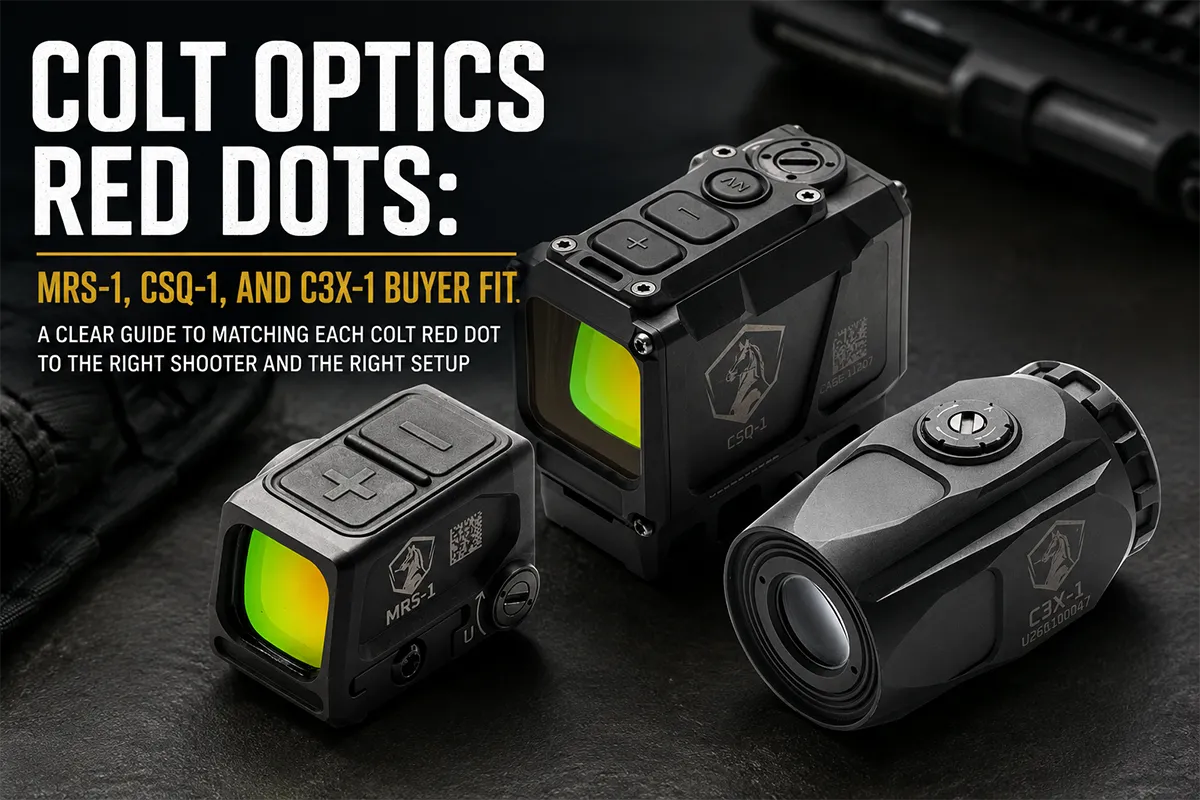
Colt Optics red dots are moving from announcement to retailer shelves with three distinct choices. The MRS-1 is an enclosed pistol sight. For rifles, the CSQ-1 provides a full-size sight. Adding the C3X-1 puts 3x magnification behind a compatible red dot. This guide explains the published specifications, mounting questions, and buyer tradeoffs so you can decide which product fits your firearm and budget.
Colt Electro Optics announced the family on June 29, 2026. Early interest centers on the large viewing windows, American assembly, and premium pricing. The important question is not which optic has the longest feature list. It is whether the footprint, sight height, reticle, and total system weight match how you plan to use it.
Colt Optics Red Dots at a Glance
| Model | Type | Magnification | Reticle | Mount | Weight | Published MSRP |
|---|---|---|---|---|---|---|
| MRS-1 | Enclosed pistol red dot | 1x | 3 MOA dot | ACRO footprint | 2 oz. | $428 |
| CSQ-1 | Enclosed rifle red dot | 1x | 1.5 MOA dot with selectable ballistic references | Compact rifle-dot footprint | 8 oz. | $824 |
| C3X-1 | Flip-to-side magnifier | 3x | Magnifies the primary sight | Picatinny crossbolt mount | About 6.2 oz. | $604 |
These figures are manufacturer specifications, not independent test results. Street prices may change as inventory reaches dealers. Buyers should also confirm the exact mounting hardware included with a listing. A good optic can still be a poor purchase if it needs an unexpected plate, riser, or replacement mount.
MRS-1: Best Fit for an Enclosed Pistol Setup
The MRS-1 is the straightforward choice for an optics-ready pistol that accepts the ACRO pattern. Its enclosed housing protects the emitter from rain, lint, dust, and debris. That design can appeal to owners who carry frequently or shoot outdoors. It also adds more housing around the window than a typical open-emitter sight, so visual preference still matters.
Colt lists a 20-by-21 mm window, a 3 MOA red dot, eight daylight settings, and four night-vision settings. A CR2032 battery powers the unit. The advertised middle-setting life is 75,000 hours, while motion activation and a ten-minute auto shutoff manage power. The aluminum housing weighs two ounces and carries an IP68 rating.
Before buying, verify that your slide or adapter plate truly uses the ACRO footprint. “Optics ready” does not mean every optic bolts directly to every pistol. Plate thickness also changes sight height and may affect iron-sight co-witness. Compare the MRS-1 dimensions with your holster clearance, especially around a closed hood or optic cover.
Researchers comparing suitable hosts can browse GunGenius semi-auto pistols. Focus on mounting pattern, slide width, backup-sight height, and holster support rather than brand name alone.
CSQ-1: A Large Window for Rifle Use
The CSQ-1 targets carbines and rifles. Its defining feature is a large square viewing window intended to reduce the tunnel effect that some shooters notice with compact tube sights. The housing uses 7075-T6 aluminum. Top-mounted controls provide eight daylight and four night-vision brightness levels, and motion activation wakes the reticle.
The selectable reticle gives buyers a meaningful choice. A simple 1.5 MOA dot supports an uncluttered sight picture. Ballistic reference marks can offer faster holds when the chosen ammunition, zero distance, and target distance agree with the reticle design. Those marks are references, not automatic solutions. Confirm actual impacts at the range before relying on any hold.
Colt advertises 50,000 hours of battery life at a middle setting from one CR2032 battery. Published weight is eight ounces before adding a magnifier. That makes system weight worth calculating. A CSQ-1 and C3X-1 pair is about 14.2 ounces before any extra hardware, which can change the balance of a light carbine.
The CSQ-1 makes the most sense for someone who values window size, selectable reticle options, and night-vision settings enough to accept the price and mass. Owners researching possible hosts can compare GunGenius semi-auto rifles. Keep rail space, charging-handle access, and backup-sight placement in view.
C3X-1: When a Magnifier Adds Useful Reach
The C3X-1 sits behind a primary red dot and enlarges the view three times. It does not add a reticle or change the red dot’s zero. Its adjustment controls center the primary sight image within the magnifier. The manufacturer lists a 75-to-85 mm eye-relief range, a roughly 7.5-degree field of view, and an included flip-to-side crossbolt mount.
A magnifier can help with target identification and a more precise sight picture. It also adds weight, occupies rail slots, and introduces an eye box. The C3X-1 includes a riser for two mounting heights and can flip left or right. Confirm that its 1.54-inch optical centerline, with the selected riser arrangement, aligns with your primary optic.
The compact 2.72-inch body preserves rail space better than many longer magnifiers. Eye relief still determines where it must sit. Test your normal stock position and head placement before locking every component down. The rear backup sight may need to move or come off if the rail becomes crowded.
Mounting and Compatibility Checks
- Confirm the interface. Match the exact footprint or rail specification, not a product photo that looks similar.
- Calculate sight height. Include plates, mounts, and risers when comparing iron-sight co-witness or magnifier alignment.
- Measure clearance. Check ejection, charging-handle, folding-sight, and holster space before ordering.
- Add total weight. Count the optic, magnifier, plate, mount, and riser as one system.
- Verify the zero. Follow the manufacturer manual, then confirm groups and any ballistic holds with your actual ammunition.
The official MRS-1 technical data sheet is a useful baseline for footprint, dimensions, environmental rating, and controls. Save the manual for the exact model you buy. Published specifications can change, and dealer descriptions are sometimes copied before final inventory arrives.
Which Colt Optic Fits Your Use?
Choose the MRS-1 if your priority is a sealed handgun sight with an ACRO-pattern interface and a moderate 3 MOA dot. Choose the CSQ-1 if a large rifle window and selectable reticle matter more than keeping cost and weight low. Add the C3X-1 only if you have a recurring need for 3x identification or aiming detail and enough rail space for a comfortable eye position.
Budget deserves a direct comparison. The published price of the CSQ-1 and C3X-1 together is $1,428. At that level, compare the pair with established red-dot and magnifier packages, prism sights, and low-power variable optics. Consider warranty terms, replacement mounts, independent durability testing, and dealer support. A new product’s specification sheet cannot show long-term reliability by itself.
Brand interest will draw some buyers, but fit should close the decision. GunGenius readers can review the broader Colt catalog while comparing the platform that will carry the sight. Colt Optics red dots are promising on paper because each model has a defined role. The best choice is the one whose mount, height, controls, weight, and price survive your checklist.
Final Research Checklist
- Identify the firearm, mounting interface, and available rail space.
- Decide whether you need an enclosed pistol dot, a rifle dot, or a magnified rifle system.
- Compare total installed weight and height, not the optic body alone.
- Check included mounts, risers, tools, battery access, and warranty coverage.
- Look for independent testing as production examples reach shooters.
- Confirm zero and reticle holds under safe range conditions before field use.
Early adopters get a distinctive American-assembled option, but they also accept limited long-term field history. Cautious buyers can wait for broader retail availability and independent test data. Either approach is reasonable when it follows a clear use case instead of a logo-driven purchase.