
Glock Gen 6 vs Gen 5: Changes, Compatibility, and Model Fit
July 28, 2026
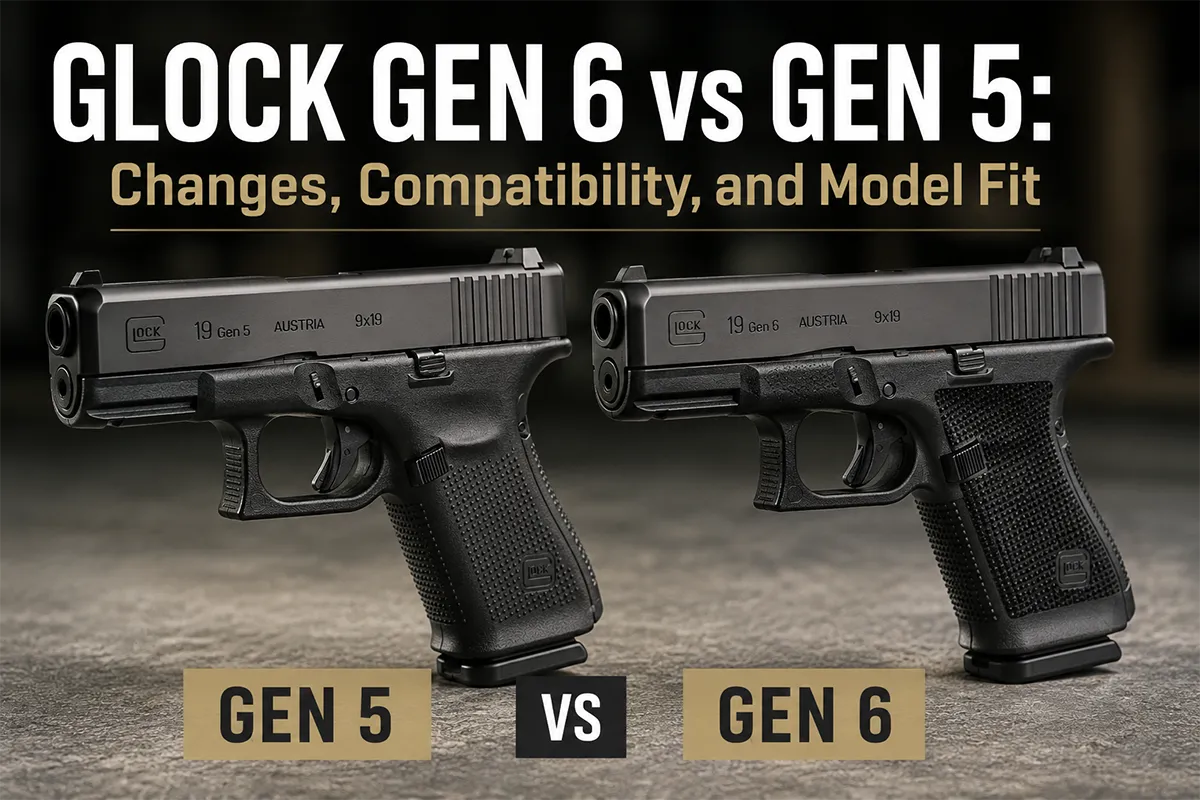
A Glock Gen 6 vs Gen 5 comparison comes down to four practical questions: Does the new grip fit better, do you want the revised optic system, will your current gear still work, and which frame-slide combination suits your use? Gen 6 is an evolution of Glock’s familiar striker-fired 9mm design. It is not a modular-chassis redesign. For many buyers, that makes the decision easier because the changes are focused and familiar.
The first U.S. Gen 6 lineup includes the G17, G19, and G45. All three use 9×19 mm ammunition. The full-size G17 carries 17 rounds in its standard magazine, while the compact G19 uses a shorter grip and 15-round standard magazine. The G45 combines the compact-length slide with a full-size grip. Capacity may be restricted by state or local law, so confirm the exact SKU and included magazines.
Glock Gen 6 vs Gen 5 at a Glance
| Feature | Gen 5 | Gen 6 | Why It Matters |
|---|---|---|---|
| Grip | Gen 5 texture and interchangeable backstraps | RTF6 texture, palm swell, thumb rest, larger beavertail | Changes hand contact and trigger reach |
| Trigger shoe | Curved | Flat faced | Changes finger placement, not the basic Safe Action concept |
| Optics | MOS plate system on MOS models | New optic-ready plate interface | Requires checking optic and plate compatibility |
| Controls | Ambidextrous slide stop | Revised border around slide stop | Aims to reduce unintended activation |
| Magazines | Established double-stack pattern | Retains legacy magazine compatibility | May preserve part of an existing magazine inventory |
| Holsters | Large established market | Many Gen 5 holsters may fit | Retention still needs hands-on verification |
None of these rows should be treated as a universal upgrade verdict. A Gen 5 that fits your hand, runs your chosen magazines, and carries an optic securely remains useful. Gen 6 mainly offers a factory route to newer ergonomics and a revised optics setup.
What Changed in the Gen 6 Grip and Trigger?
The frame is the most obvious change. Glock added a palm swell, an extended textured thumb rest, a larger beavertail, and broader RTF6 texture coverage. The trigger guard is undercut, and the distance to the trigger is reduced. Those details are intended to support a higher grip and easier trigger reach across more hand sizes.
Fit remains personal. A stronger texture can feel secure during range work but abrasive against bare skin during concealed carry. A palm swell may fill one shooter’s hand and crowd another’s. Handle the pistol with the backstrap options installed, then check whether the trigger finger reaches the flat shoe without shifting the firing grip.
The flat-faced trigger changes the contact surface and can make finger placement more repeatable. It does not turn the pistol into a different operating system. Gen 6 retains Glock’s Safe Action system with three passive mechanical safeties. Buyers should judge the trigger by a safe dry-fire evaluation at a dealer or range, not by its shape alone.
How Does the Gen 6 Optic System Differ?
Standard Gen 6 pistols are optic ready. Glock supplies three numbered adapter plates that support several common optic families, including footprints associated with Trijicon or Holosun, C-More, and Leupold or EOTech. The optic screws through the selected plate into the slide. This differs from the older MOS arrangement and can place supported optics lower.
Do not assume that an existing MOS plate transfers to Gen 6. Match the optic model, plate number, screw thread, and screw length to current instructions. Glock’s official G17 Gen 6 specifications are a useful starting point, but the optic manufacturer’s manual governs the sight itself. After installation, verify torque, witness marks, zero, and clearance around the extractor area.
The new optics interface is a reason to compare complete setups, not just pistol prices. Include the sight, correct plate, screws, installation, and backup-sight plan.
Will Gen 5 Magazines, Holsters, and Parts Work?
Legacy double-stack Glock magazines remain the easiest compatibility win. A G19 can also accept longer compatible magazines, although the magazine will extend below the grip. Inspect every magazine for correct lockup, feeding, slide-lock function, and free drop before relying on it. Magazine restrictions can also change what ships with a particular listing.
Many Gen 5 holsters fit corresponding Gen 6 models, but “many” is not the same as “all.” The enlarged beavertail, control area, light choice, optic, and precise molding can affect fit. Confirm that the trigger guard is fully covered, the pistol seats completely, active retention works, and the draw does not move the holster. Duty holsters deserve special care because their locking hardware can be model specific.
Internal parts are a different matter. Gen 6 includes design changes beyond the visible trigger shoe and texture. Do not assume that a Gen 5 slide, barrel, trigger assembly, extractor component, or aftermarket part is interchangeable. Check the part maker’s explicit Gen 6 approval and use a qualified armorer when the work affects safe operation.
Which Gen 6 Model Fits Your Use?
G17 Gen 6: Full-Size Range and Duty Fit
The G17 offers the longest slide and sight radius of the three launch models, plus a full-size 17-round grip. Glock lists a 4.49-inch barrel, 7.95-inch overall length, and 21.16-ounce weight without a magazine. That combination favors range use, duty-size holsters, and buyers who want the largest standard package.
G19 Gen 6: Compact All-Around Fit
The G19 pairs a compact slide with a shorter, 15-round grip. It is usually the easiest model to compare for mixed carry and range use. The shorter grip can reduce printing under clothing, while the compact slide still leaves room for a weapon-mounted light or optic if those match the intended setup.
G45 Gen 6: Compact Slide, Full-Size Grip
The G45 uses a G19-length slide with a G17-size grip and standard 17-round magazine. That crossover format gives the firing hand full room while keeping the front end shorter. It can suit duty, home-defense research, and range use, but the longer grip may be harder to conceal than a G19.
Readers can compare more semi-auto pistols and browse the Glock brand catalog before narrowing the model. Use the catalog to compare configurations, then verify every listing against the manufacturer’s current SKU details.
Glock Gen 6 vs Gen 5 Research Checklist
- Handle both generations and compare trigger reach, palm swell, texture, and beavertail contact.
- Choose the G17, G19, or G45 by grip length and intended holster, not by generation alone.
- Identify the exact optic footprint and the correct Gen 6 plate before buying.
- Test each existing magazine for lockup, feeding, slide lock, and release.
- Verify holster fit with the actual light and optic installed.
- Treat internal-part compatibility as unconfirmed until the maker lists Gen 6 support.
- Compare total setup cost, including optic hardware, sights, holster, and magazines.
- Confirm capacity rules and the exact included accessories for your location and SKU.
Is Gen 6 Worth Choosing Over Gen 5?
Gen 6 makes the clearest case for a new buyer who prefers its grip, wants the current factory optic system, and has not already invested heavily in a Gen 5 setup. It can also make sense for an existing owner whose current frame shape or optic height is a persistent problem.
Staying with Gen 5 is reasonable when the pistol already fits, performs reliably, and supports a complete set of proven magazines, holsters, and parts. The best choice is the complete configuration that passes your fit and compatibility checks. Generation numbers are useful labels, but they do not replace hands-on evaluation.