
Smith & Wesson Spec Series R: 686 Plus Optics-Ready Revolver Deep Dive
April 28, 2026
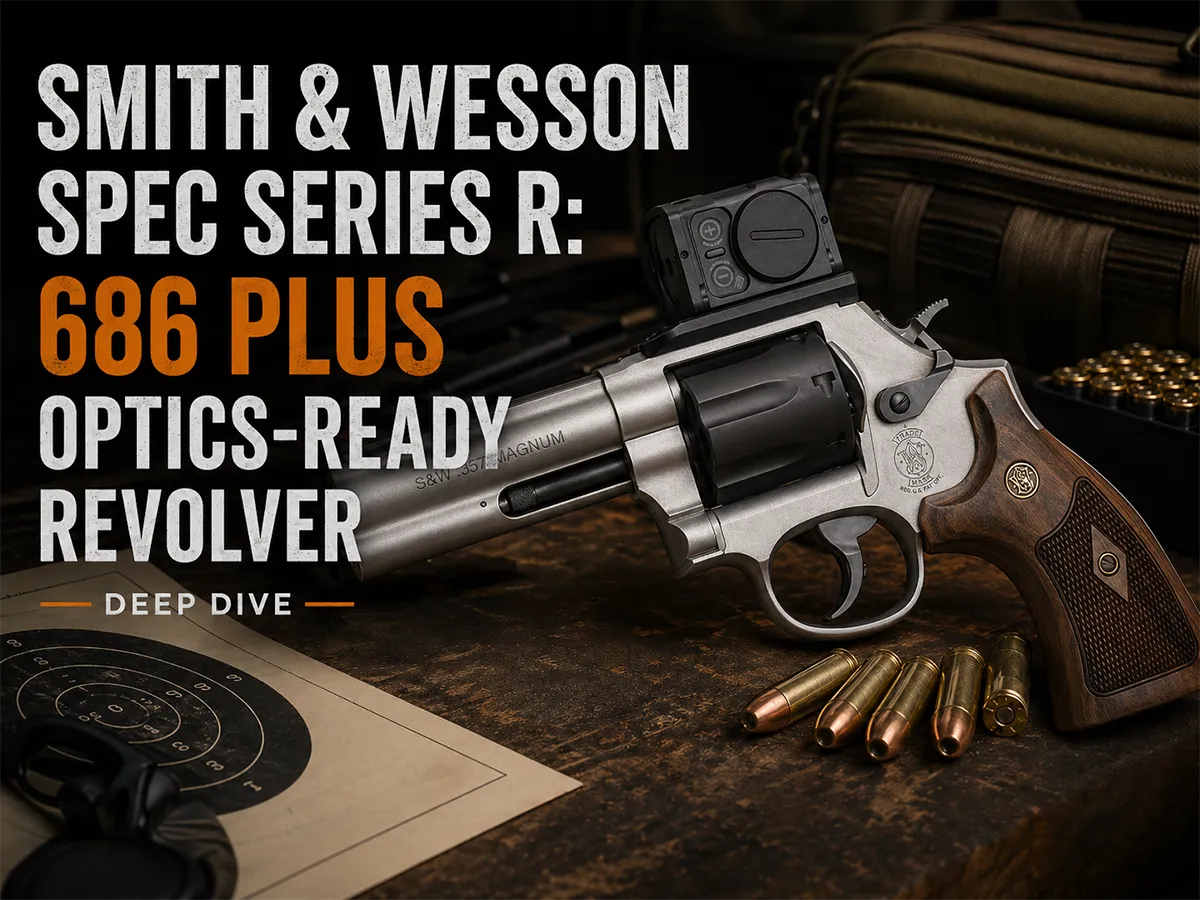
The Smith & Wesson Spec Series R is a limited 686 Plus revolver for researchers who like classic .357 Magnum hardware. It adds modern sighting gear, factory porting, and a complete range package. This is not the cheapest way to own an L-frame. Instead, the package is a focused bundle for buyers comparing collector appeal, optics readiness, recoil control, and practical range value in one box.
The short version: this is a seven-shot revolver built around the familiar 686 Plus pattern. The package adds a ported 4.13-inch barrel, an Aimpoint ACRO P-2, moon clips, a custom base, and Spec Series accessories. If you already like Smith & Wesson wheelguns, the core gun is credible. The real question is whether the package solves a real research problem for you. That makes it a useful test case for the broader move toward red-dot revolvers and ported magnum range guns.
What the Smith & Wesson Spec Series R Adds
The Spec Series R takes the Model 686 Plus idea and gives it a competition-leaning, range-ready treatment. The L-frame size gives the gun enough weight to make .357 Magnum manageable for many shooters. The seven-shot cylinder adds one round over the traditional six-shot pattern. That matters for range drills, field carry research, and comparisons against compact semi-auto pistols.
The headline feature is the factory optic setup. The revolver ships with an Aimpoint ACRO P-2 on a custom base. That means the buyer is not starting with a bare topstrap and a list of adapter questions. A red dot on a revolver changes the evaluation process. It can make precise holds easier. It also raises questions about holster fit, optic height, battery access, and dot visibility during presentation.
Smith & Wesson also uses a Power Port on the stainless barrel. Porting vents gas upward to reduce muzzle rise. It does not remove recoil, and it can add blast near the front sight. Still, it can help the sights return more predictably during controlled strings. Check current factory details on the official Smith & Wesson product page before comparing street listings.
| Platform | Action | Caliber | Barrel/Weight | Capacity | OAL | MSRP/Street |
|---|---|---|---|---|---|---|
| L-frame 686 Plus | DA/SA revolver | .357 Magnum / .38 Special +P | 4.13 in. / 42.4 oz. | 7 rounds | Not listed | MSRP about $1,999 / street varies |
Who This 686 Plus Revolver Fits
This revolver makes the most sense for a shooter who wants a premium .357 Magnum range gun. It also fits someone who wants a modern revolver learning platform or a distinctive limited-edition piece. The setup is especially relevant if you prefer revolver controls but want to research red-dot aiming without custom machining.
It is less convincing as a first handgun or a budget field revolver. The optic, finish, accessories, and limited-run presentation add cost. A standard 686 Plus, GP100, or used L-frame can teach the same double-action fundamentals for less money. The Spec Series R earns attention when the complete configuration has value from day one.
Size also matters. At more than 42 ounces before loaded ammunition, this is a steady revolver, not a featherweight carry gun. That weight helps at the range, especially with .38 Special practice loads and midrange .357 Magnum loads. It also means belt, holster, and carry method become part of the purchase decision.
Optics-Ready Revolver Tradeoffs
An optics-ready revolver is useful because it supports target-focused shooting. Many shooters find the dot easier to see than a black rear notch, especially on small targets or in mixed lighting. The ACRO P-2 is an enclosed-emitter optic, so its LED and emitter area are more protected from dust, lint, rain, and debris.
The tradeoff is presentation. A dot mounted above a revolver bore can sit higher than iron sights. New users may spend time hunting for the dot until their grip and wrist angle settle down. That is not a flaw by itself. It is a training cost to include in the research plan.
Holster support can be another limitation. A standard 686 holster may not clear the optic or mount. Buyers should confirm support for the exact barrel length, optic height, and front sight setup before assuming that existing leather or Kydex will work.
How to Compare It Before Buying
Start by deciding whether you want a revolver because of the action system or because of the cartridge. If the draw is .357 Magnum flexibility, compare the Spec Series R with standard 686 Plus models, Ruger GP100 variants, and other medium-to-large-frame revolvers. If the draw is optic use, compare it against modern optic-ready semi-auto pistols too.
- Confirm the final SKU, included optic, and accessory package.
- Handle the gun with the optic mounted, not just as a bare 686.
- Test whether the dot appears naturally from low ready and from a holster-safe presentation.
- Compare .38 Special, .38 Special +P, and .357 Magnum recoil in the same session if possible.
- Check holster support before treating it as a carry or field option.
- Price a standard 686 Plus plus optic work so the bundle premium is clear.
The moon clips are worth a separate look. They can speed reloads and simplify brass collection, but they also require compatible ammunition rims and careful handling. Bent clips can create headaches. For casual range use, standard loading may still be simpler. For a shooter who likes structured drills, moon clips are part of the appeal.
Where It Stands Against Semi-Auto Options
The Spec Series R will not match a modern compact 9mm for capacity, reload speed, or daily carry convenience. That is not its job. It competes on trigger feel, cartridge flexibility, visual distinctiveness, and the slower, deliberate rhythm many revolver shooters enjoy. For range research, that can be enough.
The fair comparison is not seven rounds versus 15 rounds in isolation. The better question is what experience you want. A tuned-feeling double-action revolver with a red dot rewards clean trigger control and careful follow-through. A compact striker-fired pistol rewards magazine capacity, common holster support, and simpler accessory paths.
The Spec Series R is best viewed as a premium research revolver, not a universal replacement for a compact 9mm.
Research Checklist for the Smith & Wesson Spec Series R
Before making a short list, verify the current street price, the included ACRO P-2 mount, local transfer rules, and holster availability. Then compare the bundle against the exact shooting role you have in mind. A range-focused buyer may value the optic, porting, moon clips, and weight. A field buyer may care more about durability, support gear, and how the port behaves around dust or low light.
Also think about ammunition cost. The revolver can use .38 Special for lower-recoil practice and .357 Magnum for full-power evaluation. That flexibility is one of the strongest reasons to consider a 686 Plus platform. It lets you separate trigger practice from recoil testing without changing guns.
For most researchers, the decision comes down to value. If you want the optic-equipped package, limited Spec Series treatment, and seven-shot .357 Magnum platform together, the Smith & Wesson Spec Series R has a clear identity. If you only want a strong .357 revolver, start with standard models and spend the savings on ammunition, training, and support gear.