
ZEV ZR15: 8.5 vs 12.5 vs 16-Inch Buyer Checks
November 24, 2026
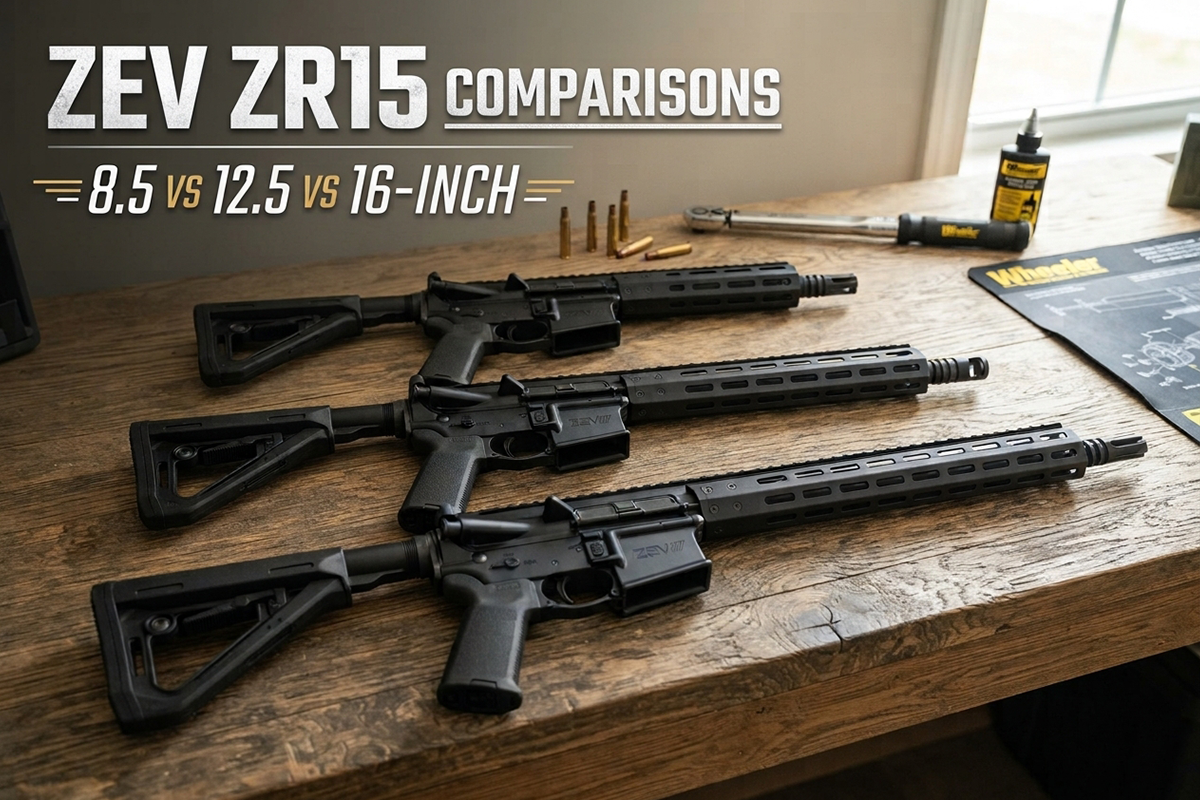
The ZEV ZR15 arrives in three configurations with one shared price, but they serve different needs. The 8.5-inch model uses .300 Blackout. The 12.5- and 16-inch versions use .223 Wylde. This comparison sorts the confirmed specifications from the questions a buyer should settle before choosing a model.
ZEV announced the line on November 17, 2026, as the successor to its Core Elite rifles. The company positions its receiver-indexed handguard and upgraded controls as the common foundation. Barrel length, chambering, weight, and transfer considerations make the real difference. This is a research guide based on published details, not a range test.
ZEV ZR15 configurations at a glance
| Configuration | Chambering | Barrel | Gas system | Unloaded weight | Published MSRP |
|---|---|---|---|---|---|
| Compact | .300 BLK | 8.5 inches | Pistol length | 5 lb 15 oz | $2,195 |
| Mid-length | .223 Wylde | 12.5 inches | Mid-length | 6 lb 9 oz | $2,195 |
| Full-length | .223 Wylde | 16 inches | Intermediate | 7 lb 2 oz | $2,195 |
Those figures come from the ZEV launch release carried by The Shooting Wire. The release calls the two shorter configurations short-barreled rifles. Confirm the exact SKU, current classification, and transfer process with a licensed dealer before ordering. Do not assume that a shared model name means identical requirements.
What stays the same across the lineup?
Each ZR15 uses ZEV’s Modular Monolithic Rail, or MML, design. Its 6061 aluminum handguard fastens to the billet 7075 upper with twelve screws. The handguard indexes from the receiver instead of the barrel nut. That leaves the barrel free floating while giving the front end a rigid connection. It is a useful design distinction, although the launch release does not provide independent accuracy data for each version.
The published common parts include a 416R stainless barrel with a 1:7 twist and diamond-like carbon finish. ZEV also lists a TriggerTech two-stage trigger at 3.5 pounds, a VLTOR A5 buffer system, and an A5-3 heavy buffer. Radian supplies the ambidextrous Talon safety and Raptor charging handle. The lower receiver is forged 7075 aluminum with controls accessible from both sides.
At the muzzle, the release lists a SilencerCo ASR open-tine device. It also describes a user-replaceable steel roll pin at the charging-handle latch. These details may matter to buyers comparing complete rifles rather than bare receivers. Check the actual listing and included accessories, because launch specifications can change by SKU or production batch.
That shared parts list also makes model comparison simpler. If you like the ZEV ZR15 controls and receiver design, focus the next round of research on cartridge, length, and weight. Do not assume identical handling just because the trigger and safety are the same. A different barrel and gas system can change how a rifle feels with a chosen load. The available launch information does not quantify those differences, so a hands-on trial remains valuable.
Which barrel and chambering fit your use?
8.5-inch .300 Blackout
The shortest ZR15 is also the only .300 Blackout option in the announced group. Its 5-pound-15-ounce unloaded weight gives it the lightest published starting point. A compact package can be attractive when storage space matters. Ammunition choice also deserves attention, since .300 Blackout loads vary widely in intended use and performance.
Do not treat the short barrel as a free substitute for the longer .223 Wylde models. The chambering, ammunition cost, sighting setup, and legal classification all change the ownership decision. If you already own one cartridge, compare the cost and availability of the other before buying. Ask the dealer for the precise factory designation and paperwork path.
12.5-inch .223 Wylde
The middle model combines .223 Wylde chambering with a 12.5-inch barrel and a published 6-pound-9-ounce unloaded weight. ZEV specifies a mid-length gas system for this configuration. For a buyer committed to .223/5.56-pattern ammunition who also wants a shorter package, it is the obvious model to compare with the 16-inch rifle.
The shorter package is not automatically the better one. Consider where the rifle will be used, what optics and accessories will be mounted, and how much weight those additions bring. Also verify the transfer requirements before comparing final costs. The same MSRP does not guarantee the same total purchase process.
16-inch .223 Wylde
The 16-inch ZR15 is the longest and heaviest at a published 7 pounds 2 ounces unloaded. ZEV pairs it with an intermediate gas system. It is the straightforward comparison point for shoppers seeking a conventional rifle-length configuration and the shared ZR15 components. With all three models listed at $2,195, choosing this one is mainly about configuration rather than a lower entry price.
Its extra barrel and handguard length may offer more room for a support hand and accessories. The tradeoff is a longer, heavier rifle to carry and store. Handle a complete example if possible. Published unloaded weights do not include your optic, sling, loaded magazine, or other gear.
Does the MML upper justify the price?
The MML joint is the ZR15’s clearest design feature. A handguard attached directly to the upper can reduce movement at that connection. ZEV says the arrangement offers the consistency of a conventional monolithic upper while retaining a free-floating barrel. The claim is plausible as a design goal, but the launch material does not establish a measured advantage over every other AR-pattern rifle.
Evaluate the rifle as a complete package. The trigger, controls, barrel finish, buffer system, and handguard all contribute to the stated price. A cheaper rifle plus later upgrades can approach the same cost, but that depends on the specific parts and any installation expense. Conversely, buyers who would replace these components anyway may get little value from paying for them twice.
The strongest evidence still has to come from shooting. ZEV reports extensive development use, including tens of thousands of rounds across challenging conditions. That is a manufacturer claim, not a standardized independent endurance test. Seek range reports on the exact configuration, especially if reliability or a particular ammunition type drives your decision.
Research checklist before choosing a ZR15
- Confirm the exact barrel length, chambering, factory SKU, and classification on the dealer listing.
- Compare the total cost, including any required transfer steps, optic, mount, magazines, and ammunition.
- Check which accessories ship with the rifle rather than assuming the launch photo shows the full package.
- Handle the rifle if possible and judge balance with the optic and sling you expect to use.
- Look for independent testing of the specific configuration and ammunition you plan to use.
- Review the manufacturer’s current manual and warranty before committing to a purchase.
GunGenius can help you browse related semi-auto rifles and the ZEV Technologies brand catalog. Use those pages to compare the announced ZR15 with other research options. Confirm that any model listing matches the configuration you want, since a family name alone will not identify the chambering or barrel.
When reading early reviews, separate observations from the maker’s stated specifications. A single review sample can reveal useful fit or control details, but it cannot settle durability for every production rifle. Record the model’s barrel length and chambering alongside each review. That will keep feedback about a compact ZEV ZR15 from being applied too broadly to the full-length version.
The practical choice
Choose by chambering and intended role first. The 8.5-inch .300 Blackout ZR15 is the compact, different-cartridge choice. For a shorter .223-platform package, consider the 12.5-inch .223 Wylde model. At 16 inches, the third version offers a conventional rifle-length option. All share the MML design and listed premium components, so the real question is which configuration you will actually use.
As of November 23, 2026, rely on the exact dealer listing for availability and final details. A launch release sets the baseline, but it cannot replace a check of the rifle in hand. Keep the comparison grounded in confirmed specifications, and revisit it when independent range data becomes available.