
Vortex Defender CCW vs ST: Fit, Footprints, and Buyer Checks
September 10, 2026
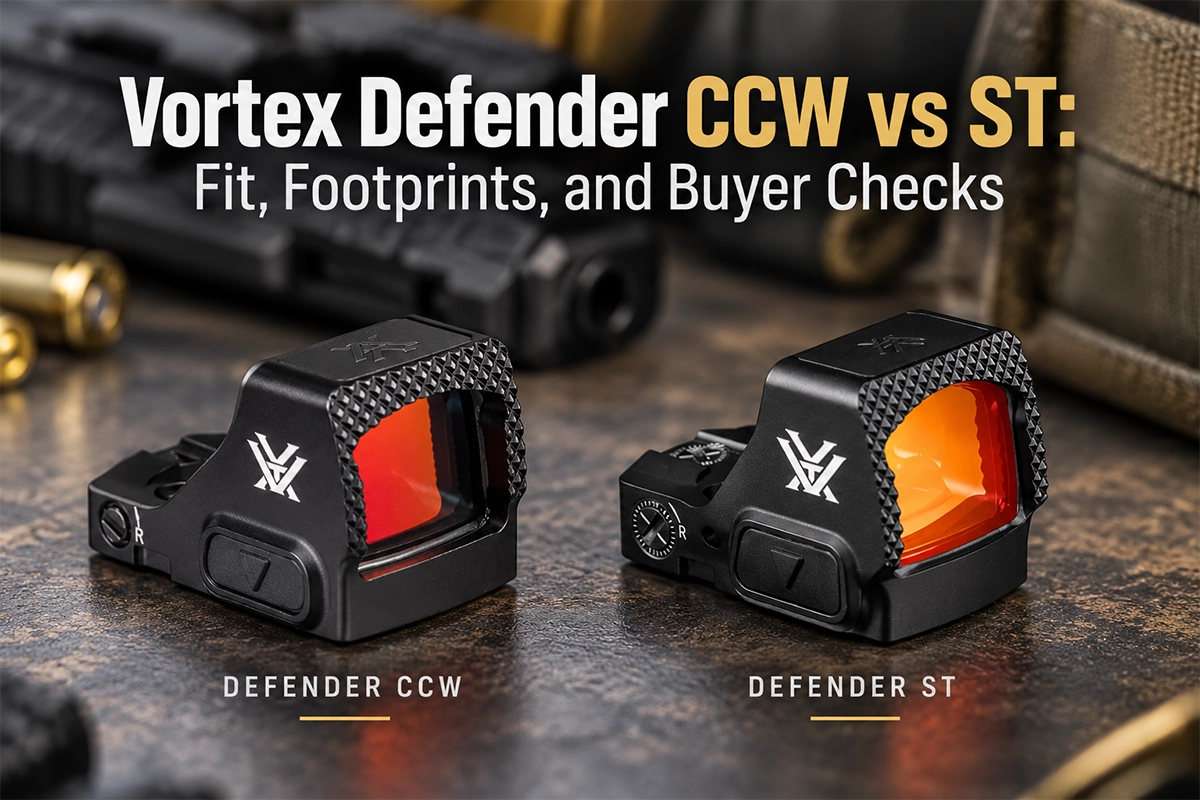
The Vortex Defender CCW vs ST decision starts with the pistol, not the feature list. The smaller Defender-CCW uses the Shield RMSc footprint and favors slim carry pistols. By contrast, the Defender-ST uses the larger DeltaPoint Pro footprint and suits many compact or full-size pistols. It can also serve on a shotgun or as an offset carbine sight. Choose the model that fits the host correctly, then compare window size, weight, battery, and intended use.
Short answer: pick the CCW for a narrow RMSc-cut slide and minimum bulk. Pick the ST for a compatible larger slide, a wider working window, or use across several firearm types.
Vortex Defender CCW vs ST Specifications
| Category | Defender-CCW | Defender-ST |
|---|---|---|
| Primary role | Slim concealed-carry pistols | Compact or full-size pistols, shotguns, offset carbines |
| Footprint | Shield RMSc | DeltaPoint Pro |
| Dot options | 3 or 6 MOA | 3 or 6 MOA |
| Battery | CR1632, top access | CR2032, top access |
| Listed runtime | 9,500 hours | 25,000 hours |
| Weight | 0.95 ounce | 1.48 ounces |
| Length | 1.59 inches | About 1.8 inches |
| Included mounting support | Common screws and shim; package varies by SKU | Common screws, Glock MOS plate, and Picatinny mount on standard package |
These figures describe the open-emitter models. Vortex also offers enclosed Defender variants, so read the full SKU before comparing a listing. An enclosed model protects its emitter behind an additional lens. It is not automatically the same size, price, or battery configuration as the open version.
The Footprint Decides What Fits
A mounting footprint defines the optic’s screw pattern and the shape of its contact surface. The Defender-CCW’s Shield RMSc pattern is common on slim slides. In comparison, the Defender-ST’s DeltaPoint Pro pattern needs a different direct cut or adapter plate. Similar-looking optics are not interchangeable just because two screw holes appear close.
Start by identifying the exact pistol model, generation, and factory optic system. A narrow semi-auto pistol may accept the CCW directly. A full-size slide may favor the ST or require a plate for either model. Owners researching a Glock must distinguish factory MOS systems, direct cuts, and generation-specific plates.
A plate can solve a pattern mismatch, but it adds height and another fastener interface. It may also leave visible space around a small optic on a wide slide. That gap can be cosmetic, yet the plate still needs proper recoil support. Never assume the mounting screws alone should absorb every cycling load.
CCW Size Versus ST Window
The CCW weighs about half an ounce less and has a narrower body. That difference is small on paper. On a slim carry pistol, it can reduce side overhang and preserve the pistol’s balanced profile. It may also leave more room around a closely fitted holster sweat guard.
The ST offers more housing and a larger working window. A larger window can make a slightly imperfect presentation easier to diagnose during practice. It does not correct poor grip or alignment. Once the shooter builds a repeatable presentation, either window can keep the dot visible through normal recoil.
Independent side-by-side testing has found the smaller CCW appropriate for concealed carry and the middle-size ST more forgiving across broader roles. That practical split matches Vortex’s product positioning. The result is a fit decision, not a claim that one model is universally better.
Battery Life and Controls
The CCW uses a CR1632 battery and lists up to 9,500 hours of runtime. The ST uses the larger CR2032 and lists up to 25,000 hours. Both provide top battery access, so a battery change should not require removing the sight. Listed runtime depends on brightness and use conditions, so it is not a maintenance schedule.
Set a recurring replacement date that matches your use. Inspect the battery compartment, lens, screws, witness marks, and brightness controls at the same time. Confirm zero after installation and after any event that could disturb the optic or plate.
Should You Choose 3 MOA or 6 MOA?
Minute of angle, or MOA, describes the dot’s apparent angular size. A 3 MOA dot covers about three inches at 100 yards. A 6 MOA dot covers about six inches at that distance. At common pistol practice distances, both cover a much smaller area.
The 3 MOA option gives a finer aiming reference for smaller targets. The 6 MOA option can appear faster and easier to see, especially for users who prefer a bold aiming point. Astigmatism may make either dot look streaked or irregular. View both at useful brightness levels before deciding, if possible.
Host Examples and Adapter Tradeoffs
Many slim pistols from SIG Sauer use compact optic systems, but model details still matter. Some slides accept RMSc-pattern optics directly, while others use a related pattern with different recoil bosses. Verify the manufacturer diagram and optic instructions instead of relying on a retailer’s compatibility list.
Larger pistols from Springfield may offer adaptable mounting systems. The correct plate can support the ST without forcing a smaller optic onto a broad slide. Plate thickness affects sight height and backup-iron visibility. Screw length must provide safe thread engagement without contacting internal parts.
If a CCW already mounts securely on a wide slide, cosmetic gaps alone do not prove a functional problem. Test access to the controls, ejection clearance, holster fit, and the sight picture. A fitted spacer may improve appearance or support, but it must match the exact slide, plate, and optic combination.
Which Defender Is the Better Buy?
- Choose the CCW when your slide has a direct Shield RMSc cut, concealment matters, and you want the lightest open Defender.
- Choose the ST when your host supports DeltaPoint Pro, you prefer a larger window, or the optic may move to a shotgun or carbine mount.
- Pause before buying when the listing omits the footprint, full SKU, included plate, or screw specifications.
- Compare total cost when either choice needs a quality adapter, different iron sights, or holster changes.
Price promotions can reverse the usual price gap. Do not let a discount decide compatibility. A cheaper optic plus the wrong plate is not a bargain. Confirm what comes in the current package because dealer bundles and older inventory may differ.
Vortex Defender CCW vs ST Research Checklist
- Record the pistol’s exact model, generation, slide cut, and optic-system name.
- Match that system to Shield RMSc or DeltaPoint Pro using manufacturer diagrams.
- Confirm whether direct mounting is supported or a specific plate is required.
- Check plate thickness, recoil bosses, screw thread, screw length, and torque guidance.
- Compare optic width with the slide and check controls, ejection clearance, and holster fit.
- Choose 3 or 6 MOA after viewing the dots at realistic brightness.
- Install according to both manufacturers’ instructions, then verify function and zero.
- Inspect fasteners and replace the battery on a recorded schedule.
Use the official Vortex Defender pages to confirm current manuals, footprint diagrams, included hardware, and model variants. Product families change over time, and retailer descriptions can combine open and enclosed versions. The manufacturer’s diagram should control the fit decision.
Bottom Line
The Vortex Defender CCW vs ST comparison is simpler once footprint and host width come first. The CCW is the compact RMSc choice for slim carry pistols. Its ST counterpart is the larger DeltaPoint Pro option for compatible duty-size pistols and multi-platform use. Verify the complete mounting stack, then choose the window, dot, and battery format that fit your actual practice.