
Viper G3 vs G2: What Changed and Which Fits?
November 3, 2026
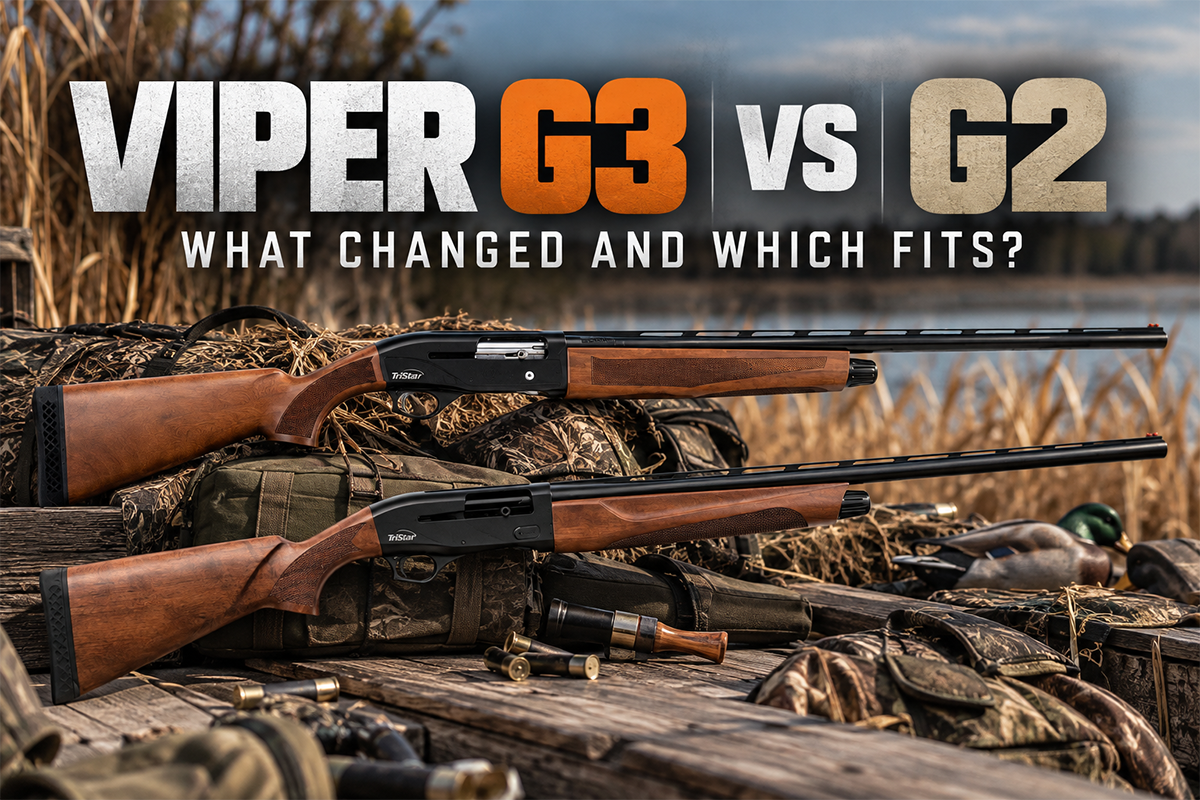
Comparing the Viper G3 vs G2 starts with a simple question: does the newer shotgun solve a problem you actually have? TriStar says the G3 has revised internals and larger controls. Yet both generations share many core features. This guide separates confirmed changes from familiar equipment, then shows what to check on a specific model.
TriStar announced the full G3 lineup in October 2026. Its current listings show several G2 and G3 models side by side. That makes this a useful comparison for shoppers weighing an existing G2 against a new G3. It is not a hands-on reliability test, and manufacturer claims should be treated accordingly.
Viper G3 vs G2 at a glance
| Buyer question | Viper G2 | Viper G3 |
|---|---|---|
| Operating system | Gas-operated semi-auto | Gas-operated semi-auto |
| Controls | Standard generation controls | Oversized controls announced |
| Internal system | Established G2 design | Revised system claimed by TriStar |
| Choke pattern | Beretta/Benelli Mobil | Beretta/Benelli Mobil |
| Example walnut 12-ga, 28-in | 6.9 lb; $869 MSRP | 6.9 lb; $799 MSRP |
| Example synthetic 12-ga, 28-in | 6.9 lb; $789 MSRP | 6.9 lb; $739 MSRP |
The example prices above come from TriStar’s listings checked on October 27, 2026. They are suggested retail prices, not dealer quotes. The table compares matching 12-gauge barrel and stock styles. It does not imply every G2 and G3 configuration has the same weight, price, or equipment.
What actually changed on the G3?
TriStar’s launch announcement calls out a stronger internal system and oversized controls. The company also says its updated gas system accommodates a wider range of ammunition out of the box. Those are the stated generational changes. TriStar has not published a controlled G2-versus-G3 cycling test or a parts-level engineering breakdown in the material reviewed here.
Larger controls can matter when gloved hands make small buttons awkward. They may also help a shooter identify controls by feel. That is a fit question, though, not an automatic performance advantage. Handle the exact G3 model and compare it with the G2 before deciding that the change is worth paying for.
Do not read the ammunition claim as proof that every light load will run in every gun. TriStar’s current G2 and G3 series pages both describe use from light target loads to heavy waterfowl loads. Shell choice, individual gun condition, and maintenance still matter. Ask a dealer or TriStar about the specific ammunition and model you intend to use.
Which features are shared?
Both series are gas-operated semi-automatic shotguns. TriStar lists a 3-inch chamber for the main wood and synthetic models, a fiber-optic front sight, a vent rib, and a chrome-lined chamber and barrel. Its series pages also list a recoil pad, three Mobil-pattern choke tubes, and a five-year warranty. These shared items should not be sold to you as exclusive G3 upgrades.
The two series pages even share much of their feature wording. That makes careful model comparison more valuable than a broad generation label. The GunGenius semi-auto shotgun category gives you a wider view of the format. The TriStar brand page helps place both Vipers within the company’s catalog.
TriStar lists shim kits for many models, but its G3 page excludes the Turkey model. A shim changes stock fit, which can affect how naturally the gun points. Ask what comes in the box for your exact item number. Likewise, confirm the choke tubes included with the specific configuration before planning around them.
How do matching models compare on paper?
For a Viper G3 vs G2 price check, a close match is the walnut 12-gauge with a 28-inch barrel. TriStar lists both at 6.9 pounds with a 14¼-inch length of pull. The G3’s listed MSRP is $799, while the G2’s is $869. Those figures do not prove the G3 is a better value at your dealer. Inventory, discounts, and included accessories can reverse the real-world price gap.
The synthetic 12-gauge, 28-inch examples also list the same 6.9-pound weight and 14¼-inch length of pull. Their current MSRPs are $739 for the G3 and $789 for the G2. Treat these as reference points only. Check the item number, barrel length, and current quote when comparing two guns on a rack.
The G2 walnut listing includes a 16-gauge item with a 2¾-inch chamber. TriStar’s G3 announcement names 12, 20, and 28 gauge plus .410 bore, with 3-inch chambers across that announced lineup. That is a notable model-availability difference. A shopper specifically seeking 16 gauge should check the G2 listing and actual stock before assuming a G3 equivalent exists.
For a smaller shooter, the compact variants may matter more than the generation. Stock length, balance, and overall fit vary across configurations. A lighter listed weight is not a substitute for trying the exact model. Compare the compact versions directly, and check whether a shorter stock gives a natural, repeatable mount.
Does the G3 replace the G2 for hunting or clays?
There is no universal answer. For field use, the useful comparisons are fit, handling, barrel length, weather-resistant finish, and the loads you plan to buy. For clays, consider how the gun tracks for you and which sporting configuration is actually offered. A generation name alone tells you little about those details.
TriStar offers walnut, synthetic, camouflage, and sporting options across the families, but combinations differ. The newer G3 also has Turkey and Pro versions listed on its site. Compare a hunting G2 with a hunting G3, or a sporting G2 with a sporting G3. Mixing unlike trims makes the upgrade look larger or smaller than it is.
A waterfowl buyer should check the selected model’s finish and barrel length. An upland hunter may care more about carry weight and how the stock fits. A clay shooter may prioritize balance and a longer barrel. In each case, the G3’s control update is one factor among several, not the whole decision.
What remains unproven?
TriStar says the G3 has more robust internals and broader load flexibility. That is useful context, but it is not independent evidence of a measured reliability gain over the G2. Both series pages mention 5,000-round endurance testing. The public descriptions reviewed here do not provide a matched protocol, failure counts, or results by load for both generations.
Parts interchangeability is another open question. A shared choke pattern does not mean every internal component, stock, or accessory transfers between generations. Get a compatibility answer from TriStar for any part you intend to reuse. Avoid ordering based on exterior similarity alone.
The official TriStar Viper G3 series listing provides model numbers and current specifications. Its G2 series page offers a matching baseline. Recheck both before purchase because listed prices and configurations can change. For the detailed Bronze gauge decision, the existing GunGenius Bronze comparison covers that separate question.
Research checklist before choosing
- Write down both item numbers and compare the same gauge, barrel length, stock style, and intended use.
- Confirm chamber marking, included choke tubes, shims, and other box contents for each exact model.
- Compare current dealer quotes with TriStar’s MSRP; include any extras you would otherwise buy.
- Handle both stocks if possible, and assess balance, control reach, and a natural shoulder fit.
- Ask TriStar about ammunition or accessory compatibility when a specific use depends on it.
These checks keep the purchase decision tied to the gun in front of you. They also prevent a product-family claim from being mistaken for a specification on every trim. Keep a copy of the model listing when you compare offers, since dealer descriptions sometimes omit important variants.
Viper G3 vs G2: which should you choose?
Choose a G3 if its larger controls appeal to you, the exact configuration fits, and the actual price works. A matching G2 remains sensible when it fits better, has the trim you want, or carries a stronger dealer offer. The G3’s announced internal update is worth considering, but no public matched test here proves a specific reliability advantage.
Start with the same gauge and comparable trim. Then check stock fit, included equipment, and the final price. If you are buying for hunting or target use, the best choice is the model that meets those needs without relying on unverified upgrade claims.