
Two Point Sling in 2026: The Practical Guide to Comfort, Control, and Not Hating Your Rifle
March 3, 2026
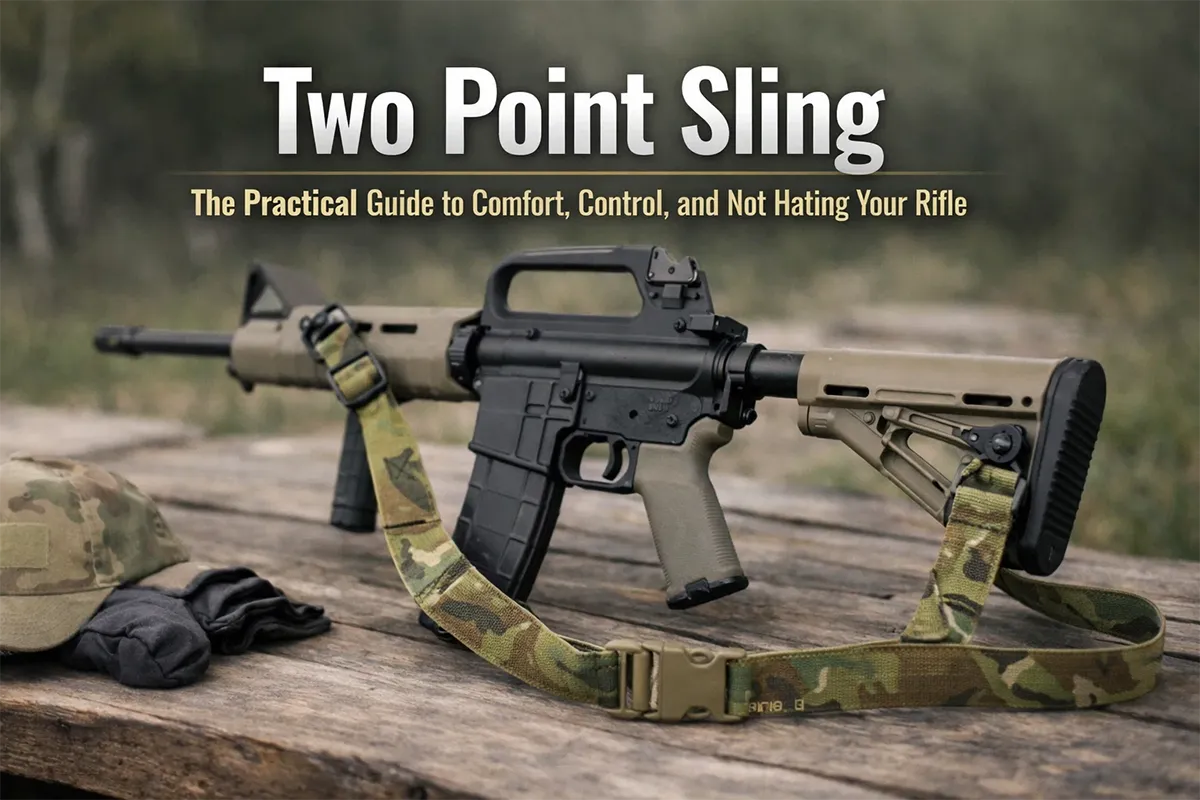
If you’re shopping a two point sling in 2026, you’re usually trying to solve one of three problems: your rifle is annoying to carry, it swings like a wrecking ball when you go hands-on with anything else, or it never seems to sit where you want it when you transition from “carry” to “shoot.” The good news is that modern two-point slings—especially quick-adjust styles—are a mature, proven solution. The bad news is that the “right” sling still depends on your rifle type, attachment points, and what you do most (range, hunting, training, or all of it).
This deep dive covers what makes a two-point sling work, how to choose width and padding, how quick-adjust hardware changes everything, and how to avoid the most common setup mistakes—without turning this into a cosplay loadout exercise. You’ll finish with a simple checklist and a few research paths that make sense for ARs and bolt guns alike.
Why a Two Point Sling Is Still the Default “Do-It-All” Choice
One-point and three-point slings exist, and they can shine in narrow roles. But for most shooters, a two-point sling wins because it balances three things that matter in the real world:
- Carry comfort: It can spread weight over your shoulder and keep the rifle stable.
- Control: It keeps the muzzle from swinging everywhere when your hands are busy.
- Usability: With modern quick-adjust designs, you can tighten for carry and loosen for shooting in seconds.
Think of the sling as “hands-free rifle management,” not just a strap. If your sling setup makes you fight the rifle, you’ll either take it off (bad) or stop bringing the rifle along (also bad).
Two Point Sling Basics: Fixed vs Quick-Adjust
There are two main families:
- Fixed-length two-point: Simple, often lighter, fewer moving parts. Great for classic hunting carry if you rarely need to change length quickly.
- Quick-adjust two-point: Adds a pull-tab or slider so you can rapidly tighten/loosen. This is the go-to for modern carbines and training rifles because it lets the same sling behave like a “carry strap” and a “working sling.”
In 2026, quick-adjust is usually the smart default unless your rifle lives almost entirely in a scabbard, a blind, or a simple “carry to stand, then shoot” hunting routine.
Width, Padding, and Material: Comfort vs Control
Sling comfort isn’t just “softness.” It’s how well the sling distributes weight and how well it stays put.
- 1-inch webbing: Common on training slings. Good control, less bulk, can bite your shoulder with heavier rifles or long days.
- 1.25-inch webbing: A popular middle ground—often comfortable without feeling floppy.
- Padded slings: Great for heavier rifles, suppressed setups, or long hikes. Downside: more bulk around chest rigs or layers, and sometimes more “grip” that can snag on gear.
- Slick vs grippy materials: Slicker materials slide and adjust easily; grippier materials stay put but can feel sticky over jackets.
A useful rule: if your rifle is light and your sessions are short, you can prioritize control and low bulk. If your rifle is heavy or you’ll carry it for hours, prioritize comfort and stability (often meaning a wider or padded sling).
Attachment Points: QD, Loops, and “Why Is This Twisted?”
Most sling frustration comes from attachment choices. A great sling can feel terrible if the swivels or mounting points fight your body mechanics.
Common attachment styles
- QD swivels: Quick-detach push-button swivels are common on modern AR stocks and handguards. They’re convenient, but quality matters—cheap swivels can rattle, bind, or wear.
- Fixed loops / traditional studs: Common on hunting rifles. They’re durable and simple, but slower to reconfigure.
- Paraclip/HK-style hooks: Fast and functional, but can be noisy and may chew up attachment points over time.
- Direct threading: Some slings thread directly through a slot for maximum simplicity and minimal hardware.
The goal is a setup that stays flat, doesn’t twist into a rope, and doesn’t put the adjuster in a spot where you can’t reach it under stress (or with gloves).
Where to Mount It: AR-Style Carbines vs Hunting Rifles
Mounting location changes how the rifle hangs, how it transitions to the shoulder, and how much it bangs into your knees.
AR-style carbines
A common modern approach is rear attachment near the stock and front attachment toward the handguard. That keeps the rifle stable and makes quick-adjust slings useful for tightening the gun to your body. The exact spots depend on your handguard length and accessories (lights, bipods, barricade stops).
If you’re building around an AR platform, browsing semi-auto rifles and comparing common rail and stock setups can help you understand what attachment points you’ll actually have before you buy hardware.
Bolt-action and traditional hunting rifles
Many hunting rifles use classic front/rear studs. That’s fine for over-the-shoulder carry, but if you want better control (like muzzle-down carry or a tighter “hands-free” position), you may benefit from a sling that adjusts quickly or from hardware that lets the rifle sit flatter against your body.
For hunting setups, it can help to start with bolt action rifles and note whether the models you’re considering ship with studs, QD cups, or something proprietary.
Quick-Adjust Slings: How the “Tighten/Loosen” Move Should Feel
A quick-adjust sling should do two things well:
- Tighten easily: One pull and the rifle tucks in close to your torso for hands-free movement.
- Loosen predictably: One movement and you can mount the rifle without fighting the sling.
If tightening is smooth but loosening feels sticky, you’ll avoid loosening under time pressure—and you’ll end up trying to shoot “around” your sling. That’s the fastest route to hating the whole idea.
Also pay attention to where the adjuster rides. Many shooters want it reachable with the support hand without breaking grip on the rifle. If the slider ends up behind your shoulder or under a chest strap, the feature might as well not exist.
Common Mistakes That Make Any Sling Feel Bad
- Too long by default: A sling that hangs the rifle too low feels heavy and swings into everything.
- Front point too far back: Makes the muzzle wander and reduces control when hands-free.
- Rear point too far forward: Can interfere with shoulder transitions and make the gun feel cramped.
- Hardware overload: Too many clips and adapters adds noise, bulk, and failure points.
- Ignoring lefty/ambi needs: A sling set up for one side can feel terrible when you switch shoulders.
Most of these aren’t “buy a different sling” problems—they’re “move one attachment point” or “shorten the baseline length” problems. Before you return anything, try three small adjustments: shorten it more than you think, move the front point forward one position, and reposition the adjuster so your support hand can reach it naturally.
Spec Table: Sling Types and What to Compare
| Category | Compatibility | Materials | Weight | Dimensions | Features | MSRP |
|---|---|---|---|---|---|---|
| Two-point (fixed) | Studs, loops, or QD with adapters | Nylon webbing (varies by SKU) | Varies by SKU | Adjustable length range varies | Simple carry, low bulk | Varies widely |
| Two-point (quick-adjust) | QD, loops, clips; depends on ends chosen | Nylon webbing + hardware | Varies by SKU | Adjustable length + quick slider | Fast tighten/loosen, better control | Varies widely |
| Two-point (padded quick-adjust) | Same as above | Padded section + webbing | Varies by SKU | Bulkier profile | More comfort for heavy rifles | Varies widely |
| One-point (reference) | Receiver/endplate mounts typical | Webbing + bungee optional | Varies by SKU | Short overall | Fast shoulder transitions | Varies widely |
Note: Sling “specs” don’t tell the whole story. The biggest difference you’ll feel is whether the adjuster moves smoothly under load and whether the sling lies flat without twisting.
Brand Research Paths: Start With the Rifle You’re Actually Using
Because the rifle’s mounting options drive the sling setup, it’s smart to anchor your sling research to a common platform you can compare against. For example:
- Modern AR setups: Browsing Daniel Defense rifles can give you a good baseline for handguard and stock attachment options on a “modern carbine” pattern.
- Hunting and mixed-use rifles: Browsing Ruger bolt guns and carbines can help you see how often you’ll be dealing with classic studs vs QD cups across common hunting models.
You don’t need to buy those brands to benefit from the comparison. You just need a consistent reference point so you can evaluate whether you’re solving a “carry comfort” problem, a “control” problem, or a “transitions” problem.
Research Checklist: Buy the Right Two Point Sling Without Overthinking It
- Define the role: range/training, hunting carry, or mixed.
- Choose fixed vs quick-adjust: quick-adjust for most modern use; fixed for simple carry.
- Pick width/padding: heavier rifle = wider or padded; lighter rifle = slimmer is fine.
- Confirm attachment points: QD cups, studs, loops—match hardware to your rifle.
- Plan adjuster placement: reachable with support hand, not buried under straps.
- Set baseline length shorter than you think: then loosen only when you need to shoot.
- Test three positions: muzzle down, muzzle up, and across-chest—keep the one that controls the rifle best for your normal movement.
Do that, and a two-point sling stops being “an accessory” and becomes part of how you run the rifle—quietly, comfortably, and without constant fiddling.