
Taurus TTX Suppressors: Models, Host Fit, and Buyer Checks
September 24, 2026
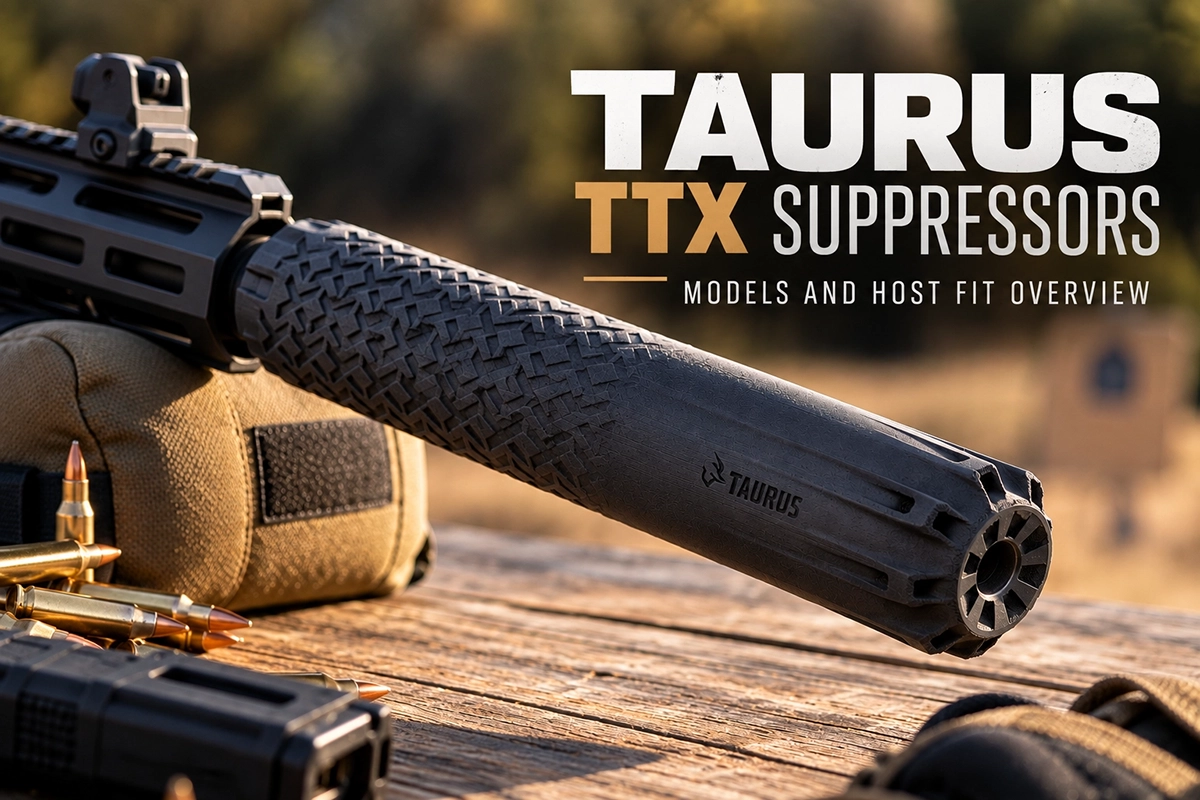
Taurus TTX suppressors give buyers three purpose-built choices instead of one broad, do-everything model. The TTX22 covers rimfire hosts. Fixed-barrel pistol-caliber platforms are the TTX9C’s target. Meanwhile, the TTX30 serves common .30-caliber rifle cartridges. Choosing among them starts with the firearm you will use most, not the longest caliber list.
The September launch also marks Taurus’s first move into suppressors. Each model uses additively manufactured titanium, a direct-thread mount, and a listed sound reduction of up to 30 decibels. Those shared features make the family easy to compare, but they do not make the models interchangeable.
Taurus TTX Suppressors at a Glance
| Model | Primary role | Rated cartridges | Mount | Size | Weight | MSRP |
|---|---|---|---|---|---|---|
| TTX22 | Rimfire | .22 LR, .22 WMR, .17 HMR, 5.7×28 FN | 1/2×28 direct thread | 5.5 x 1 in. | 3.71 oz. | $299.99 |
| TTX9C | Fixed-barrel PCC | 9mm, .380 ACP, .32 ACP, .22 LR | 1/2×28 direct thread | 7 x 1.5 in. | 11.5 oz. | $599.99 |
| TTX30 | Centerfire rifle | .300 BLK, .308 Win., 7.62×39, 6.5 Creedmoor, .300 Win. Mag. | 5/8×24 direct thread | 7.5 x 1.75 in. | 14.31 oz. | $599.99 |
Published specifications describe all three as full-auto rated and finished in Cerakote C-Series. A rating is not a substitute for the manual. Buyers should confirm minimum barrel length, firing schedule, cooling guidance, and cartridge limits for the exact model before use.
Which TTX Model Fits Your Main Host?
TTX22: the light rimfire option
The TTX22 is the easiest starting point for a threaded rimfire pistol or rifle. Its 3.71-ounce weight adds little leverage at the muzzle. The 1-inch diameter should also preserve a trimmer sight picture than the larger centerfire models.
Taurus designed it with the TX22 family in mind, but the key checks still involve threads, alignment, and cartridge rating. Buyers comparing Taurus hosts can start at the Taurus brand catalog. Confirm that the selected barrel is threaded 1/2×28 and that its shoulder gives the suppressor a proper mounting surface.
Rimfire ammunition leaves substantial residue. Cleaning access and the maker’s maintenance interval matter as much as headline weight. Ask how the monocore is removed, which cleaners are permitted, and whether special tools come in the box.
TTX9C: built for fixed-barrel 9mm platforms
The “C” in TTX9C points buyers toward carbines and other fixed-barrel hosts. This model uses a direct-thread mount and does not include a recoil booster. That distinction is critical. Many conventional locked-breech pistols need a piston or booster system to cycle reliably with a suppressor.
A threaded 9mm muzzle alone does not prove compatibility. Check the action type, thread pitch, shoulder, bore alignment, and the manufacturer’s host guidance. The TTX9C makes the strongest case on a pistol-caliber carbine that already uses 1/2×28 threads.
Its 11.5-ounce weight is manageable on a carbine, yet it changes balance more than the TTX22. Include that extra seven inches when planning storage, transport, and handguard clearance. A short platform can become surprisingly long once every component joins the party.
TTX30: broad rifle coverage
The TTX30 covers the broadest centerfire range in the family. Its published list runs from .300 Blackout through .300 Winchester Magnum. That makes it relevant to many bolt-action, semi-automatic, and hunting rifles that use a 5/8×24 muzzle.
Start by browsing the GunGenius rifle category, then verify the exact rifle SKU. Two rifles in the same chambering can have different barrel lengths, muzzle threads, gas settings, or factory muzzle devices. Those differences affect mounting and the final setup.
The 14.31-ounce TTX30 also places more mass forward. Hunters may value the titanium construction, while high-volume shooters should focus on heat limits and firing cadence. Semi-automatic users should expect a suppressor to change gas flow and fouling. Follow the firearm and suppressor makers’ maintenance guidance.
Direct Thread, Alignment, and Sound Claims
Direct thread keeps the parts list simple. It can also expose a mismatch quickly. The thread pitch must match, the shoulder must seat correctly, and the suppressor bore must align with the firearm bore. Never treat a hand-tight fit as proof of alignment.
SAAMI’s suppressor standard covers thread and socket drawings, sound measurement, alignment measurement, and design testing. It gives researchers a useful framework for evaluating published specifications. Actual sound at the shooter’s ear still varies with the host, barrel, ammunition, environment, and test method.
The “up to 30 dB” figure is best treated as a manufacturer ceiling, not a universal result. Supersonic ammunition keeps its ballistic crack. Action noise and port noise also remain. A suppressor can reduce sound without making every combination hearing safe, so appropriate hearing protection remains the prudent baseline.
Taurus TTX Suppressor Research Checklist
- Name the primary host and cartridge. Buy for the setup you will shoot most.
- Confirm the host action. The TTX9C is described for fixed-barrel platforms, not a typical tilting-barrel pistol.
- Verify the exact muzzle thread, shoulder, and bore alignment requirements.
- Check barrel-length limits, cartridge ratings, firing cadence, and cooling instructions in the current manual.
- Compare total length and forward weight after mounting.
- Review cleaning access, service intervals, warranty terms, and included tools.
- Confirm current federal, state, and local requirements with authoritative sources and a qualified dealer.
- Budget for the complete setup, including any compliant transfer costs and host changes.
This checklist also helps prevent a common buying mistake: choosing by caliber alone. A 9mm rating does not tell you whether a model works on a moving-barrel pistol. Matching threads do not establish alignment. Barrel-length and firing-schedule limits still apply to a rifle-rated model.
How the Three-Model Strategy Compares
Taurus TTX suppressors follow the dedicated-tool approach often favored by experienced owners. The rimfire model stays small and light. By contrast, the carbine model avoids pretending to be a universal pistol solution. Its rifle sibling accepts added size to cover higher-pressure cartridges.
The tradeoff is that one model will not cover every host. Someone with a TX22, a locked-breech 9mm pistol, and a .308 rifle may still need different solutions. The TTX9C’s lack of a booster deserves special attention because it narrows the intended 9mm use case.
Availability evidence and independent test data remain early. Published dimensions and cartridge ratings are useful, but they cannot replace verified sound testing, long-term durability reports, or a hands-on balance check. Buyers should compare dealer inventory by exact item number and avoid assuming that every listed host is ready without inspection.
Total ownership cost deserves a separate comparison. A lower MSRP may not produce the least expensive working setup if the host needs a threaded barrel, a different handguard, or professional compatibility work. Dealer transfer fees and local requirements can also vary. Record the suppressor item number, host model, barrel length, thread specification, and planned ammunition before visiting a dealer. That short worksheet gives the dealer enough detail to flag obvious mismatches. It also creates a clean basis for comparing another model if TTX inventory is limited.
Warranty support matters for a new product family as well. Ask what Taurus considers normal service, which components the owner may remove, and how repairs are handled. Keep the manual and proof of purchase with the suppressor records. These steps are ordinary product research, but they become valuable when specifications or accessories change after launch.
The Bottom Line
The TTX22 is the clearest fit for lightweight rimfire use. A compatible fixed-barrel pistol-caliber platform is the TTX9C’s intended home. For rifle users, the TTX30 offers the widest cartridge coverage, with more length and forward mass. Each choice becomes easier once the primary host is fixed.
For most researchers, the next step is to verify the host’s action, threads, barrel limits, and intended firing schedule. Then compare the complete system instead of one specification. Taurus TTX suppressors are a notable first lineup, but correct fit remains the deciding feature.