
Taurus RPC 9mm PDW: Roller-Delayed Deep Dive for Buyers
May 8, 2026
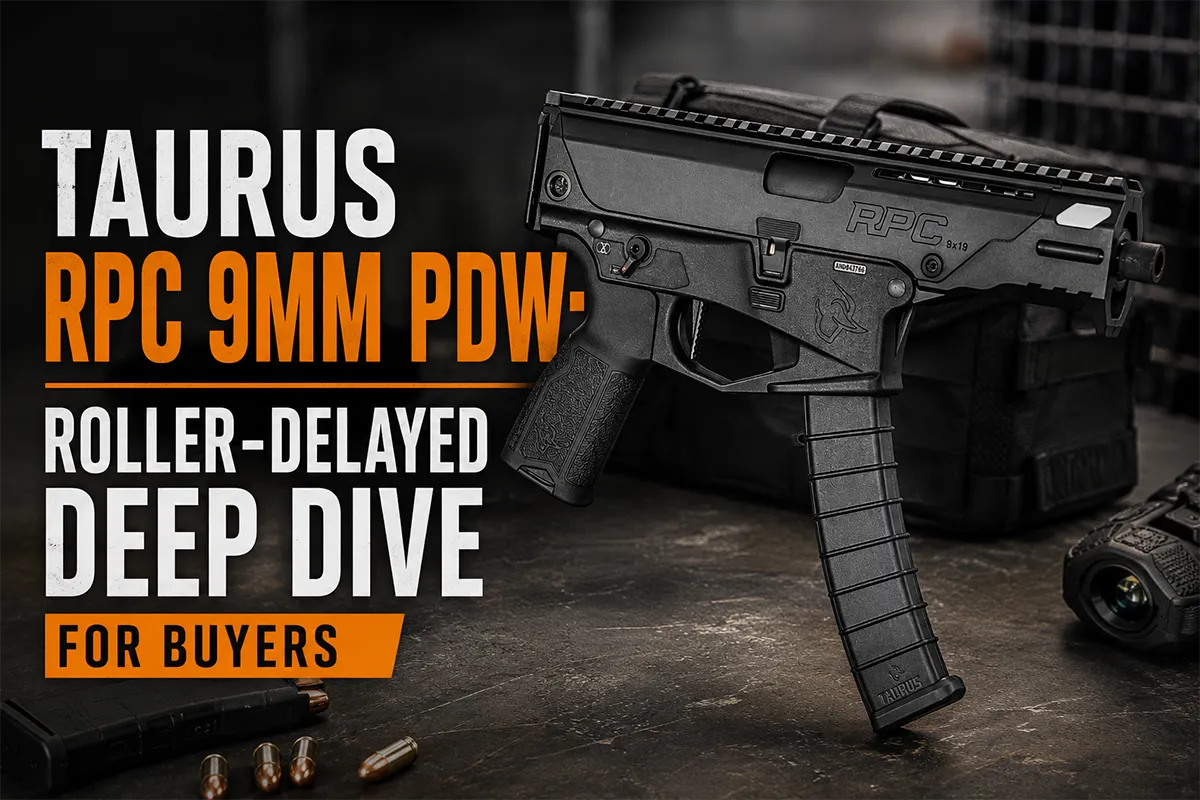
The Taurus RPC 9mm PDW is one of the more interesting compact 9mm launches of the spring. It gives buyers a roller-delayed platform, a very short barrel, ambidextrous controls, and a price point that sits below many premium pistol-caliber carbines.
For GunGenius readers, the useful question is not whether the RPC sounds new. The useful question is whether it solves a real research problem for someone comparing compact 9mm platforms for range use, home-defense research, or a truck-to-range bag setup.
Quick Answer: What Is the Taurus RPC 9mm PDW?
The Taurus RPC is a compact 9mm personal defense weapon style pistol. Taurus says the RPC is its first entry into the dedicated 9mm PDW category, with a roller-delayed operating system, a 4.5-inch threaded barrel, and 32-round magazines.
That matters because most affordable 9mm carbines and large-format pistols use simple blowback actions. Blowback designs can be reliable and inexpensive, but they often need a heavier bolt to control cycling. Roller delay can soften the recoil impulse and help the gun stay flatter under fast strings.
The RPC also lands in a crowded category. It competes for attention with MP5-style clones, the Springfield Kuna, CZ Scorpion variants, Grand Power Stribog models, and AR-style 9mm builds. The Taurus angle is simple: modern controls, compact size, and roller-delayed operation without premium pricing.
Why Roller-Delayed Operation Matters
Roller-delayed operation uses mechanical delay to slow the opening of the action. The shooter usually feels that as less abrupt movement compared with many straight-blowback 9mm platforms. It does not erase recoil, but it can make a compact 9mm easier to track through a red dot.
This is the main reason the RPC is drawing attention. A compact 9mm with a 4.5-inch barrel is easy to make loud and lively. A smoother action helps the platform feel more serious, especially for users who want fast, controlled practice at close and medium indoor range distances.
There is a catch. Roller-delayed systems can be more sensitive to ammunition, suppressor setup, locking geometry, and maintenance. The RPC is new, so long-term reliability data from normal owners is still limited. Early buyers should treat that as an open question, not a deal breaker.
Taurus RPC 9mm PDW Specs That Matter
On April 17, 2026, Taurus USA’s launch announcement listed the core RPC features: 9mm chambering, 32-round capacity, full-length Picatinny top rail, M-LOK handguard, ambidextrous controls, a flat-faced trigger, AR-15 compatible grip, and a quick-change 4.5-inch threaded barrel.
| Platform | Action | Caliber | Barrel/Weight | Capacity | OAL | MSRP/Street |
|---|---|---|---|---|---|---|
| RPC Standard | Roller-delayed semi-auto | 9mm | 4.5 in / about 4.5 lbs | 32-round magazines | About 12.2 in | $939.99 MSRP |
| RPC with Strike Industries brace | Roller-delayed semi-auto | 9mm | 4.5 in / varies by setup | 32-round magazines | Varies folded or extended | $1,098.99 MSRP |
The numbers tell a clear story. The RPC is not a featherweight handgun, and it is not trying to be one. It is a compact 9mm platform that asks the buyer to add an optic, think through sling setup, and decide whether the brace-equipped model fits the intended use.
Where the RPC Fits in the Taurus Line
The RPC is not another compact carry pistol from Taurus. It sits closer to the pistol-caliber carbine world, even though the launch configuration is a large-format pistol. That gives it a different job than a GX4, G3, TX9, or compact defensive handgun.
Readers comparing ordinary semi-auto pistols should view the RPC as a separate tool. It is larger, heavier, and less holster-friendly than a carry pistol. In exchange, it offers more contact points, a longer sighting platform, rail space, and a magazine format built around range and defensive research.
The closest buyer is probably someone who already understands handguns, but wants a compact 9mm that behaves more like a mini carbine. That person may care less about deep concealment and more about controllability, red-dot use, and magazine capacity.
Strengths to Put on the Shortlist
- Control layout: Ambidextrous controls help left-handed shooters and users who practice support-side handling.
- Optics-ready top rail: The full-length rail gives room for a compact red dot and other aiming aids.
- M-LOK handguard: The handguard makes light placement easier without forcing a single factory layout.
- AR-15 compatible grip: A familiar grip angle and aftermarket support can make setup easier.
- Roller delay: The operating system is the headline feature and the main reason to compare it against blowback rivals.
Those strengths line up with current search intent. People are not just asking whether another 9mm exists. They want to know if an affordable roller-delayed option can deliver a calmer shooting experience than a basic blowback PCC.
Tradeoffs and Open Questions
The biggest question is magazine support. The RPC uses 32-round magazines, but buyers should verify availability and pricing before treating the gun as a complete system. A low entry price matters less if spare magazines become hard to find.
The second question is durability over time. Taurus has improved its reputation in recent years, but a new roller-delayed platform needs a track record. Watch for owner reports on feeding, extraction, suppressed use, parts support, and how the quick-change barrel system holds up.
Legal configuration is also part of the research. Brace rules and state restrictions can change, and some setups may be treated differently by jurisdiction. Treat this as a compliance checkpoint before buying, transporting, or changing any configuration.
How to Compare the RPC Against Other 9mm PDWs
- Start with operating system. Compare roller delay, radial delay, and straight blowback.
- Check magazine type. Favor platforms with available spare magazines and clear replacement support.
- Compare optic mounting. Budget for a reliable red dot if the platform does not include useful sights.
- Review parts support. New guns need springs, magazines, small parts, and warranty clarity.
- Handle the controls. A compact PDW only helps if charging, locking, and loading are natural.
This approach keeps the decision grounded. The Taurus RPC 9mm PDW may be a strong value if the action runs well and magazine supply stabilizes. It may be less attractive for buyers who want a mature ecosystem on day one.
Research Checklist Before You Buy
- Confirm the exact SKU, brace configuration, and included magazines.
- Price at least four spare magazines before comparing total cost.
- Look for owner reports with common 115-grain, 124-grain, and defensive 9mm loads.
- Check whether your preferred red dot height works with the stock or brace setup.
- Confirm all federal, state, and local rules for the exact configuration.
- Compare the RPC against at least one mature option, such as an MP5-pattern gun or Stribog.
The RPC is most compelling for buyers who want a compact 9mm research platform with modern controls and a smoother action, but who can tolerate early-adopter uncertainty.
Bottom Line on the Taurus RPC 9mm PDW
The Taurus RPC 9mm PDW deserves attention because it brings roller-delayed operation into a lower-priced compact category. Its 4.5-inch threaded barrel, ambidextrous layout, rail space, and 32-round magazines make it more than a curiosity.
The sensible take is measured. Research it if you want a compact 9mm PDW with modern controls and less blowback-style snap. Wait for more user data if you need proven magazines, a mature parts ecosystem, and long-term suppressed-use reports before committing.