
Straight-Pull Rifles in 2026: Speed, Safety, and Who They’re Really For
January 12, 2026
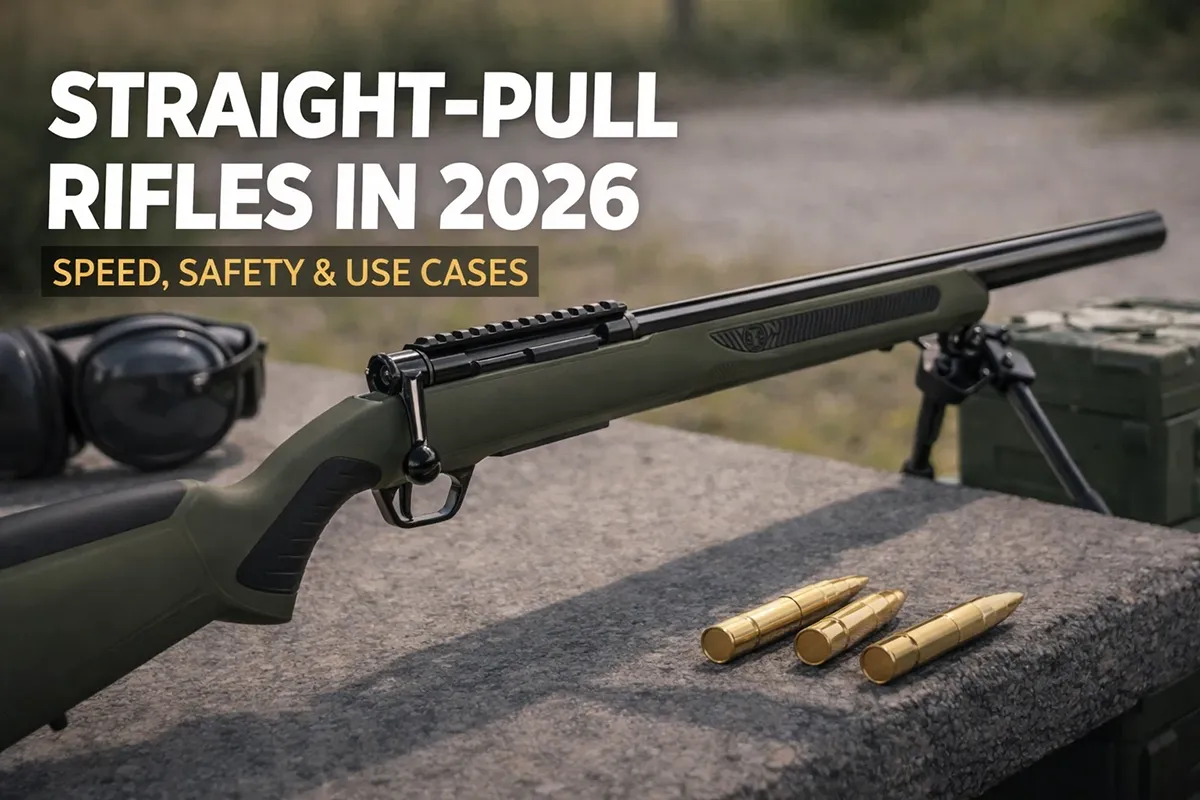
Straight-pull rifles let you cycle the action in one linear motion instead of lift–pull–push–down like a traditional bolt gun. For hunters and practical shooters who value fast follow-up shots without going semi-auto, 2026 offers more viable choices than ever—led by Savage’s U.S.-centric lineup and a few premium European standouts.
On January 12, 2026, we took stock of where straight-pull rifles sit in the U.S. market. The short version: they’re no longer just a Euro curiosity. Straight-pull rifles promise speed and an uninterrupted sight picture, with modern designs emphasizing robust lockup, user-swappable bolt heads, and optic-friendly actions. This deep dive explains what changed, who benefits, and how to compare the current crop to proven turn-bolt hunting rifles.
The Trend: Straight-Pull Rifles Gain Practical Ground
What is a straight-pull? Unlike a traditional bolt action—where you rotate the handle up, pull back, push forward, then rotate down—a straight-pull cycles in a single linear pull and push. The appeal is threefold: faster follow-up shots, less motion that can disturb your sight picture, and a repeatable, glove-friendly stroke. The trade-offs to watch are mechanical complexity, cost, and compatibility with the optics and accessories you actually use.
Why 2026 looks different: U.S.-available options are broader than a few years ago, with models configured for common hunting calibers, threaded muzzles for brakes/suppressors, and drop-in stock and barrel variants that make the platform more “American practical” than “exotic import.” If you want the speed of a straight-pull but prefer the familiarity of a mainstream hunting rifle footprint, the current generation finally hits the mark.
Spec Highlights & Standouts
- Lockup & safety: Modern straight-pulls use strong, multi-lug or collet-style systems to ensure secure lockup. Look for designs that fully enclose the case head, provide clear cocking indicators, and include manual safeties that lock the bolt when desired (handy in brush or when climbing).
- Barrels & threading: Factory threading (most commonly 5/8×24 on .30-cal and up, 1/2×28 on smaller bores) is now typical, making it easy to add a brake or suppressor. Cold-hammer forged or button-rifled barrels with sensible sporter-to-medium contours keep carry weight reasonable while maintaining accuracy.
- Optics readiness: Many straight-pulls ship with optic rails or drilled-and-tapped receivers. Since rapid follow-ups are the point, prioritize stable mounts with steel crossbolts or proven Picatinny rails.
- User-fit ergonomics: Adjustable combs, spacers for length of pull, and vertical-ish grip geometry help you stay behind the glass during the cycle. In plain English: fit often matters more than raw “speed.”
- Parts & support: Choose a brand with U.S. parts availability. That means bolt heads, magazines, extractors, and rails are easy to source—today and five seasons from now.
Comparisons: Straight-Pull vs. Turn-Bolt vs. Semi-Auto
Straight-Pull vs. Turn-Bolt: A well-designed straight-pull feels quicker and smoother under stress, and it lets you keep your head on the stock while cycling. Traditional bolts still win on entry price, enormous aftermarket (stocks, triggers, pre-fit barrels), and proven longevity across thousands of models. Accuracy potential is a wash at realistic hunting round counts; your barrel and ammo choice dominate.
Straight-Pull vs. Semi-Auto: Semi-autos deliver the fastest shot strings and minimal shooter input, but they add weight, length, and gas-system variables (especially with suppressors). Straight-pulls are lighter, simpler to clean, and generally friendlier to “all-weather” neglect. If you hunt in cold, muddy conditions or travel by small bush planes where weight and length matter, that simplicity shines.
Where straight-pulls shine: Driven-style hunting, timber and brush hunts with fleeting shot windows, and any setup where maintaining your sight picture through the cycle is a priority. They’re also a smart pick for hunters who want faster follow-ups without switching to a semi-auto platform.
Notable Models & How to Shop
Start your research with mainstream, U.S.-supported options. For many hunters, that means beginning with Savage’s straight-pull family, then comparing features and support to premium European offerings.
- Savage “straight-pull family” — U.S.-centric calibers, threaded muzzles, and practical trim levels for big game and general-purpose hunting. Highlights to look for: removable bolt heads for caliber families, sensible barrel lengths, and stocks that balance recoil control with field carry.
- Beretta — While better known here for shotguns and pistols, Beretta’s rifle ecosystem and dealer network are worth tracking if you want European fit/finish with stateside support. Keep an eye on modular stocks and hunting-friendly barrel profiles.
As you compare, use our rifle category pages to ground the decision in fundamentals—caliber, barrel length, weight, and overall length—since those drive how a rifle actually carries and recoils. A good starting point is the broader bolt-gun category, which includes straight-pulls alongside traditional turn-bolts: Bolt-Action Rifles.
Straight-Pull Rifles: Cost, Caliber, and Config Decisions
Budgeting: Expect to pay a bit more than an entry-level turn-bolt. You’re buying a more complex action and (often) nicer fit and finish. Put dollars first into barrel quality and a scope that tracks true; a crisp 2–3 lb. trigger is the icing on the cake.
Caliber selection: For general big-game hunting, .308 Win and 6.5 Creedmoor remain the easiest-to-feed choices with broad factory ammo options. If you want flatter trajectories for Western hunts, the 7mm PRC and 6.5 PRC are increasingly common—just confirm magazine length and action stroke play nicely with your chosen cartridge.
Barrel length & threading: Don’t chase velocity that doesn’t help your real shots. For suppressor use, a 20–22″ sporter-to-moderate contour barrels keeps the system compact. If unsuppressed, a 22–24″ barrel provides a touch more speed for PRC-class rounds without turning your rifle into a pike.
Stock & ergonomics: Adjustable combs help keep your eye centered through the cycle—arguably the whole point of a straight-pull. Textured forends and a vertical-ish grip improve control during fast follow-ups, especially from sticks or a pack.
Magazines & feeding: Detachable box magazines are common; verify capacity and how easily spares are sourced. For a dedicated backcountry rifle, a reliable 3–5 round magazine that locks positively is worth more than a higher-capacity option that rattles. (Nothing like chasing springs in the dark to kill a hunt’s vibe.)
What to Watch Next
Expect continued trickle-down of premium features—adjustable stocks, suppressor-ready barrels, robust rails—into mid-price straight-pulls, alongside more chamberings in 6.5/7 PRC and classics like .270 Win and .30-06. Also keep an eye on accessory ecosystems: purpose-built rails, low-profile brakes, and compact suppressors that keep overall length manageable with 20–22″ barrels.
Still deciding between a straight-pull and a traditional bolt? Browse our broader rifle category to weigh specs and trims side-by-side: Rifles. And if you want to stick with proven turn-bolts from familiar names, compare options from Tikka, Sako, Ruger, and Winchester as benchmarks.
Bottom line: Straight-pull rifles deliver real speed and sight-picture benefits without the weight and gas-system complexity of a semi-auto. If fast, confident follow-ups matter to your hunt—and you value a simple field routine—a modern straight-pull is finally a practical, stateside-friendly choice.