
Single-Shot Pistols in 2026: What They’re Good for (and What They Aren’t)
January 19, 2026
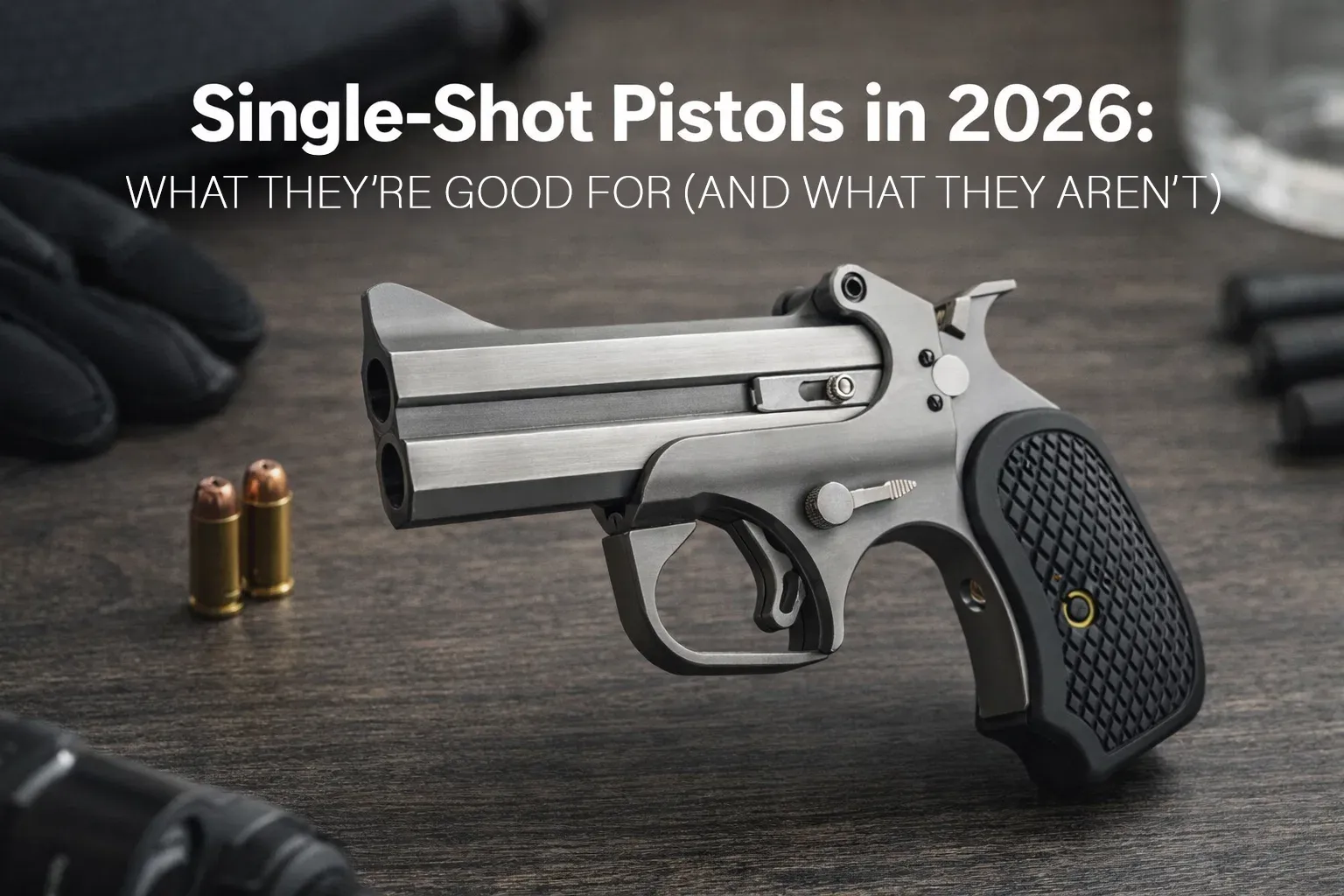
Single-shot pistols are exactly what they sound like: one round at a time, manually reloaded. In 2026, they’re still a niche—but a useful one—if you want ultra-simple operation, compact storage, or a specialized “tool” gun for the field. If you want fast follow-up shots, better sights, and easier practice, a small revolver or compact semi-auto is usually the smarter research lane.
Single-shot pistols don’t show up in most “best carry gun” conversations for a reason. But as a research category, they’re worth understanding—because the people who buy them are often buying for a very specific constraint: minimal size, maximum simplicity, or a weirdly practical task where “one good shot” is the whole plan. (One shot, zero drama—at least until you reload.)
What “single-shot pistols” really means
A single-shot pistol is a handgun that holds one cartridge in the chamber. After firing, you open the action (or otherwise unload), remove the spent casing, load a fresh round, and close it again. No magazine. No cylinder. No “tap-rack” or slide cycling as part of normal operation.
That simplicity can be a feature—especially for owners who value:
- Clear status (many designs make it obvious when the action is open/unloaded)
- Low part count (fewer moving pieces compared to semi-autos)
- Compact storage (some models fold down extremely small)
- Specialized chamberings (certain single-shots are built around niche roles)
If you want to browse what’s currently in the catalog, start here: Single Shot Pistols.
Why people still buy single-shot pistols
Think of this category as “constraint-driven.” Most buyers aren’t choosing a single-shot pistol because it’s the best general handgun. They’re choosing it because it solves a specific problem.
1) Ultra-compact storage and discreet packability
Some single-shot pistols are designed to store flatter or smaller than almost anything else. For certain owners, the priority is “always with me” portability—like a deep-pocket option, a tackle box gun, or a compact emergency piece that lives in a bag (handled and stored safely, and in compliance with local laws).
2) Simple manual operation
There’s no magazine to seat, no slide to run as part of the firing cycle, and no feeding/ejection rhythm to troubleshoot. That doesn’t mean “no malfunctions ever,” but it does mean the user experience is straightforward: load one, close, fire, open, unload, repeat.
3) A “tool gun” mindset for the field
Some owners treat single-shot handguns like a specialized tool for farm/ranch utility, pest control tasks, or occasional field use where shots are deliberate and close-range. In those cases, what matters most is safe handling, consistent ignition, and practical accuracy—not speed.
4) Collector appeal and mechanical novelty
Let’s be honest: a portion of the market simply enjoys oddball designs. Folding pistols and hybrid “hand cannon” formats draw interest because they’re different—and because they’re a conversation starter at the range.
Where single-shot pistols fall short
Single-shot pistols have two baked-in limitations you can’t “train around” completely:
- Follow-up shots are slow. Even with practice, reloading one round at a time is slower than swapping a magazine or rolling a cylinder.
- Practice convenience is lower. More time loading equals less time shooting, and many shooters simply practice less with guns that are tedious to run.
They can also be harder to shoot well than you’d expect. Ultra-compact designs often have short sighting systems and minimal grips. Larger “utility” single-shots may be easier to hold, but can introduce their own quirks (balance, recoil behavior, or how the gun carries).
If your use case includes defensive carry, this is where it’s worth doing honest comparison shopping in more mainstream categories, like Revolvers and Semi Auto Pistols.
What to look for before you buy
When you’re researching a single-shot pistol, focus less on hype and more on a few practical checkpoints.
Action design and loading process
Ask: how do you open it, load it, and close it—under normal conditions? Some designs are intuitive and safe to verify at a glance. Others require more steps or more careful handling. The “best” design is the one you can operate consistently and safely.
Extraction and ejection
With single-shots, a stubborn casing can turn “simple” into “annoying.” Pay attention to how the gun extracts spent cases and whether users report sticky extraction with certain ammo types.
Sights you can actually use
Many compact single-shots have minimal sights. If your use case involves anything beyond very close-range point shooting, prioritize models with usable irons or a practical way to mount an optic. Even better: pick something that doesn’t require proprietary parts to stay functional long-term.
Ergonomics and recoil reality
Small grips and lightweight frames can make even mild calibers feel “snappy.” If you know you won’t enjoy shooting it, you’re less likely to practice—so the best “paper specs” won’t matter much.
Ammo availability and your actual plan
Be realistic about what you’ll feed it. The easiest single-shot pistol to own is the one that runs common, easy-to-find ammunition—and that you’ll actually take to the range.
Two single-shot pistols worth comparing on GunGenius
Rather than treat “single-shot pistol” as one thing, it helps to compare two very different interpretations of the category: a compact folding rimfire and a larger utility-style handgun.
| Model | Category fit | Caliber / type | Capacity | Notable research angle |
|---|---|---|---|---|
| Trailblazer Firearms LifeCard | Ultra-compact folding single-shot | Rimfire (commonly .22 LR variants) | 1 | Extreme portability; “always-with-you” concept |
| Rossi Brawler | Utility-style single-shot handgun | Multi-caliber concept (often .410 bore / .45 Colt variants) | 1 | Larger format; field/utility mindset |
How to use the table: If your goal is maximum compact storage, you’ll naturally gravitate toward the folding-style concept. If your goal is a more traditional grip and “handgun-like” handling, the utility format tends to feel more familiar—even though it’s still a single-shot.
So… who should actually consider single-shot pistols?
- The minimalist collector who wants a novel design and understands the limitations.
- The field-utility user who wants a deliberately fired, occasional-use handgun (and is prioritizing safe handling over speed).
- The “deep concealment” researcher exploring extremes of size and storage—then comparing against small revolvers and micro-semi-autos for practicality.
If you’re primarily shopping for personal protection, your research usually lands in better-performing categories with easier training pathways. That’s not a knock on single-shots—it’s just matching tool to job.
A quick buying checklist
- Can you load/unload it safely and consistently?
- Do you have a realistic practice plan (and will you follow it)?
- Are the sights usable for your expected distances?
- Is the caliber easy to source and affordable enough to shoot?
- Does it fit your storage/carry method safely (case, pocket, bag, etc.)?
When you’re ready to broaden your comparison set, browse the full Handguns catalog and cross-check how single-shots stack up against more common systems.
For more single-shot options and variants, start with the category page: Single Shot Pistols.