
Scout Rifles: 2025 Deep Dive on the Do-Most-Things Carbine
December 4, 2025
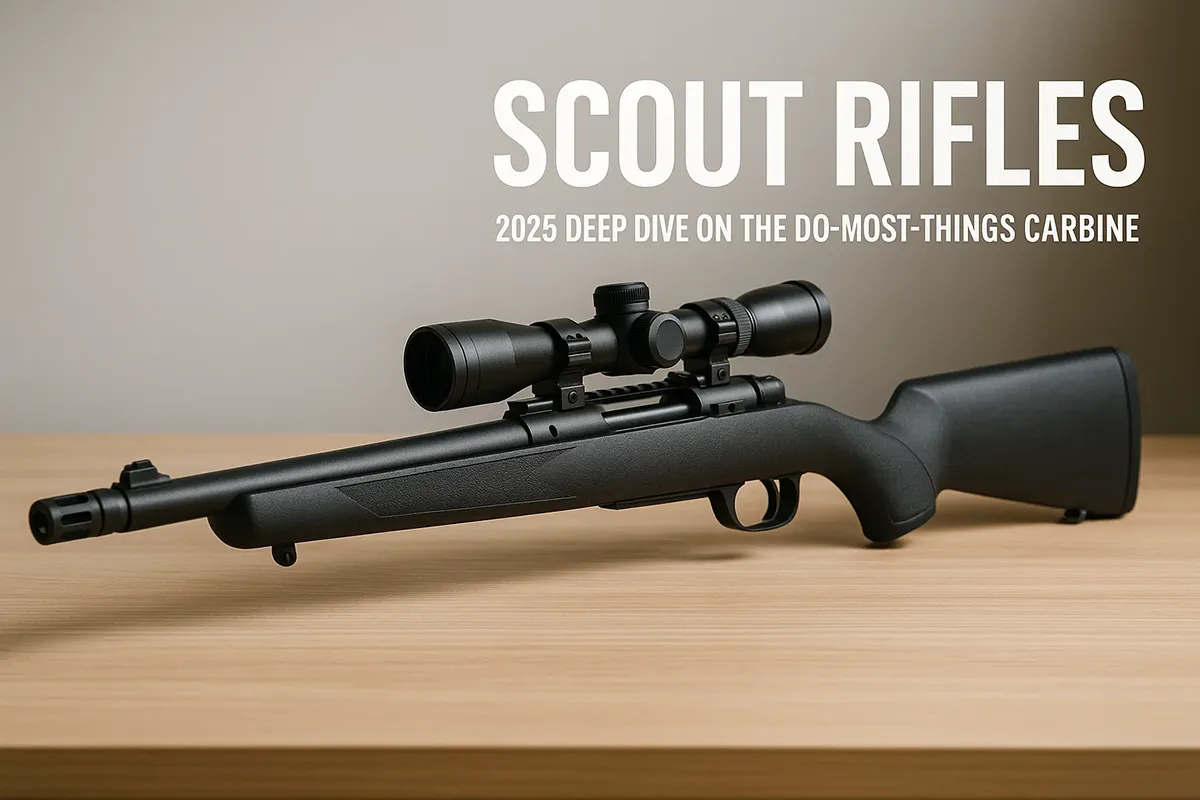
Quick take: In 2025, scout rifles remain the most versatile bolt-action (and scout-ish semi-auto) concept for shooters who want one handy carbine to cover training, practical field work, and general purpose use. This deep dive explains the scout idea, how to choose, and which brands to browse first—plus a spec snapshot to calibrate expectations.
What Is a Scout Rifle—And Why It Still Matters
Born from Jeff Cooper’s “one rifle” vision, the scout rifle emphasizes light weight, compact length, fast handling, and practical accuracy. Typical hallmarks include a 16–20″ barrel, a forward (or conventional) optic option, useful iron sights, a sling that actually works in the field, and a magazine system that balances speed with reliability. In a world of specialized long guns, the scout rifle is the Swiss Army knife—never the absolute best at one niche, but remarkably capable across many.
How to Choose a Scout Rifle in 2025
Caliber & mission. For a true “do-most-things” rifle, .308 Win remains the default for its broad ammo availability and terminal performance. If you’ll shoot more steel than venison, 6.5 Creedmoor offers flatter flight and gentle recoil. For budget and training volume, .223/5.56 scout variants (or “patrol” carbines in a scout format) are easy to live with.
Weight & balance. Target an all-up weight (with optic and sling) under ~8.5 lb if you plan to hike with it. Short barrels feel lively, but don’t discount a correctly profiled ~18″ tube that steadies the sight picture without turning the rifle into a bench queen.
Optics mounting. Traditional scout rails mount a long-eye-relief (LER) scope ahead of the receiver for maximum awareness and fast loading; modern receivers often include a standard Picatinny section over the action, too. Pick the rail scheme that matches your optic plan—LER scopes, low-power variables (LPVOs), or a rugged red dot.
Magazine system. Detachable box magazines speed reloads and administrative handling, while internal magazines keep things trim and simple. If you go detachable, confirm reasonable magazine availability and price. (Your future self will thank you.)
Sights & sling. A scout without iron sights or a field-worthy sling misses the point. Look for adjustable ghost-ring irons and a forend with sling-mounting options that won’t fight your support hand.
Where to Start Browsing
Open our Bolt-Action Rifles category to compare compact, scout-style carbines side-by-side. For semi-auto “scout squad” style rifles (short barrels, practical sights, forward rail options), also scan Semi-Auto Rifles. Brand families with established scout offerings include Ruger (Gunsite Scout lineage), Mossberg (MVP Scout pattern), and Springfield Armory (M1A Scout-style configurations).
Scout Rifles vs. “Short Tactical” Carbines
Not every compact bolt gun is a scout. A heavy, chassis-based 16–18″ rifle with no irons and a long, top-mounted scope is great for precision, less so for snap shots and field carry. The scout ethos prizes practical portability and speed. If you’ll mostly shoot from supported positions at distance, a short precision rig might be better. If you want a rifle that lives comfortably in a truck scabbard, stalks easily through timber, and rings steel from 50 to 400 yards, scout wins.
2025 Feature Checklist (Scout Essentials)
- Barrel: 16–20″, threaded (suppressor/flash hider ready), practical contour.
- Stocks: Adjustable LOP or spacer system; durable synthetic or well-sealed laminate.
- Optics: Forward rail for LER scope or red dot and/or receiver rail for an LPVO; keep mounts low for a natural cheek weld.
- Sights: Real irons—aperture rear + protected front post—co-witness if possible.
- Magazines: Internal 4–5-round for simplicity or detachable AICS/pattern mags for speed; secure, glove-friendly release.
- Sling: Two- or three-point options that don’t conflict with your support-hand grip or bipod stud.
- Controls: Ambi or reversible where possible; quiet, positive safety.
Scout Rifles: Typical Specs (At a Glance)
| Platform | Action | Caliber | Barrel length / Weight | Capacity | Overall length | MSRP / Street |
|---|---|---|---|---|---|---|
| Scout-style bolt gun | Bolt | .308 Win (common); 6.5 CM; .223/5.56 | 16–20″ / ~6.5–7.8 lb | 4–10 (mag dependent) | 36–40″ | $800–$1,500 / varies |
| “Scout squad” semi-auto | Semi-auto | .308 Win; 6.5 CM (limited) | 16–18″ / ~8.0–9.5 lb | 10–20 (mag dependent) | 38–40″ | $1,500–$2,100 / varies |
Optic Setups That Work
LER “true scout” scope (2–7x). Keeps the action clear for single-loading and preserves peripheral vision. Mount as low as possible over the barrel. Great for snap shots and fast dope at modest distances.
LPVO (1–6x/1–8x) on receiver rail. The modern default if your rifle offers conventional mounting. A daylight-bright 1x acts like a red dot; higher magnification lets you spot/troubleshoot hits at range.
Robust red dot. Ultralight, intuitive, and shockingly effective from 25–200 yards with a good zero and consistent holdovers. Pairs well with backup irons; add a flip-to-side magnifier only if it doesn’t wreck your cheek weld.
Ammo Choices for the General-Purpose Rifle
Practice: Pick a load that tracks close to your field round’s point of impact and buy in bulk. For .308 Win, 147–150-gr FMJ is a budget friendly staple. For 6.5 CM, 120–140-gr ball does the trick. Zero with your intended field load and confirm your dope with practice ammo.
Field/utility: .308 shooters can lean on 150–168-gr soft points or all-copper options for deer-size game and general utility. 6.5 CM excels with 120–143-gr controlled-expansion bullets at modest recoil. If you adopt .223/5.56 for its economy, use appropriate bullets (bonded/monolithic) for your target and keep shot distance realistic.
Maintenance & Reliability Notes
Keep it simple. Scout rifles shine when they’re light and uncluttered. Resist bolting on every accessory. Focus on fit (stock length/cheek height), zero (confirmed and logged), and repeatability (torque on action screws and optic mounts).
Mag sanity. If you run detachable mags, mark them and rotate. Most “mystery malfunctions” trace to one misbehaving magazine—retire it early.
Witness marks. After zeroing, paint-pen your optic screws and base. If anything starts to shift under recoil, you’ll catch it before your groups grow.
2025 Quick Picks by Role
- Classic, field-ready bolt gun: Start with compact, iron-sighted offerings on the Bolt-Action Rifles page; prioritize threaded barrels and real sling mounts.
- Magazine commonality: Scout-style rifles that accept common detachable mags simplify logistics and training—browse brand ecosystems like Ruger and Mossberg for AICS or platform-pattern options.
- Scout-ish semi-auto: If you prefer irons plus a forward rail in a semi-auto format, check “scout squad”-type models in Semi-Auto Rifles and compare configurations from Springfield Armory.
Scout Rifles in 2025: Bottom Line
If you want one rifle that’s easy to carry, quick to mount, and accurate enough for most real-world shots, the scout rifle checks the boxes. Keep it light, keep backups (irons and a sensible sling), and choose ammo that fits your mission. The rest is reps—preferably outside, where this platform was meant to live. (Your bench will forgive you.)
Browse compact bolt guns on Bolt-Action Rifles, then compare brand families like Ruger, Mossberg, and Springfield Armory to zero in on the configuration that suits you.