
Ruger 250th Anniversary Series: Why This 2026 Launch Is More About Collectability Than Reinvention
March 30, 2026
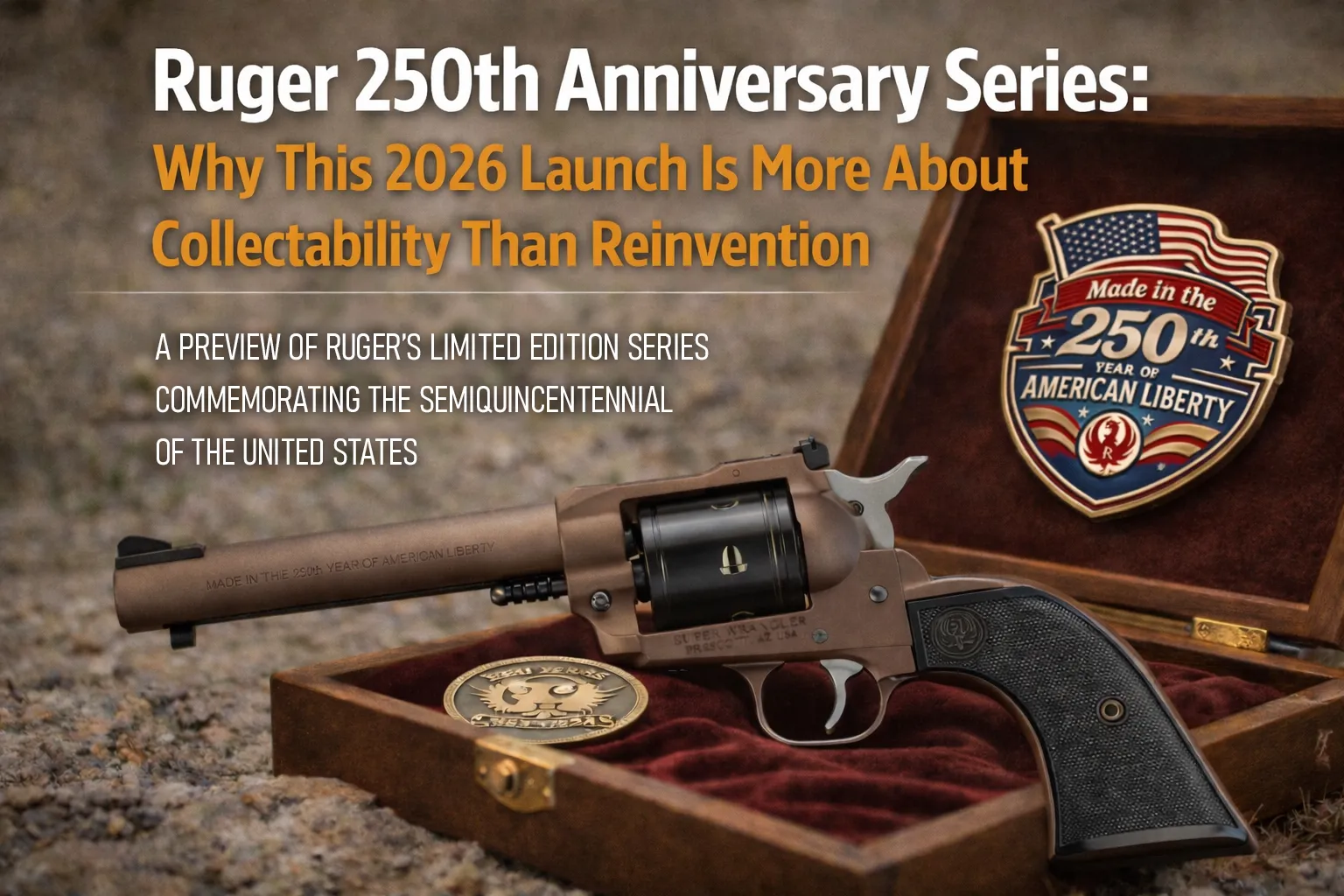
TL;DR: The Ruger 250th Anniversary Series is one of the more interesting firearms stories of late March 2026 because it is not really about a new operating system, a new cartridge, or a breakthrough feature. It is about how a major manufacturer turns familiar, proven models into limited-production commemoratives that appeal to both shooters and collectors without pretending they are entirely new guns.
On March 25, 2026, Ruger announced its 250th Anniversary Series to mark the United States semiquincentennial. The initial lineup spans several of the company’s best-known platforms, including the 10/22 rifle, LCP MAX pistol, Ruger American Gen II rifle, Mark IV 22/45 pistol, Super Wrangler revolver, and a commemorative AR lower. That wide spread is what makes this launch worth covering. Ruger is not chasing one niche buyer here. It is offering a commemorative option across rimfire, centerfire, compact carry, revolver, and rifle categories in one coordinated push.
That also gives the story a different flavor from the usual “new gun” cycle. This is not a pure performance launch. It is a branding and collector play built on models people already know. And honestly, that is what makes it useful to analyze. Buyers do not need help figuring out whether these guns are conceptually new. They need help deciding whether limited-edition markings and commemorative positioning actually add value for the kind of ownership they care about.
For a broader look at where these models sit, you can browse the main firearms category, then narrow into the wider Ruger brand page to compare standard production options against the commemorative angle. If your interest is more rifle-focused, the rifles category is the fastest place to separate collectible curiosity from field-use practicality.
Why the Ruger 250th Anniversary Series Stands Out
The first reason is breadth. A lot of commemorative launches feel narrow or ceremonial, almost like they are aimed at a display case before a holster or range bag. Ruger took a broader approach by using recognizable, established models that already have everyday roles. A 10/22 can still be a training rifle. A Mark IV 22/45 can still be a range pistol. A Ruger American Gen II can still be a practical hunting rifle. The commemorative treatment does not remove the underlying utility of the base platforms.
The second reason is timing. The U.S. 250th anniversary is going to inspire a lot of branded and collectible products across many industries, but firearms manufacturers have a particularly direct way of tying that idea to legacy, domestic production, and recognizable product lines. Ruger clearly understands that this is one of those rare moments when a limited run can feel timely rather than random.
The third reason is familiarity. This launch works because buyers already know these models. Ruger does not need to explain what a 10/22 is, why the Mark IV matters, or where the LCP MAX fits. The company is using platforms with built-in recognition and adding commemorative value on top. That is a much easier sell than asking buyers to learn a brand-new platform and pay a premium for its special-edition finish at the same time.
| Model Family | Type | Practical Role | Commemorative Appeal | Best Fit |
| 10/22 | Rimfire rifle | Training, plinking, small game | High familiarity, broad collector interest | Buyers who want a usable collectible |
| LCP MAX | Compact semi-auto pistol | Carry-size platform research | Limited-edition version of a known seller | Ruger fans who like modern-pocket-pistol relevance |
| Ruger American Gen II | Bolt-action rifle | Hunting and general field use | Adds commemorative angle to a working rifle | Hunters who want novelty without a strange platform |
| Mark IV 22/45 | Rimfire pistol | Range use and rimfire training | Strong crossover between shooters and collectors | Enthusiasts who actually shoot their special editions |
| Super Wrangler | Single-action rimfire revolver | Casual range use and traditional appeal | High visual and thematic fit | Buyers who like heritage-flavored handguns |
| AR Lower | Receiver component | Custom build starting point | Commemorative base for a build project | Builders who want the theme without buying a full rifle |
What Ruger Is Really Selling Here
At one level, Ruger is selling limited-production versions of existing firearms. At another level, it is selling a story about ownership. Commemorative guns occupy a strange middle ground. Some buyers want them as safe queens, meaning firearms kept primarily for collection rather than regular use. Others like the idea of a limited-edition gun that still gets used on the range or in the field. Ruger seems to be aiming at both groups at once.
That strategy makes sense because the company’s chosen models support it. A 10/22 or Mark IV can be shot often without feeling like you are abusing some fragile museum piece. A Ruger American Gen II still makes sense as a practical rifle first. Even the Super Wrangler fits the commemorative mood without becoming too precious to enjoy. In other words, these are collector-themed guns, not untouchable curiosities.
That distinction matters. A commemorative firearm earns more interest when it begins with a platform people already trust. Buyers can understand the product in two layers: the underlying gun and the limited-edition treatment. If they like both layers, the purchase makes sense. If they only like the engraving or the theme, the decision becomes harder to justify unless collecting itself is the primary goal.
Why Some Models in the Series Make More Sense Than Others
The strongest fits in the lineup are probably the 10/22 and the Mark IV 22/45. Both are iconic enough to support a commemorative treatment, and both are practical enough that buyers can still enjoy them as shooters. That is the sweet spot for a limited-edition gun: recognizable, functional, and still fun after the announcement glow wears off.
The Ruger American Gen II is arguably the most interesting choice because it brings the commemorative concept into a working-rifle lane. A lot of collectors might not think first of a bolt-action hunting rifle in an anniversary series, but that is exactly what gives it appeal. It offers a way for a buyer to own a limited-run version of a practical field gun without stepping into a purely decorative product.
The LCP MAX is the hardest one to read. On one hand, it keeps the lineup rooted in a current, commercially relevant pistol family. On the other, compact carry pistols are usually bought for pragmatic reasons, not historical sentiment. That does not make it a bad inclusion. It just means it will likely appeal more to Ruger completists and brand collectors than to someone cross-shopping ordinary carry guns on pure function.
The Super Wrangler may be the cleanest thematic fit of all. Single-action rimfire revolvers already lean into heritage and nostalgia, so a commemorative treatment feels natural instead of forced. The AR lower is also a clever inclusion because it gives builders a lower-cost entry point into the anniversary theme without committing to a full commemorative rifle. That is a smart nod to a different kind of buyer.
Should Buyers Treat These as Collectibles or Shooters?
The honest answer is both, but not equally across the lineup. The rimfire models are the easiest “shoot it and enjoy it” choices because their use cases naturally involve frequent, lower-cost range time. The bolt-action rifle also makes sense as a practical shooter if a buyer genuinely wants that model for hunting or field use. The carry pistol and AR lower are more likely to attract buyers who care about the commemorative aspect first and the practical role second.
This is where expectations matter. Limited-production does not automatically mean instant collector gold. Some commemorative guns hold value well because of timing, platform popularity, or true scarcity. Others mostly hold sentimental appeal for owners who simply like the theme. Buyers should not confuse “special edition” with guaranteed appreciation. That is true in firearms just as it is in every other collecting category that occasionally gets a little too excited about itself.
The better framework is to decide which kind of satisfaction you want. If you want a special Ruger that still gets real use, the rimfires and the Ruger American Gen II are the strongest entries. If you want a limited-edition firearm tied directly to the 250th-anniversary moment, then the commemorative value may be enough on its own. Neither approach is wrong. Problems only start when a buyer expects a sentimental purchase to behave like a flawless investment thesis.
Research Checklist Before Buying a Commemorative Ruger
- Start with the base model. Make sure you actually like the underlying firearm before caring about the anniversary treatment.
- Decide whether this is a shooter or a collectible. That one decision changes how much premium makes sense.
- Compare to standard production versions. A commemorative model is more compelling when the price gap feels reasonable.
- Think about long-term use. Rimfires are easier to enjoy often without overthinking the special-edition aspect.
- Buy the model that fits your habits. A commemorative carry pistol is still a carry-size pistol, and a commemorative hunting rifle is still a hunting rifle.
- Browse the broader lineup first. The wider Ruger catalog may reveal a standard model that fits your needs better than the limited-edition version.
What This Launch Says About 2026
The bigger lesson here is that 2026 will not just be about new platforms and new calibers. It will also be a year when heritage, collectibility, and national-anniversary branding show up more often across the firearms market. Ruger is simply one of the first major brands to make that move in a broad, easy-to-understand way.
That makes the 250th Anniversary Series a useful snapshot of where buyer interest may split this year. Some shoppers will keep chasing pure function and value. Others will look for products that offer a little more narrative, a little more scarcity, and a little more reason to buy something familiar in a fresh package. Ruger is clearly betting that enough customers want both.
For now, that is the right way to read this launch. It is not a technical revolution. It is a carefully timed commemorative collection built on proven firearms that already have strong identities. For the right buyer, that is enough. Browse the wider firearms lineup and compare the standard Ruger offerings before deciding whether the anniversary treatment adds real value for your kind of ownership.