
Red Dot Magnifier vs LPVO in 2026: Which Setup Makes More Sense on Your AR?
March 4, 2026
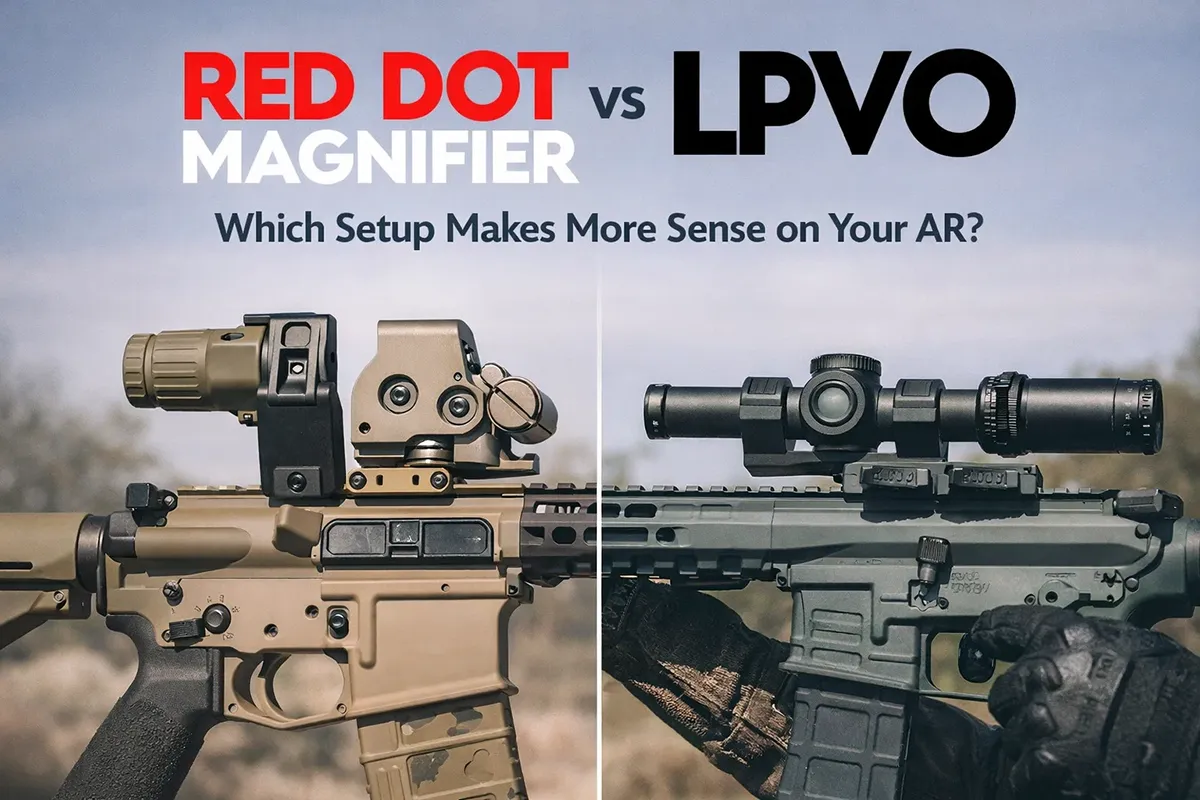
If you’re stuck between a red dot magnifier setup and an LPVO (low-power variable optic) in 2026, you’re not alone. Both are “correct” answers on an AR-style rifle—but they solve different problems. The fastest way to pick is to decide what you value more: speed at true 1x and a simple aiming point, or precision and identification with a reticle that gives you more tools at distance.
This deep dive breaks down real-world tradeoffs: how each system handles close-range work, how they feel from 50–300 yards, what weight and balance do to your rifle, and what to look for so you don’t end up buying the “right optic” in the wrong configuration.
Red Dot Magnifier vs LPVO: The Core Difference (in Plain English)
A red dot magnifier setup is usually a non-magnified red dot paired with a flip-to-side magnifier (often 3x or 6x). You get a fast, bright dot at 1x, and you can add magnification only when you need it.
An LPVO is a variable-power scope that typically runs from about 1x up to 4x, 6x, 8x, or higher depending on the model. You get a reticle with holds and reference marks, and you can “dial” magnification as distance or target size changes.
Think of it like this:
- Red dot + magnifier: “Fast first, zoom when needed.”
- LPVO: “Precision tools always available, even at 1x.”
Who Each Setup Fits Best
Most buyers get better results when they match the optic to the rifle’s job instead of trying to build a mythical “one optic does everything perfectly” gun.
Choose a Red Dot + Magnifier if you prioritize:
- Fast close-range shooting (inside 25–50 yards) with minimal visual clutter.
- Simple aiming under stress: “put dot on target, press.”
- Quick transitions between targets.
- Passive use with night vision (for those who train that way), where a true 1x dot can be friendlier than a scope.
- Modularity: You can remove the magnifier and keep the rifle light.
Choose an LPVO if you prioritize:
- Target identification and better visual information at distance.
- Reticle-based holds for elevation/wind or quick references.
- Precision on small targets (steel plates, varmints, tight groups) from 100–400 yards.
- One optic doing the whole job without flipping anything to the side.
If your AR is mostly a “50–200 yard” rifle with occasional closer drills, both can work. The real tie-breaker is whether you want reticle utility (LPVO) or always-ready speed (dot).
The Big Tradeoffs That Actually Show Up on the Range
1) True 1x feel and “both eyes open” shooting
Red dots are the gold standard for uncomplicated 1x shooting. Most people find them easier for quick snapshots, awkward positions, and movement.
LPVOs can be excellent at 1x, but they’re still scopes. Eye position matters more, and some users experience a slightly “scope-like” feeling that’s slower if their cheek weld or head position is inconsistent—especially in rushed or improvised positions.
2) Precision and holds from 100–300 yards
LPVOs usually win here. Even at moderate magnification, a good reticle can help you call shots, hold for drop, and aim at smaller features without guessing. A red dot with magnifier can absolutely hit at 200–300, but the dot can cover more of the target, and you typically have fewer built-in reference points.
3) Speed when switching “near” to “far”
With a dot + magnifier, you physically flip magnification in or out. That can be very fast—especially if your shooting is mostly 1x and you only occasionally need zoom.
With an LPVO, you twist a magnification ring. That can also be fast, but it depends on your throw lever (if used), your practice, and how often you need to change magnification during a drill.
4) Weight, balance, and “top-heavy” rifles
Either option can add noticeable weight up high on the gun. LPVOs often bring more total weight once you include a sturdy mount. Dot + magnifier can be surprisingly hefty too, especially with robust mounts on both pieces.
The practical takeaway: if your rifle already feels front-heavy (long handguard, weapon light, suppressor-ready muzzle device, etc.), be careful adding a heavy optic package. A rifle you don’t enjoy handling is a rifle you won’t train with as much.
Quick Spec Table: What to Compare When Shopping
| Setup | Type | Magnification | Reticle | Weight | Length | Mount | MSRP |
|---|---|---|---|---|---|---|---|
| Red dot + magnifier | Reflex + flip magnifier | 1x + (3x/6x typical) | Dot (holds vary) | Varies by SKU | Varies by SKU | Two mounts (often) | Varies widely |
| LPVO | Variable optic | 1–4x / 1–6x / 1–8x typical | BDC/MOA/MIL options | Varies by SKU | Varies by SKU | One mount | Varies widely |
Tip: When specs vary by model, focus on the “system weight” (optic + mount(s)), eye relief, and how the controls work for your hands. Those are the details you feel every single rep.
Compatibility Notes: Mount Height, Eye Relief, and Rail Space
Optics are “bolt-on,” but how you mount them changes everything.
- Mount height: A taller mount can feel more comfortable for many shooters (especially with modern, more upright head positions), but it may change cheek weld consistency. Pick a height you can repeat.
- Eye relief and head position (LPVO): If your stock position varies, a scope can punish you with slower sight acquisition. If you’re new to LPVOs, choose forgiving eye relief and practice mounting the rifle the same way every time.
- Rail space (dot + magnifier): Two separate optics demand room. If your AR has a short upper receiver rail or you’re running backup sights, plan your layout so nothing fights for space.
- Offset sights/offset dot: Some LPVO users add an offset red dot for close work. It’s effective, but it adds cost, complexity, and more “stuff” on the rifle.
If you’re still selecting the host rifle, start with the category page for semi-auto rifles and narrow to AR-pattern models that give you the rail space and ergonomics you want before you obsess over optic selection.
Practical Scenarios: Which One Wins?
Home-defense / close-range training carbine
In many cases, a red dot (with or without magnifier) is the simpler, faster answer. If your realistic distances are “room to yard,” you’ll likely live at 1x almost all the time. A magnifier becomes optional: nice for checking details at distance, not required for the rifle to be effective.
General-purpose AR that sees 50–300 yards regularly
This is where the debate gets real. If your shooting includes smaller targets, tighter groups, or you want to learn holds without dialing turrets, an LPVO often feels like a cheat code (in a good way). If your shooting is more “practical carbine” with lots of movement and fast target transitions, dot + magnifier keeps life simple.
Hunting and field use
LPVOs are commonly favored for field identification and shot placement, especially when targets are partially obscured or small. That said, for thick woods and very close distances, a red dot can be extremely fast. Your environment should decide this one.
Good Research Anchors: Start With a Known AR Platform
If you try to pick an optic in a vacuum, everything sounds good and nothing feels certain. A better approach is to choose (or at least anchor) your research to a common AR-style rifle and build from there.
For example, browsing the Daniel Defense catalog can give you a consistent “baseline” for modern AR ergonomics and rail setups. Once you have that baseline, it’s easier to decide whether you want the simplicity of a dot + magnifier or the reticle utility of an LPVO.
If you want a concrete model to anchor comparisons, a common reference point is a mid-length, general-purpose AR like a Daniel Defense DDM4 V7. The goal isn’t to declare it the only answer—it’s to have one known configuration so you can compare optic choices apples-to-apples.
Research Checklist: Make the Decision in 5 Minutes (Then Shop Smarter)
- What distance do you actually shoot most? If it’s mostly close, lean dot. If it’s often 100–300, lean LPVO.
- Do you want reticle holds? If yes, LPVO becomes more attractive fast.
- How important is true 1x speed? If it’s your priority, dot wins.
- Can you commit to practice? LPVOs reward consistent mounting and reps on the magnification ring.
- What’s your weight tolerance? Compare total system weight (optic + mount(s)).
- Do you need modularity? Dot + magnifier lets you remove the magnifier and keep the gun lighter.
Once you answer those, the “internet argument” fades away and the choice becomes obvious for your use. And that’s the point: the best setup is the one you’ll train with, carry (if applicable), and run confidently when it counts.