
Pump Action Shotgun in 2026: A Practical Home-Defense and Field-Use Buyer’s Guide
February 10, 2026
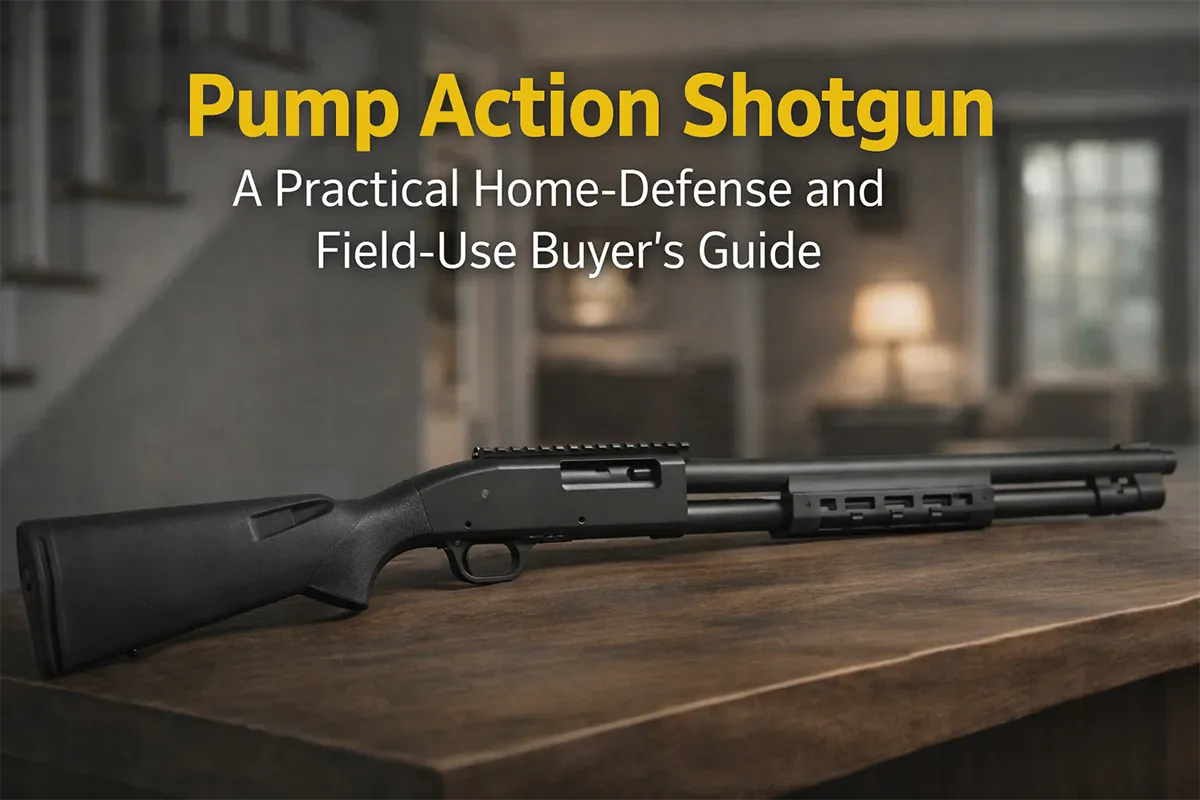
A pump action shotgun is still one of the most researched “do a lot with one long gun” options in 2026. People choose pumps for three big reasons: they’re simple to understand, they can be very reliable across a wide range of loads, and they offer tons of configuration options—from basic field guns to purpose-built defensive setups. The trick is choosing the right pump for your actual role, not the one that looks coolest in a product photo.
This guide breaks down what matters (barrel length, controls, and reliability), what to avoid (over-accessorizing, poor fit), and how to build a research checklist that leads to a shotgun you’ll practice with. To compare models broadly, start at pump action shotguns and sort by intended use.
What a pump action shotgun does best
Pumps are manually cycled: you fire, then rack the forend to eject the spent shell and load the next. That manual action is the platform’s superpower. It means a pump can often run loads that some semi-autos may struggle with—very light target shells, odd specialty loads, and everything in between—because you provide the cycling energy.
Pumps also excel at role flexibility. With the right barrel and choke setup (a choke is a constriction at the muzzle that shapes the shot pattern), a pump can go from clays to birds to deer-season slug duty. For home defense research, the pump’s strengths are simplicity, load flexibility, and a long history of proven models with deep parts and accessory support.
The biggest decision: defensive shotgun, field shotgun, or “one that does both”
Most buying regret happens when someone tries to force one shotgun into two roles without acknowledging the tradeoffs.
- Defensive-focused pump: Typically shorter barrel, faster handling, and set up for a sling and a white light. Often trades some swing smoothness for quick maneuvering.
- Field-focused pump: Typically longer barrel, designed to swing smoothly for birds/clays, often with interchangeable chokes.
- “Do both” compromise: Usually a field gun with a second barrel, or a configuration that leans one direction but can be adapted.
If home defense is a primary driver, prioritize handling, a dependable sighting setup, and practical mounting options for a light. If field use is primary, prioritize barrel/choke compatibility and a stock fit that supports quick, consistent mounting.
Fit and recoil: why stock shape matters more than brand
Shotguns are uniquely sensitive to fit. A poor-fitting stock can make recoil feel sharper and make it harder to mount the gun consistently. Two terms to know:
- Length of pull (LOP): Distance from trigger to buttpad. Too long and the gun feels clumsy; too short and you may feel cramped.
- Comb height: Where your cheek rests. If it doesn’t align your eye naturally with the sights, you’ll fight the gun.
For defensive use, a stock that lets you mount the gun quickly and consistently is the goal. For field use, fit is still crucial, but comfort over long days and smooth pointing often matter most. If you can shoulder a model before deciding, do it. If you can’t, prioritize common platforms with readily available stock options and broad support.
Barrel length, capacity, and controls: the practical spec triad
| Spec | Why it matters | Typical defensive preference | Typical field preference |
|---|---|---|---|
| Barrel length | Handling vs swing smoothness | Shorter for maneuvering | Longer for birds/clays |
| Capacity | How many shells onboard | More is helpful, but not everything | Usually less important |
| Controls | Safety and action release placement | Must be easy under stress | Must be intuitive with gloves |
One reality check: “more capacity” isn’t automatically better if it makes the gun front-heavy or harder to cycle smoothly. Balance matters because it affects how the shotgun mounts, tracks, and returns after recoil.
Accessories for a defensive pump: keep it boring and functional
If you’re setting up a pump for home defense, you don’t need a pile of add-ons. You need a small number of things that improve identification and control.
- White light: If you’re using a shotgun defensively, a quality light helps you identify what you’re aiming at. This is a safety issue, not a “tactic.”
- Sling (optional): A sling helps manage the long gun if you need your hands briefly.
- Sights: Simple bead sights work, but many people prefer more defined sights for slug use and confident aiming.
What to be cautious about: excessive side saddles and heavy furniture that turn the gun into a front-heavy project. A pump shotgun should cycle smoothly and mount naturally. If accessories compromise that, they’re not upgrades.
Reliability: the pump’s advantage (and the user’s responsibility)
Pumps are often reliable, but they’re not “automatic.” The most common pump-induced malfunction is user short-stroking—failing to rack the action fully to the rear and fully forward. The fix is not a gadget; it’s practice with deliberate, consistent cycling. If you’re new to pumps, this is the skill that matters most.
For research purposes, prioritize models with a long service history and robust parts availability. A pump is a lifetime tool when support is strong and the platform is common.
Common pump action shotgun short list: how to compare the classics
These are widely researched because they cover the major “pump personalities”: hard-use defensive builds, general-purpose field guns, and value-forward options. Compare exact variants—many have multiple trims and barrel packages.
Mossberg 590A1: hard-use defensive orientation
The 590A1 is commonly researched as a dedicated defensive pump. People who want a rugged, duty-leaning shotgun often start here, especially if they want a platform that feels built for hard handling. It’s usually not the lightest option, but many like the “tool gun” vibe.
Explore: Mossberg
Mossberg 500: the flexible “one shotgun” template
The Mossberg 500 family is popular because it spans field and defensive configurations, often with barrel packages that let you cover multiple roles. If you want one pump that can reasonably do a lot (and you value broad support), this is a common starting point.
Explore: Mossberg
Remington 870: iconic platform with huge ecosystem
The Remington 870 is one of the most well-known pumps ever, and the reason is simple: it’s been everywhere, for a long time. Many buyers research it for parts availability and familiarity. The key is to compare specific versions and intended roles, because the “870 experience” can vary by configuration and era.
Explore: Remington
Winchester SXP and Benelli Nova: value and field-first ergonomics
If your priority is a field gun that can still serve as a home-defense long gun with the right setup, models like the Winchester SXP and Benelli Nova often get attention. They’re commonly cross-shopped by people who want a practical pump for hunting and clays first, with defensive capability as a secondary role.
Explore: Winchester • Benelli
Research checklist: pick the right pump action shotgun the first time
- Primary role: defensive, field, or truly mixed?
- Fit: does the stock mount naturally, and can you reach the controls easily?
- Barrel plan: one barrel, or a package with options?
- Recoil plan: are you choosing a load you’ll actually practice with?
- Light plan (defensive use): does the platform support a clean, sturdy mount?
- Support: how common are parts, barrels, and accessories for your chosen model?
- Practice reality: will you train consistent cycling to avoid short-stroking?
If you answer those questions honestly, you’ll end up with a pump that fits your life instead of a pump you’re constantly trying to “fix.” Pumps don’t need to be complicated—just well chosen and well practiced.