
M-LOK Handguards in 2026: How to Choose the Right AR-15 Rail
January 29, 2026
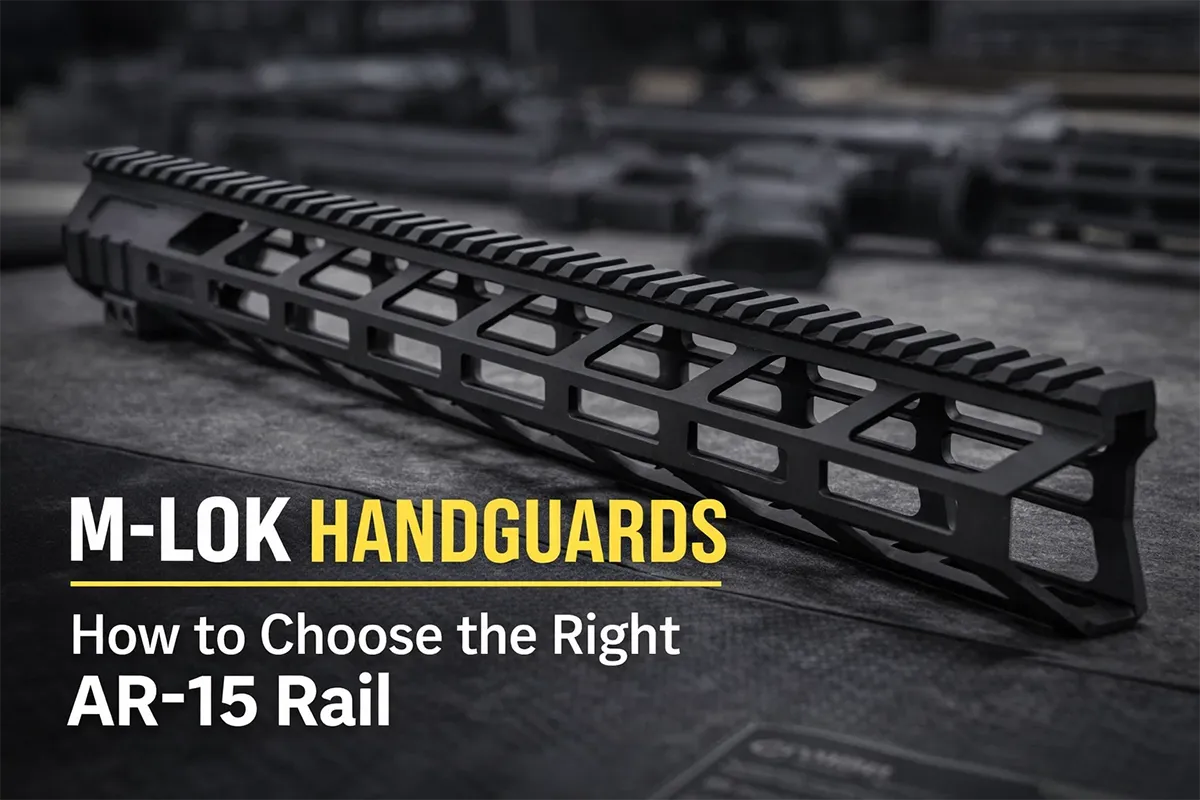
If you’re shopping M-LOK handguards in 2026, you’re usually trying to solve one of three problems: (1) you want a steadier, more comfortable grip than plastic drop-in guards, (2) you want smarter accessory placement without turning your rifle into a cheese grater, or (3) you want a clean path to a lighter, more “modern” setup without guessing which parts play nicely together. This deep dive breaks down what actually matters—rail length, attachment standards, heat management, fitment, and real-world tradeoffs—so you can research the right rail the first time.
One quick note: A handguard is the forend you hold, and on many modern rifles it also provides attachment points for lights, grips, bipods, and sling mounts. “Free-float” means the handguard doesn’t touch the barrel, which can help consistency and usually gives you more mounting space.
The 2026 Trend: Why M-LOK Handguards Keep Winning
M-LOK (Modular Lock) has become the default “do-most-things” mounting system on modern semi-auto rifles because it’s low-profile, widely supported, and easy to configure without covering every inch of the gun in Picatinny rail. In plain terms: you can mount what you need where you need it—then leave everything else smooth, lighter, and easier on the hands.
That doesn’t mean Picatinny is “dead.” A full-length top Picatinny rail is still the standard for optics, and some shooters still prefer quad rails for hard-use setups or for maximum mounting at any angle. The practical 2026 answer is usually a hybrid: M-LOK on the sides and bottom, with Picatinny on top.
Mounting Standards, Plain-English: M-LOK vs Picatinny vs KeyMod
| Accessory | Compatibility | Materials | Weight | Dimensions | Features | MSRP |
| M-LOK handguard | AR-pattern rifles (varies by SKU) | Usually aluminum; some polymer | Varies by SKU (often “mid”) | Varies by SKU (7–15″+ common) | Low-profile slots; add rails only where needed | Varies by SKU |
| Picatinny quad rail | AR-pattern rifles (varies by SKU) | Usually aluminum | Varies by SKU (often “higher”) | Varies by SKU | Maximum rail everywhere; great indexing, more bulk | Varies by SKU |
| KeyMod handguard | AR-pattern rifles (varies by SKU) | Usually aluminum | Varies by SKU | Varies by SKU | Older slot standard; accessories less common than M-LOK | Varies by SKU |
Bottom line: If you want the easiest accessory ecosystem and the smoothest “carry/handle” feel, M-LOK is usually the safest bet. If you want the most mounting “real estate” with the fewest add-on pieces, a quad rail still does that job—just expect more bulk and a harsher feel unless you cover it.
What Actually Matters When Picking a Handguard
1) Length: Don’t buy “as long as possible” by default
Handguard length should match how you shoot and what you mount. Longer rails give you more grip space and accessory spacing (especially for a light and sling), but they also add length and sometimes weight out front.
- 7–9 inches: Compact builds and short barrels; easy handling, less reach.
- 10–13 inches: The “most people” zone for 14.5–16″ rifles; plenty of room without feeling like a canoe paddle.
- 14–15+ inches: Great for a modern support-hand grip, bipods, and maximum accessory spacing—just confirm it won’t interfere with your muzzle device or intended setup.
2) Free-float vs drop-in: Know what you’re buying
Drop-in handguards typically use the rifle’s standard front cap and delta ring setup. They’re simple and often cheaper, but they limit options and usually don’t give you the same rigidity.
Free-float handguards attach to a barrel nut and don’t contact the barrel. They’re the standard on many modern rifles because they’re rigid, provide more mounting space, and often improve consistency (especially with a sling or bipod). The tradeoff is fitment complexity—if you’re unsure, it’s smart to have a qualified armorer or gunsmith handle installation.
3) Heat management: The part everyone forgets—until they don’t
Handguards get hot during extended strings of fire. Slim M-LOK rails feel great in the hand, but “slim” can also mean less insulation. If you do longer range sessions or fast drills, pay attention to:
- Diameter: Slimmer is faster to grip; slightly larger can be easier to hold when hot.
- Ventilation: More vents can help airflow, but also expose more heat.
- Material and texture: Some rails have built-in texture; others need covers or grip panels for comfort.
There’s no magic here: if you shoot hard, plan for heat. If you shoot casually or hunt, prioritize comfort, weight, and how it carries.
4) Accessory placement: Build around the “light + sling” reality
Most practical rifles end up with two accessories: a weapon light and a sling. Everything else is optional. A good M-LOK setup makes it easy to mount those without awkward reach or shadowing.
- Light: Far enough forward to reduce barrel shadow, but not so far you can’t activate it reliably.
- Sling: Mount points that don’t fight your support hand or block your light.
- Grip/Barricade stop: Helpful for control, but don’t buy one to “fix” a rail that’s the wrong length.
5) Fitment and compatibility: The “quiet” dealbreakers
Handguards are not one-size-fits-all, even within “AR-style” rifles. Before you buy, confirm:
- Receiver height/profile: Some rails match certain upper receiver rail heights better than others.
- Gas system clearance: Especially with low-profile gas blocks and longer rails.
- Barrel nut system: Many free-float rails use proprietary barrel nuts.
- Anti-rotation features: Helpful for keeping rails aligned under hard use.
If you’re researching complete rifles instead of parts, this is simpler: compare factory configurations and pick a rifle that already has the handguard style you want.
Real-World Examples: How Modern Rifles Use M-LOK (and Why)
To make this concrete, here are a few modern semi-auto rifles that illustrate common handguard approaches. Use these as “patterns,” not prescriptions.
- Daniel Defense DDM4 V7 — A classic example of a modern free-float rail concept: long, light, and built around M-LOK utility for accessories.
- Springfield SAINT — Often configured with a lightweight M-LOK handguard that keeps the rifle handy for general-purpose use.
- Barrett REC7 DI — A premium-style rifle format where M-LOK supports practical add-ons without turning the rifle into a full-time rail sculpture.
- LWRC DI (example listing) — Shows another common theme: free-float rail space, ambi-friendly controls, and a “ready to configure” forend.
If you want to compare more rifles that commonly ship with modern rails, start in the Semi Auto Rifles category, then filter by the features you actually care about (rail length, weight, and accessory mounting options).
Choosing for Your Use Case
General-purpose range + home-ready setup
A mid-length free-float M-LOK rail (often in that 10–13″ neighborhood on a 16″ rifle) is the sweet spot. It gives you room for a light and sling mount without making the rifle feel front-heavy.
Hunting and field carry
Prioritize comfort, snag-free surfaces, and manageable weight. M-LOK is a strong fit here because you can mount a sling point and (optionally) a bipod adapter while keeping everything else smooth.
“Hard use” training and high accessory demand
If you truly need lots of mounting at multiple angles—or you’re running specific legacy accessories—quad rails or heavier-duty hybrid rails may still make sense. Just be honest: many shooters like the idea of “all the rail,” but end up only using two attachment points.
Research Checklist: Don’t Click “Buy” Until You Can Answer These
- Is this M-LOK handguard a drop-in or free-float design?
- What length do I actually need for my grip and my light/sling placement?
- Does it fit my rifle’s receiver and gas system (or is it already factory-installed on a complete rifle)?
- Do I care more about slim feel or heat comfort during longer sessions?
- Am I buying rail space for accessories I’ll actually mount—or for vibes?
What to Watch Next
In 2026, the most useful “next step” isn’t a brand-new rail standard—it’s smarter integration: lighter rails that stay comfortable under heat, better accessory mounting hardware that doesn’t loosen up, and more factory rifles shipping in the “already right” configuration (meaning you don’t have to swap parts immediately).
If you’re still undecided, zoom out and compare complete rifles first. It’s often cheaper (and less annoying) to buy the rifle that already matches your intended rail length and layout than to buy a rifle you plan to “fix” later.
Browse related models on Semi Auto Rifles, then narrow by the brands you trust and the features you’ll actually use.