
EAA Blue Label Combo: 20 vs 28 Gauge Buyer Checks
October 16, 2026
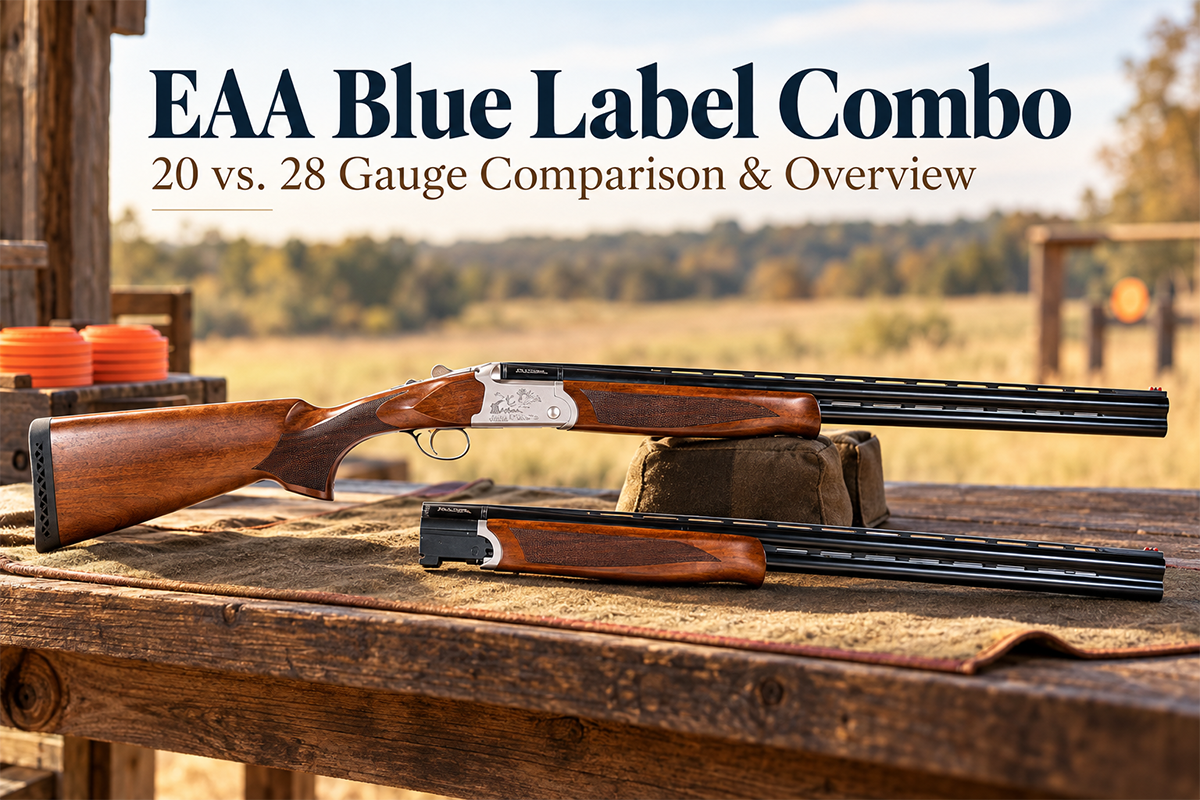
The EAA Blue Label Combo puts 20- and 28-gauge barrel sets on one over-under shotgun. That sounds like a simple way to cover clays and upland hunting with one stock. The useful question is whether the second gauge earns its cost and storage space. This guide separates EAA’s confirmed equipment from the fit, ammunition, and handling checks that still require hands-on research.
On October 12, EAA highlighted the Combo alongside two compact .410 versions in its NASGW Expo preview. The Combo is a different package from the short-barreled Blue Label Youth model. EAA’s current Blue Label product page lists two fitted walnut forends, two 26-inch barrel sets, and ten Mobil-pattern choke tubes in the Combo package.
What comes with the EAA Blue Label Combo?
The package pairs one receiver and stock with a 20-gauge barrel set and a 28-gauge barrel set. Each barrel set has its own fitted forend and five choke tubes. The listed chokes are skeet, improved cylinder, modified, improved modified, and full. Both barrel sets are 26 inches long. EAA lists 3-inch chambers for the Blue Label line, but confirm the marking on each barrel before choosing shells.
Blue Label features include a walnut stock, engraved aluminum receiver, fiber-optic front sight, extractor, and manual safety with barrel selector. An extractor lifts spent shells when the action opens; it does not throw them clear. These shared features help define the platform. They do not establish the Combo’s exact weight, stock dimensions, or current price, which should be checked by SKU.
| Package | Gauge and barrels | Included equipment | Best research question |
|---|---|---|---|
| Blue Label Combo | 20 and 28 gauge; two 26-inch sets | Two fitted forends; five chokes per gauge | Will both gauges see regular use? |
| Standard Blue Label | Single gauge; barrel length varies by model | Check the exact SKU and choke set | Is one gauge enough? |
| Blue Label Compact | .410 bore; 18.5- or 20-inch barrels | Adjustable length-of-pull kit | Does a short stock solve a fit problem? |
Those rows describe separate configurations, not interchangeable loose barrels. EAA describes the Combo as a fitted set. Do not assume a barrel bought from another Blue Label will fit a different receiver. Ask EAA or a qualified gunsmith about any replacement parts. The Combo’s appeal is its factory-matched package, not an open-ended barrel system.
20 gauge vs 28 gauge: what changes?
Gauge describes bore size, not a fixed recoil level or a guaranteed pattern. The 20-gauge barrel set offers a broad range of common target and field loads. The 28-gauge set offers a smaller bore that many upland shooters enjoy for its feel and challenge. Actual recoil depends on shell payload, velocity, gun weight, fit, and how the firearm is mounted. Compare specific loads instead of relying on gauge alone.
The two barrel sets also may balance differently on the same receiver. EAA has not published a separate weight and balance point for each Combo configuration on the product page. That matters because a gun that feels lively in one setup can feel less steady in another. If possible, shoulder both configurations with the firearm unloaded and under store or range supervision.
Ammunition access can decide the issue before handling does. Check local shelves for 20- and 28-gauge target loads, then compare the cost per box. A second gauge has little practical value if it rarely leaves its case. Hunters should also check their permitted shot materials, seasons, and local rules before choosing field ammunition.
Where can the Combo make sense?
An upland hunter who already uses both gauges may appreciate one familiar stock and trigger across two barrel sets. A recreational clay shooter might use the 20 gauge for frequent practice and reserve the 28 for occasional sub-gauge events. The exact event rules matter: some leagues specify gauge limits, and some require more than a barrel change. Check the rulebook before counting on eligibility.
The shared stock can also be a limitation. A stock that fits one shooter poorly will not improve when the barrels change. Length of pull is the distance from the trigger to the center of the buttpad. Comb height, cast, grip reach, and the shooter’s clothing also affect how the gun mounts. The factory Combo is not the short-stock Compact model. Do not buy it as a youth-fit solution without measuring the actual gun.
Compare it with a single-gauge over-under shotgun if one set would cover nearly every trip. Buyers can also browse the EAA brand page to see which Blue Label listings are available for research. The dedicated two-gauge package makes the strongest case when its owner already has a clear use for both sets.
What does the second barrel set add to ownership?
Two gauges mean two shell inventories. Keep boxes clearly separated and verify the chamber marking before each range or field session. A 20-gauge shell can lodge in a larger 12-gauge bore, creating a severe obstruction hazard if another shell is fired behind it. The Combo itself pairs 20 and 28 gauge, but a household with several shotguns needs a consistent ammunition-sorting habit.
Two fitted forends and ten choke tubes also create more small parts to track. Confirm that the case or storage plan protects both barrel sets and keeps their matching forends identified. Check that each choke is the correct gauge and approved for the chosen shot material. Use the owner’s manual and qualified service help for fit or condition concerns; never force a part that resists normal assembly.
Plan for the total package cost. Ask for the Combo’s current SKU, price, warranty terms, and included case details. Then compare that figure with a standard 20-gauge Blue Label and a separate 28-gauge option. EAA’s older single-gauge prices do not establish today’s Combo price. A listing that shows one barrel set may be a standard model even if its title uses the word “combo.”
How does it differ from the Blue Label Compact?
EAA lists Compact .410 models with 18.5- or 20-inch barrels and an adjustable length-of-pull kit. They address a shorter shooter’s reach and support needs. The EAA Blue Label Combo instead uses two 26-inch barrel sets in different gauges. Its design solves a flexibility question for someone who wants both 20 and 28 gauge. It does not automatically provide the Compact’s shorter stock or lighter front end.
The site’s earlier Blue Label Youth article covers the 18.5-inch .410 version in depth. Read that angle if physical fit is the main problem. For a shooter who already fits a standard stock, the Combo’s second barrel set is the more relevant distinction. The decision should start with the person and intended activity, then move to the catalog specification.
EAA Blue Label Combo research checklist
- Confirm the listing includes both 20- and 28-gauge 26-inch barrel sets.
- Verify two fitted walnut forends and ten choke tubes, five for each gauge.
- Read the gauge and chamber markings on both barrel sets.
- Check the exact SKU, current price, warranty, and storage case contents.
- Shoulder the unloaded gun in both configurations to compare fit and balance.
- Compare local ammunition cost and availability for both gauges.
- Ask whether your clay events permit each gauge and configuration.
- Inspect the receiver, ribs, wood fit, and included parts with qualified staff.
Keep the EAA Blue Label Combo on the shortlist if both gauges match real plans and one stock fits consistently. Choose a single-gauge model if most shooting will use one shell type. Choose the Compact only when its shorter dimensions meet a verified fit need. Whatever the choice, arrange qualified instruction, eye and ear protection, and secure storage before the first outing.