
Browning A5 20 Gauge Camo: Buyer Fit and Waterfowl Checks
July 14, 2026
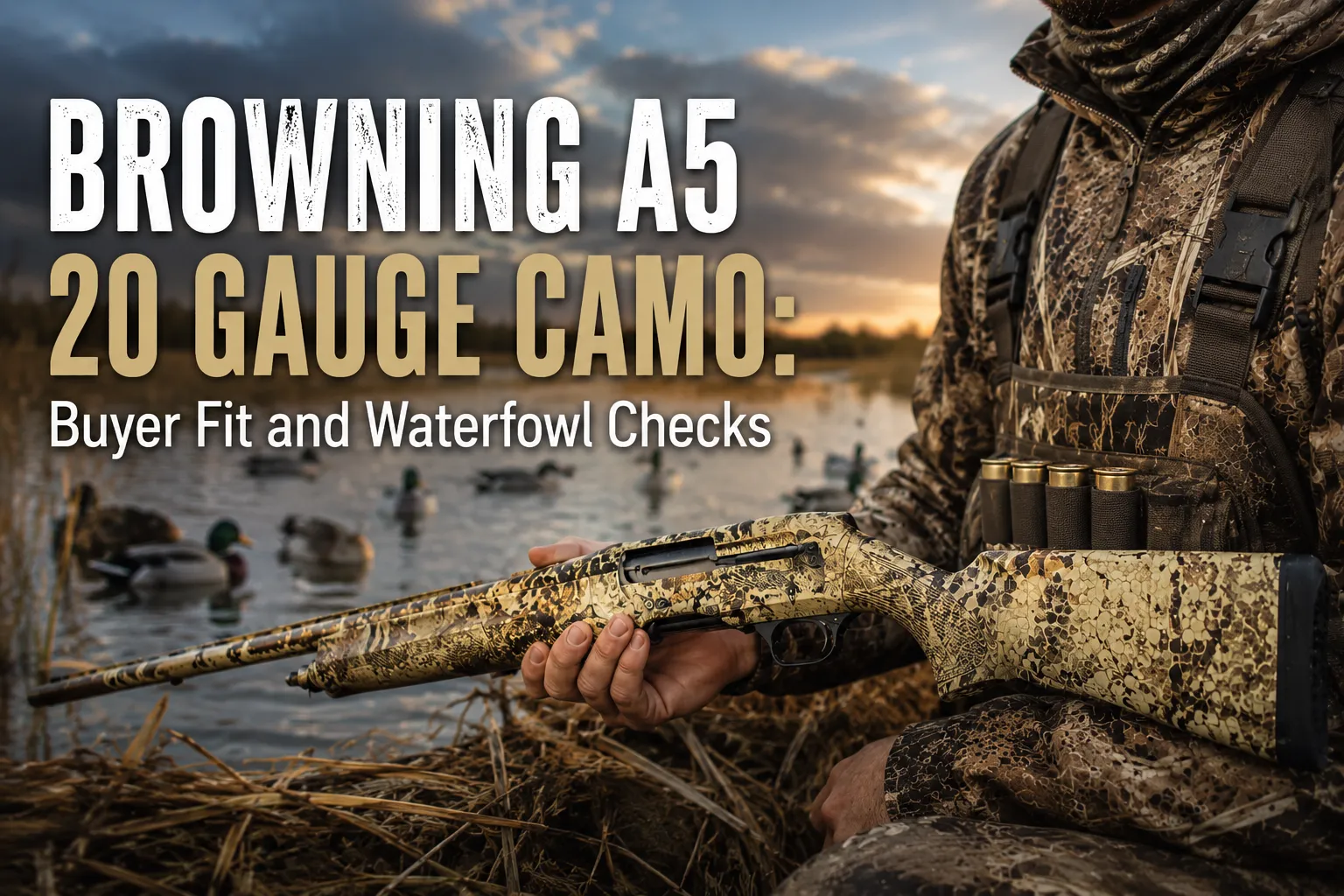
The Browning A5 20 Gauge Camo gives waterfowl hunters a lighter sub-gauge option with the familiar humpback profile, full camo coverage, and an inertia-style operating system. The practical question is simple: does this 20 gauge make sense for your blind, marsh, and field routine, or should you stay with a 12 gauge semi-auto?
The short answer is that it fits hunters who value carry weight, fast handling, and modern non-toxic 20 gauge loads. It is less ideal if you want the broadest payload range or already know heavy 12 gauge loads are central to your season.
Browning A5 20 Gauge Camo Buyer Checks
Start with the platform. Browning lists the A5 Camo 20 Gauge as a lightweight autoloading 20 gauge shotgun ready for waterfowl hunting, with a compact receiver, full camo coverage, and the recoil-operated Kinematic Drive System. That puts it in a different lane from gas guns such as many soft-shooting semi-auto shotguns.
The A5 20 Gauge Camo is not trying to be a budget field gun. It is a premium sub-gauge waterfowl shotgun for hunters who want less bulk and a weather-minded finish. If that sounds narrow, that is the point. A good buyer fit here depends on how you hunt, not just what looks good in a product photo.
| Model | Action | Gauge | Barrel/Weight | Capacity | Fit Features | Best Fit |
|---|---|---|---|---|---|---|
| A5 Camo 20 Gauge | Recoil-operated semi-auto | 20 gauge, 3-inch chamber | 26 or 28 inches / about 5 lb 13 oz to 5 lb 14 oz | 4+1 with 2 3/4-inch shells | Shim-adjustable stock, spacers, Invector-DS chokes | Mobile waterfowl, upland crossover, sub-gauge hunters |
Why the 20 Gauge Waterfowl Angle Matters
Interest in sub-gauge hunting keeps growing because modern ammunition gives hunters more options than older 20 gauge assumptions allowed. A 20 gauge still does not turn into a 12 gauge, but it can be enough for many close-to-moderate waterfowl setups when paired with the right legal loads and realistic range expectations.
The benefit is handling. A lighter gun is easier to carry through mud, cattails, timber, and long field walks. It can also mount quickly for hunters who prefer a lively swing. The tradeoff is that lighter guns can feel sharper with stout loads, especially when compared with heavier gas-operated shotguns.
Where the Browning A5 Fits
The Browning A5 line appeals to hunters who like simple recoil operation, easy field handling, and Browning’s modern take on the classic humpback sight picture. The new camo 20 gauge package adds a more specialized role: a trim autoloader for hunters who move more than they sit.
That makes the Browning A5 20 Gauge Camo a reasonable research target for teal, wood ducks, jump shooting, early-season marsh work, and mixed days where upland birds may also be in the plan. For late-season geese or big open-water spreads, many hunters will still prefer the payload flexibility of a 12 gauge.
Fit, Camo, and Barrel Length Questions
Fit should come before finish. Browning says the A5 20 Gauge Camo is adjustable for length of pull, cast, and drop, with stock spacers included. Those details matter because a shotgun that points naturally is easier to evaluate than one that forces the shooter to adapt every mount.
Barrel length is the next choice. A 26-inch barrel usually feels quicker in tight cover and in layout blinds. A 28-inch barrel can feel steadier for crossing birds and more deliberate swings. Neither choice is automatically better. The better option is the one that matches your hunting spaces and body mechanics.
Camo is partly practical and partly preference. Browning lists several patterns, including Browning Auric, Vintage Tan, Mossy Oak Shadow Grass Habitat, Mossy Oak Bottomland, and Realtree Max-7. Pick based on where you hunt most often. Timber, flooded fields, cattails, and dry grass do not hide the same way.
A5 20 Gauge vs 12 Gauge Semi-Auto Shotguns
The 12 gauge still wins on payload range, widespread shell selection, and all-around waterfowl flexibility. If you want one shotgun for nearly every duck and goose scenario, that remains a strong argument. A 20 gauge asks for more discipline in setup, load choice, and shot selection.
The 20 gauge wins when weight and handling matter more. Smaller-framed hunters may find it easier to mount. Experienced hunters may simply like the fast feel. Newer hunters should shoulder both gauges before deciding, because a light 20 gauge that does not fit can be less comfortable than a well-fit 12 gauge.
Do not buy a sub-gauge waterfowl shotgun because it is trendy. Buy it because the fit, weight, and range limits match how you actually hunt.
Research Checklist Before You Compare Listings
- Shoulder the 26-inch and 28-inch versions if possible, then note which one aligns faster.
- Confirm the camo pattern fits your normal terrain, not just your favorite catalog photo.
- Check whether your preferred non-toxic 20 gauge loads are easy to find locally.
- Compare total carry weight after sling, shells, choke tube, and blind accessories are included.
- Review the included choke tubes and decide if you need anything else for your common ranges.
- Compare the Browning brand page on GunGenius at /brands/browning with the broader shotgun category before narrowing your list.
Also compare service support, parts availability, and used-market confidence. A premium hunting shotgun is not a one-season purchase. It should be easy to understand, maintain, and evaluate years later. That matters when you are choosing between a new A5 and another proven semi-auto.
Listing Checks That Matter
When you compare listings, match the SKU to the finish and barrel length first. Browning’s camo family includes several close variants. A photo alone is not enough. Confirm the chamber, barrel length, choke tubes, spacers, manual, and condition notes.
Ask whether the box includes the original choke wrench and stock adjustment parts. Those small pieces affect fit and resale confidence. If you are looking at a used Browning A5 20 Gauge Camo, check finish wear around the receiver, magazine cap, sling points, and stock edges.
Round out your research with ammunition availability. A 20 gauge waterfowl plan depends on legal non-toxic loads you can actually buy. Pattern testing should happen after purchase at a safe range. Before purchase, focus on fit, included parts, and whether the gun matches your real hunting conditions.
Who Should Research the Browning A5 20 Gauge Camo?
Research this shotgun if you already like the Browning A5 platform, want a lighter waterfowl-ready autoloader, and can live inside the practical limits of a 3-inch 20 gauge. It also makes sense for hunters who split time between ducks, upland birds, and general field carry.
Skip it, or at least compare carefully, if your hunting is mostly late-season geese, long open-water shots, or heavy 12 gauge loads. In those cases, a bigger gun may be the simpler tool. The Browning A5 20 Gauge Camo is best viewed as a specialized fit choice, not a replacement for every 12 gauge in the safe.
For GunGenius research, the smart path is to compare this A5 against other semi-auto waterfowl shotguns by fit, operating system, chamber, barrel length, and load availability. If the shotgun shoulders well and your real hunting ranges match a 20 gauge, it deserves a serious look.