
Bolt Action Rifle for Deer Hunting: How to Pick the Right Caliber, Barrel Length, and Scope
March 26, 2026
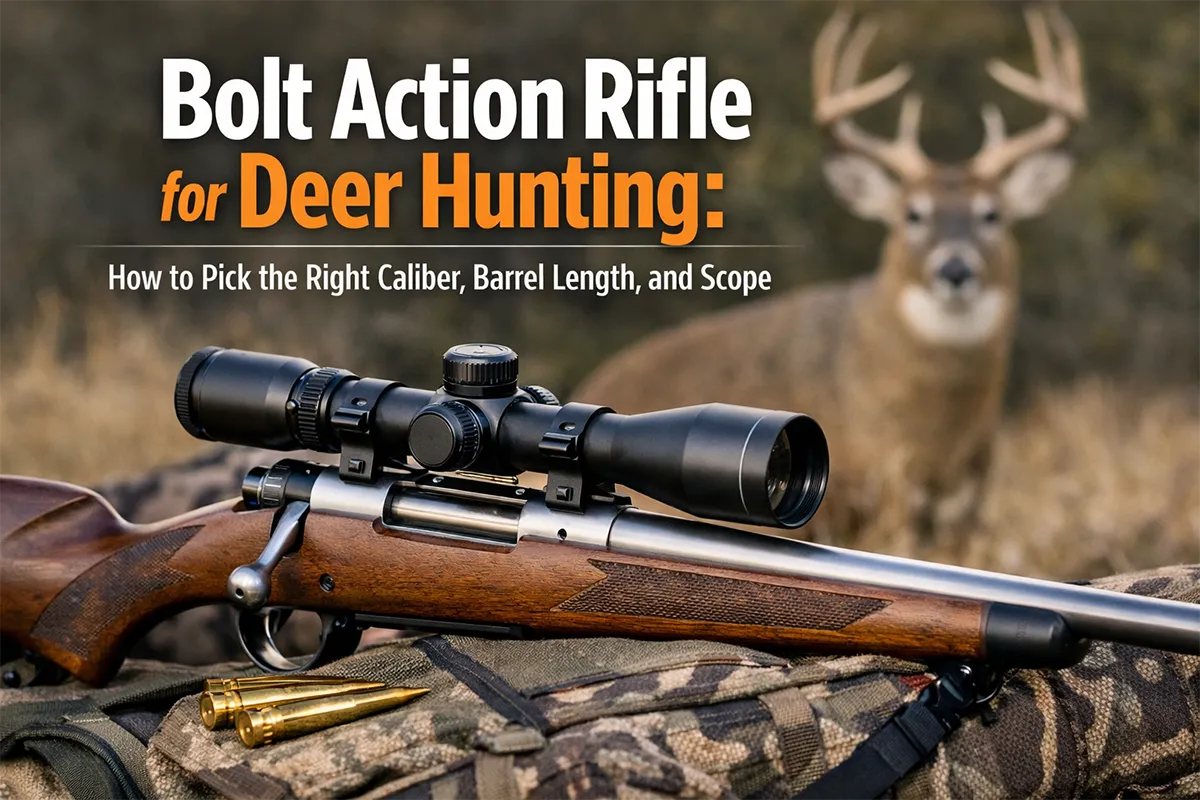
TL;DR: A bolt action rifle for deer hunting is still the easiest all-around choice for most hunters because it balances accuracy, reliability, manageable weight, and simple operation. The smartest setup usually comes down to matching caliber, barrel length, stock material, and optic choice to the terrain you actually hunt.
If you are researching your first deer rifle, or replacing an older one, the bolt gun remains the default answer for a reason. It is simple to operate, easy to maintain, and available in a huge range of chamberings and price points. It also avoids a common shopping mistake: buying more rifle than your hunting style really needs. A deer rifle should be practical first. That means enough power for clean kills, enough accuracy for the distances you expect, and a shape and weight you will not hate after a long morning in the woods.
The good news is that most hunters do not need an exotic setup. They need a rifle that fits, a cartridge they will practice with, and a sighting system they can use well in ordinary field conditions. That narrows the field quickly. If you want to browse the category before drilling into brands, start with bolt action rifles. If you are already comparing makers, pages like Bergara, Savage, Tikka, and Weatherby are a useful next stop.
Why a Bolt Action Rifle for Deer Hunting Still Makes Sense
A bolt action uses a manually operated bolt to chamber and extract cartridges. In plain English, that means fewer moving parts than many semi-autos, a strong lockup, and a design that has built a reputation for reliability over generations. It is also one of the easiest rifle types to understand, which matters when the shot opportunity is short and your brain is busy doing everything except staying calm.
For deer hunting, bolt guns hit a practical sweet spot. They are commonly lighter than many chassis-style precision rifles, more accuracy-focused than lever guns and many slug guns, and available in calibers that cover everything from compact woods hunting to longer field-edge shots. They also tend to offer good aftermarket support for optics, sling studs, stocks, and triggers, though the best choice is often the rifle that needs the fewest upgrades in the first place.
That last point matters. Plenty of buyers start with a modest rifle, then spend enough on accessories to buy a better rifle in the first place. Deer season has a way of exposing bad financial planning with great clarity. A sound base rifle with a decent optic is usually the better move than a bargain rifle buried under expensive add-ons.
Start With Caliber, Not With the Catalog Photo
Caliber should be your first major decision because it affects recoil, ammunition cost, practical range, and your confidence behind the rifle. For most deer hunters, the center of the conversation stays around .243 Winchester, 6.5 Creedmoor, .270 Winchester, .308 Winchester, and .30-06 Springfield. All of them are established deer cartridges. The better question is which one best fits your likely distances and tolerance for recoil.
.243 Winchester is often a good option for recoil-sensitive shooters who still want a legitimate deer cartridge. It can work very well with proper loads and careful shot placement, but many hunters prefer stepping up to something with a little more margin. 6.5 Creedmoor has become popular because it offers mild-to-moderate recoil, good accuracy potential, and solid downrange performance. It is a very reasonable choice for hunters who want a modern all-around deer cartridge without jumping into heavier recoil.
.270 Winchester remains a classic answer for open country and mixed terrain. It shoots flat enough for longer shots while keeping recoil manageable for many shooters. .308 Winchester is the practical workhorse of the group. It is widely available, proven on deer, and works well across many rifle sizes. .30-06 Springfield still does nearly everything, but for many ordinary deer hunters it is more cartridge than necessary unless they also want a broader big-game role.
| Platform | Action | Caliber | Barrel/Weight | Capacity | OAL | MSRP/Street |
| General-purpose deer rifle | Bolt action | 6.5 Creedmoor | Usually 20-24 in.; weight varies by SKU | Varies by SKU | Varies by SKU | Varies by SKU |
| Traditional all-around deer rifle | Bolt action | .308 Win. | Usually 20-22 in.; weight varies by SKU | Varies by SKU | Varies by SKU | Varies by SKU |
| Longer-range field deer rifle | Bolt action | .270 Win. | Usually 22-24 in.; weight varies by SKU | Varies by SKU | Varies by SKU | Varies by SKU |
| Low-recoil entry deer rifle | Bolt action | .243 Win. | Usually 20-22 in.; weight varies by SKU | Varies by SKU | Varies by SKU | Varies by SKU |
The simplest advice is this: choose 6.5 Creedmoor or .308 Winchester if you want the broadest blend of shootability and usefulness. Choose .270 Winchester if you expect more open-country hunting. Choose .243 Winchester if recoil control is the top priority and you are committed to good shot placement and appropriate hunting loads.
Barrel Length and Weight Matter in the Real World
Barrel length affects handling more than many first-time buyers expect. A 22-inch barrel often feels like the sweet spot on a deer rifle because it balances well, keeps velocity respectable, and still carries comfortably in a blind, truck, or stand. A 20-inch barrel can be even handier in timber and thick cover, especially if you value compact handling over squeezing out every bit of velocity.
Longer barrels can make sense for more open hunting country or for cartridges that traditionally benefit from added length, but there is a tradeoff. A rifle that feels excellent on a bench can feel awkward after a few hours of walking, climbing, or sitting in a cramped blind. For many deer hunters, an overly heavy rifle is a bigger day-to-day problem than a small loss in ballistic performance.
That is why field weight matters just as much as cartridge choice. Ultralight rifles are attractive on paper, but they can be less forgiving to shoot, especially with sharper recoil. Very heavy rifles are stable, but they can turn a pleasant morning into unpaid farm labor. In practical terms, a balanced hunting rifle in the ordinary sporter range usually makes the most sense for deer.
Pick the Right Scope, Not the Biggest One
A deer rifle scope should make field shooting easier, not transform the rifle into a rooftop observatory. For most hunters, a compact variable like a 2-7x, 3-9x, or 2.5-10x is plenty. These magnification ranges cover close woods shots while still giving enough detail for careful placement at normal deer distances. Bigger scopes add bulk, can sit higher over the bore, and often solve problems most deer hunters do not actually have.
Low-light performance matters more than extreme magnification. Clear glass, a usable reticle, and a scope mounted at a sensible height usually matter more than chasing the largest objective lens in the store. A rifle that shoulders naturally and gives you a fast, consistent sight picture is almost always the better hunting setup.
This is also where brand selection becomes practical rather than theoretical. A rifle from Tikka may appeal to buyers who want a smooth bolt and refined feel. Savage often draws value-minded hunters who care about accuracy and straightforward utility. Bergara is frequently considered by buyers who want a slightly more premium feel without jumping into fully custom territory. Weatherby can be appealing for hunters who want classic sporting-rifle styling with modern hunting intent.
Synthetic or Wood Stock?
This choice is less about romance versus practicality than many people think. Wood stocks can look excellent and feel traditional, and a good walnut deer rifle is hard to dislike. But synthetic stocks usually win on weather resistance, lower maintenance, and rough-use practicality. If you hunt in wet, cold, muddy conditions, synthetic often makes the smarter tool choice. If you value classic looks and hunt in milder conditions, wood still has plenty of appeal.
The only wrong answer is buying with your eyes alone. A pretty rifle that makes you nervous in bad weather is not necessarily the best hunting companion. A plain synthetic rifle that fits well and shrugs off abuse may end up being the one that gets used every season.
Research Checklist Before You Buy
- Confirm your real shot distances. Most deer rifles are bought for the hunt you imagine, not the one you actually have.
- Be honest about recoil. Confidence and follow-through matter more than chest-thumping caliber choices.
- Check overall carry weight. Rifle, scope, sling, and loaded magazine add up quickly.
- Think about terrain. Thick woods, farm country, and mountain hunting reward different balances of weight and barrel length.
- Choose your optic before buying mounts. A low, sensible setup is better than stacking parts later.
- Decide whether weather resistance matters. Blue steel and walnut are handsome; rain is not sentimental.
The Smartest Setup for Most Deer Hunters
For a large share of hunters, the smartest bolt action rifle for deer hunting is a balanced synthetic-stock rifle with a 20- to 22-inch barrel, chambered in 6.5 Creedmoor or .308 Winchester, topped with a simple 3-9x scope. That recipe works because it stays portable, easy to shoot, and versatile across common deer terrain. It is not flashy, but deer rarely award style points.
That said, the best rifle is still the one that matches your body, your terrain, and your shooting habits. Browse more bolt action rifles, then compare makers like Bergara, Savage, and Tikka before narrowing to a final shortlist. A practical rifle you shoot well is almost always the right answer.