
Bergara Premier Competition Elite: Specs and Buyer Checks
October 9, 2026
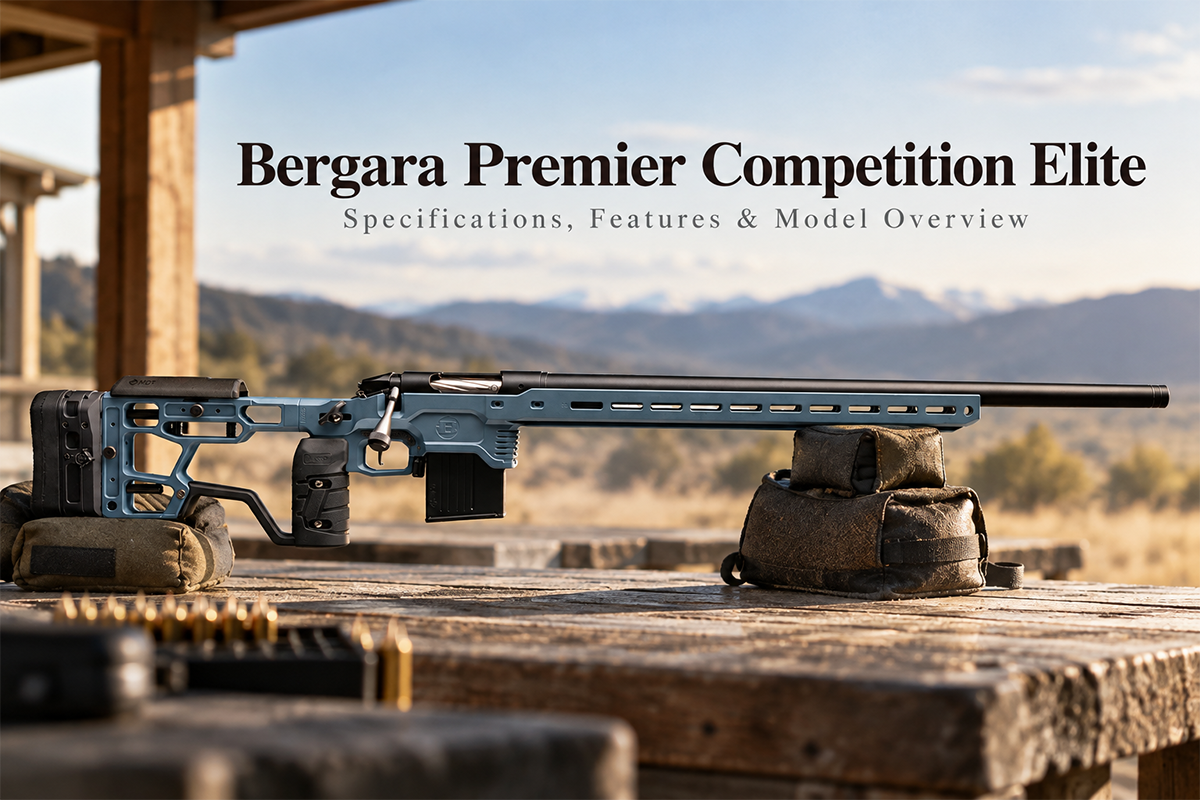
The Bergara Premier Competition Elite is a factory bolt-action rifle built for PRS-style matches. It combines a Premier action, a 26-inch heavy barrel, an MDT ACC Elite chassis, and a TriggerTech Special trigger. That package addresses a common problem for new competitors: assembling compatible match parts without turning the first season into a build project.
Bergara lists seven chamberings, a starting weight of 13.5 pounds, and a starting MSRP of $2,999. This guide explains what those numbers mean, where the rifle saves setup work, and which checks matter before choosing a configuration.
The main value is integration. Buyers get a competition-oriented barreled action, chassis, trigger, rail, and magazine in one supported factory package.
Bergara Premier Competition Elite specifications
The official Bergara product page lists a stainless steel No. 7 taper barrel, Graphite Black Cerakote finish, and AICS-pattern detachable magazine. Every listed configuration uses a 26-inch barrel and a 12-round magazine. Overall length is 46.5 inches, while twist rate changes with the chambering.
| Platform | Action | Caliber | Barrel/Weight | Capacity | OAL | MSRP/Street |
|---|---|---|---|---|---|---|
| Competition rifle | Bolt action | 22 Creedmoor, 25 Creedmoor, 6mm Dasher, 6mm GT, 6mm Creedmoor, 6.5mm Creedmoor, .308 Win. | 26 in. No. 7 stainless / 13.5 lb starting weight | 12 rounds | 46.5 in. | $2,999 starting MSRP / street price not established |
The listed weight is a starting figure, not a finished match setup. An optic, mount, bipod, muzzle device, data board, and added chassis weights can move the total much higher. That is useful for recoil control and positional stability, but it also affects transport and stage movement.
What the factory package includes
The MDT ACC Elite chassis is the center of the package. Its full-length ARCA forend allows fast fore-and-aft bipod or tripod adjustment. A tunable weight system lets the shooter change balance as accessories are added. Adjustable ergonomics help align length of pull, cheek height, and grip position with the shooter.
The chassis also provides M-LOK attachment points and competition-focused support surfaces. Those details matter when a stage moves between barricades, bags, tripods, and prone positions. They reduce the need to replace the stock before the rifle is match-ready.
Bergara pairs the chassis with a TriggerTech Special single-stage trigger. Its pull is adjustable, so buyers can tune it within the maker’s supported range. A 12-round MDT magazine provides enough capacity for common ten-shot stages while leaving a small reserve.
The No. 7 contour barrel is another competition choice. More steel adds thermal stability and helps the rifle remain balanced through repeated strings. The tradeoff is mass. A shooter seeking a dual-purpose hunting rifle will likely find a lighter profile easier to carry.
Which caliber fits your match plan?
The chambering list covers both established cartridges and more specialized competition choices. Selection should start with ammunition access, recoil goals, barrel-life expectations, and local match distances. Cartridge popularity alone does not settle the decision.
- 6.5mm Creedmoor: A practical entry point for shooters who value broad factory-ammunition access and a versatile training cartridge.
- 6mm Creedmoor: A flatter, lower-recoil match option with more factory support than several specialized competition cartridges.
- 6mm GT and 6mm Dasher: Competition-focused choices for shooters prepared to confirm magazine behavior, component supply, and loading plans.
- 22 Creedmoor and 25 Creedmoor: Specialized options that deserve a careful look at component access, match rules, and intended distances.
- .308 Winchester: A familiar cartridge with wide availability, but more recoil and trajectory penalty than the smaller match-oriented choices.
A new competitor who buys factory ammunition may prefer 6.5mm Creedmoor or 6mm Creedmoor. An experienced handloader may place greater value on 6mm GT or 6mm Dasher. Before ordering, price a realistic season of ammunition and confirm that the chosen load feeds from the supplied magazine.
Factory rifle versus a custom build
The clearest advantage of this rifle is reduced integration work. A custom build lets the buyer choose every component, but action, barrel, trigger, chassis, magazine, and gunsmithing costs add quickly. Lead times can also delay practice. The Bergara arrives as a known configuration with one manufacturer behind the core rifle.
A custom route still has valid benefits. Competitors can specify barrel contour, chamber, freebore, action features, and exact balance. Left-handed shooters should also verify availability because the published Competition Elite specifications describe the standard configuration. Buyers with firm preferences may spend less overall by building once instead of replacing factory parts later.
Compare the complete rifle with similar bolt-action rifles, then review the wider Bergara catalog. Focus on total setup cost, not the receiver price alone. A suitable optic and mount can represent a large second purchase.
Plan the complete match setup
The $2,999 starting price does not cover every item needed for a match. Add an optic with reliable tracking, a compatible mount, a bipod, a rear bag, and a muzzle device. Shooters may also need chassis weights, an ARCA-compatible support, magazines, and a durable case. Pricing those items before purchase makes the factory-versus-custom comparison more honest.
Balance deserves the same attention as total weight. A neutral rifle can settle more predictably on a barricade, while a front-heavy setup may demand more support from the shooter. Mount the optic and bipod before buying extra weights. Then test common positions with an unloaded rifle and adjust in small steps.
Plan for maintenance and wear as well. High-round-count practice consumes barrels, ammunition, and small parts. Keep a match log for round count, cleaning, torque settings, and observed shifts. That record makes troubleshooting more systematic and helps owners schedule service before an important event.
Who is the Bergara Premier Competition Elite for?
The Bergara Premier Competition Elite best fits a shooter who wants a serious factory PRS platform without selecting every component separately. It also suits a competitor who expects to tune balance, cheek position, and support gear over time. The chassis offers room to adjust without making the original configuration disposable.
It is less convincing for a buyer who primarily hunts on foot, needs a compact rifle, or wants one light rifle for several roles. A 46.5-inch rifle that starts at 13.5 pounds is purpose-built equipment. That focus is an advantage on a match stage and a burden on a long field carry.
Competition rifle research checklist
- Confirm the exact SKU, chambering, twist rate, and included magazine.
- Check factory-ammunition supply or build a component plan before selecting a specialized cartridge.
- Estimate finished weight with the optic, mount, bipod, brake, and any chassis weights.
- Verify optic height and cheek-piece adjustment before finalizing rings or a one-piece mount.
- Test magazine feeding with the intended cartridge and overall length.
- Inspect the muzzle thread and select a compatible brake or suppressor mount only where lawful.
- Confirm match division, cartridge limits, and equipment rules with the series you plan to shoot.
- Budget for a hard case, rear bag, ballistic data, and enough practice ammunition.
Buyers should also handle the chassis if possible. Grip angle, thumb-rest position, cheek shape, and control access are personal. An adjustable chassis covers a wide range, but adjustment cannot fix every preference.
Bottom line
The Bergara Premier Competition Elite packages credible match components at a $2,999 starting MSRP. Its strongest points are the heavy 26-inch barrel, MDT ACC Elite chassis, TriggerTech trigger, ARCA support, and broad chambering list. Those features remove several early upgrade decisions.
The best configuration depends on ammunition strategy and intended match use. Compare that choice against the rifle’s finished weight and full equipment budget. For buyers who want a supported factory starting point, the package is compelling. Shooters with exact component demands should still price a custom build before committing.