
Auto-Ordnance M1 Carbine SBR: Buyer Fit and Research Checks
July 24, 2026
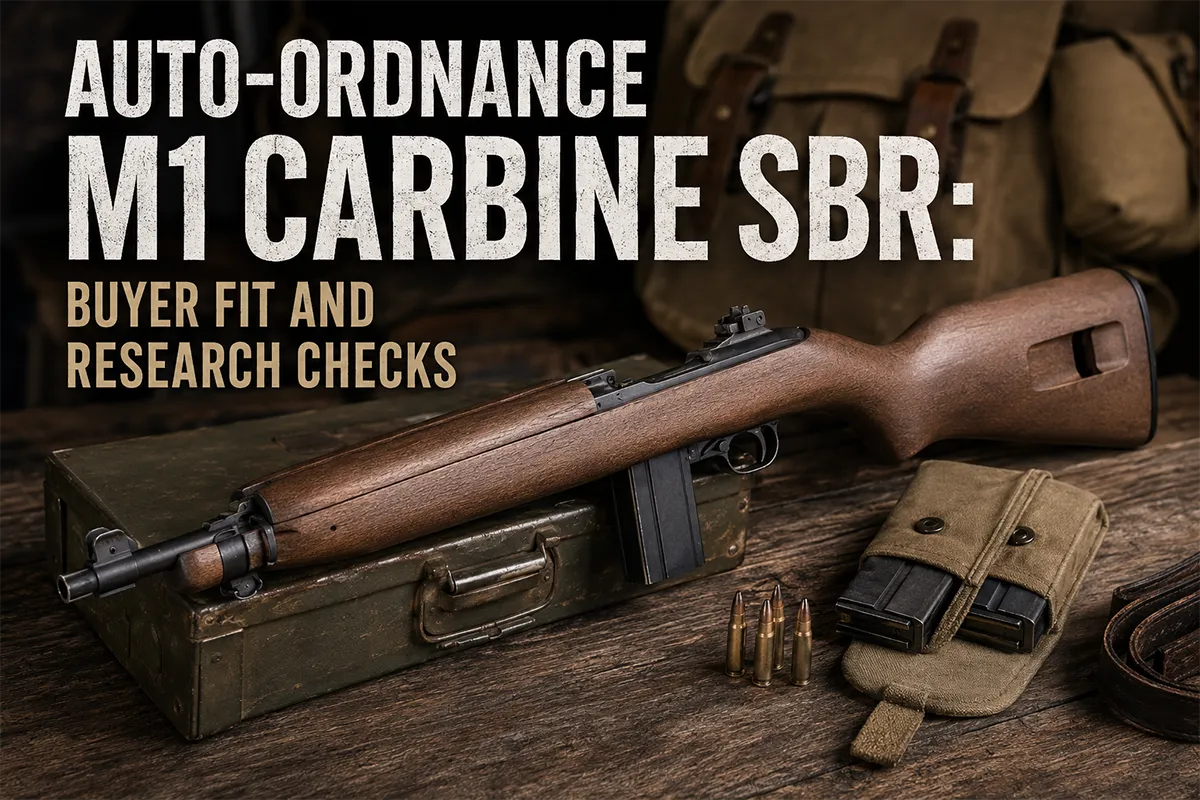
The Auto-Ordnance M1 Carbine SBR puts a 12-inch threaded barrel and M-Lok accessory slots into a walnut-stocked .30 Carbine platform. Announced on July 16, 2026, it is aimed at researchers who like the light, compact character of the M1 Carbine but want a factory short-barreled configuration. The main decision is simple: do its historic styling, compact size, and suppressor-ready muzzle justify the specialized ownership process and $1,870 MSRP?
This is not merely a standard reproduction with several inches removed. Auto-Ordnance paired traditional walnut furniture with a matte-black finish, a 1/2-28 threaded muzzle, and slots under the forearm for a light or other compatible accessory. The result sits between a faithful reproduction and a modern compact carbine.
What is the Auto-Ordnance M1 Carbine SBR?
The Auto-Ordnance M1 Carbine SBR is a newly manufactured, semi-automatic .30 Carbine with a 12-inch barrel and 30-inch overall length. Its shoulder stock and sub-16-inch barrel place it in the short-barreled rifle category under federal law. It comes in 10-round and 15-round magazine versions.
Auto-Ordnance lists model AOM230 with a 15-round magazine and AOM240 with a 10-round magazine. Both share the same stated MSRP. The shorter barrel trims six inches from the maker’s current 18-inch reproduction and reduces overall length by roughly the same amount.
| Platform | Action | Caliber | Barrel/Weight | Capacity | OAL | MSRP/Street |
|---|---|---|---|---|---|---|
| M1 Carbine pattern | Gas-operated semi-auto | .30 Carbine | 12 in. / not stated | 10 or 15 rounds | 30 in. | $1,870 / varies |
What changed from a standard M1 Carbine?
The barrel is the largest change. A conventional modern M1 Carbine reproduction normally uses an 18-inch barrel to remain a standard rifle. This model’s 12-inch tube makes the package easier to maneuver and store, while also changing its regulatory category.
The muzzle uses common 1/2-28 threads. That detail broadens the selection of compatible muzzle devices, but thread size alone does not prove that every suppressor or mount will work. Buyers should verify bore suitability, alignment, shoulder geometry, and the suppressor maker’s barrel-length guidance before choosing a setup.
The underside of the forearm has M-Lok slots. They add a practical mounting point without replacing the wood with a full aluminum handguard. Researchers can compare compact lights, hand stops, and sling hardware while preserving most of the carbine’s traditional appearance.
The walnut stock and handguard remain the visual anchor. That combination will appeal to someone who wants a compact carbine without the usual polymer-and-rail look. It also means accessory placement is more limited than on a modern modular rifle.
Controls, sights, and fit
The M1 Carbine pattern uses controls and an operating layout that differ from current AR-style rifles. A prospective owner should handle one before buying when possible. Check whether the safety, magazine release, charging handle, stock length, and sight picture feel intuitive. Familiar styling does not guarantee familiar ergonomics.
Factory details released at announcement focus on the barrel, threads, overall length, furniture, finish, capacity, and accessory slots. They do not answer every question about sight adjustment, trigger feel, weight, or compatibility with older M1 Carbine components. Treat any unstated detail in a dealer listing as a question, not an assumption.
A useful comparison starts with three rifles: this short model, an 18-inch Auto-Ordnance reproduction, and a modern compact semi-auto in a common caliber. Shoulder each one and note balance, control reach, sight acquisition, and unloaded weight. Then compare the complete ownership cost. Include magazines, ammunition, transfer expenses, secure storage, and any muzzle device. That exercise shows whether the shorter M1 format provides a practical benefit or simply a more interesting specification sheet.
Where the short M1 Carbine format makes sense
The 30-inch overall length is the clearest benefit. A shorter package can feel less awkward when carried at the range or moved through tight storage spaces. The light-carbine layout also offers a different handling experience from many current semi-auto rifles.
Historical interest is another strong fit. The M1 Carbine is recognizable, yet this version does not ask an owner to modify a collectible military firearm. Newly manufactured parts also separate it from surplus examples whose condition, originality, and safe operating state can vary.
A factory configuration can simplify the mechanical side of the research. The barrel length, muzzle threads, furniture, and accessory slots arrive as one package. Buyers still need to confirm the exact model, included magazine, and local availability with the seller.
Tradeoffs to examine before buying
A specialized cartridge and magazine system
.30 Carbine is not interchangeable with 5.56 NATO, .300 Blackout, or common handgun ammunition. Local inventory and load selection may be narrower than those mainstream choices. Check the cost of suitable practice ammunition before treating the rifle’s purchase price as the full budget.
Magazine quality matters with the M1 Carbine pattern. Compare the supplied magazine with reputable spares, and confirm whether the 10-round or 15-round model fits your location and intended use. Capacity rules vary, so a listing’s magazine description deserves careful review.
Short-barreled rifle requirements
The 12-inch barrel is not a minor paperwork footnote. Federal rules treat qualifying short-barreled rifles as National Firearms Act firearms, and state or local restrictions may also apply. Review the current ATF firearms questions and answers, then confirm the process with the transferring dealer and appropriate state authority. Rules and forms can change.
A suppressor is a separate regulated item even when the rifle arrives threaded. Do not assume that approval or possession of one item covers the other. Confirm every required approval before taking possession or changing a firearm’s configuration.
Velocity, sound, and mounting expectations
A shorter barrel can change velocity and muzzle behavior compared with an 18-inch carbine. Actual results depend on the load, atmospheric conditions, and individual barrel. Look for chronograph data from the exact 12-inch production model instead of applying numbers from a full-length rifle.
Suppressor-ready does not mean silent. Ammunition choice, action noise, gas, and the selected device all affect the result. The M1 Carbine’s operating system was not designed around every modern suppressor, so reliability testing with the intended combination remains important.
Auto-Ordnance M1 Carbine SBR research checklist
- Confirm whether the listing is AOM230 with 15 rounds or AOM240 with 10 rounds.
- Verify the 12-inch barrel, 1/2-28 muzzle threads, and 30-inch stated overall length.
- Ask what magazine, case, manual, and other factory items are included.
- Check the walnut stock and handguard for shipping or display damage.
- Inspect muzzle threads and the thread shoulder before mounting any device.
- Confirm suppressor bore, mount, alignment, and barrel-length compatibility.
- Price .30 Carbine practice ammunition and reliable spare magazines.
- Review current federal, state, and local requirements before transfer.
- Compare the $1,870 MSRP with standard-length reproductions and other compact carbines.
Who should research this carbine?
The strongest candidate values compact handling and M1 styling more than broad parts commonality. That buyer may already understand the NFA process and want a factory-built host instead of converting a longer rifle. Fans can browse the wider Auto-Ordnance catalog to compare traditional and modernized configurations.
A first-time rifle buyer may prefer a standard-length option with easier ammunition availability, simpler ownership, and a larger accessory ecosystem. A collector seeking period fidelity may also dislike the short barrel, muzzle threads, matte finish, and M-Lok slots. This carbine’s charm comes from mixing eras, which is also its main compromise.
The Auto-Ordnance M1 Carbine SBR is most compelling as a compact, newly made interpretation rather than a historical replica. Its specifications create a clear niche, but the total decision includes ammunition, magazines, muzzle compatibility, and legal process. Compare those costs and constraints before letting the walnut-and-M-Lok contrast make the choice for you.