
AR-15 Trigger Guide in 2026: Single-Stage vs Two-Stage, Pull Weight, and What Changes Your Shooting
February 24, 2026
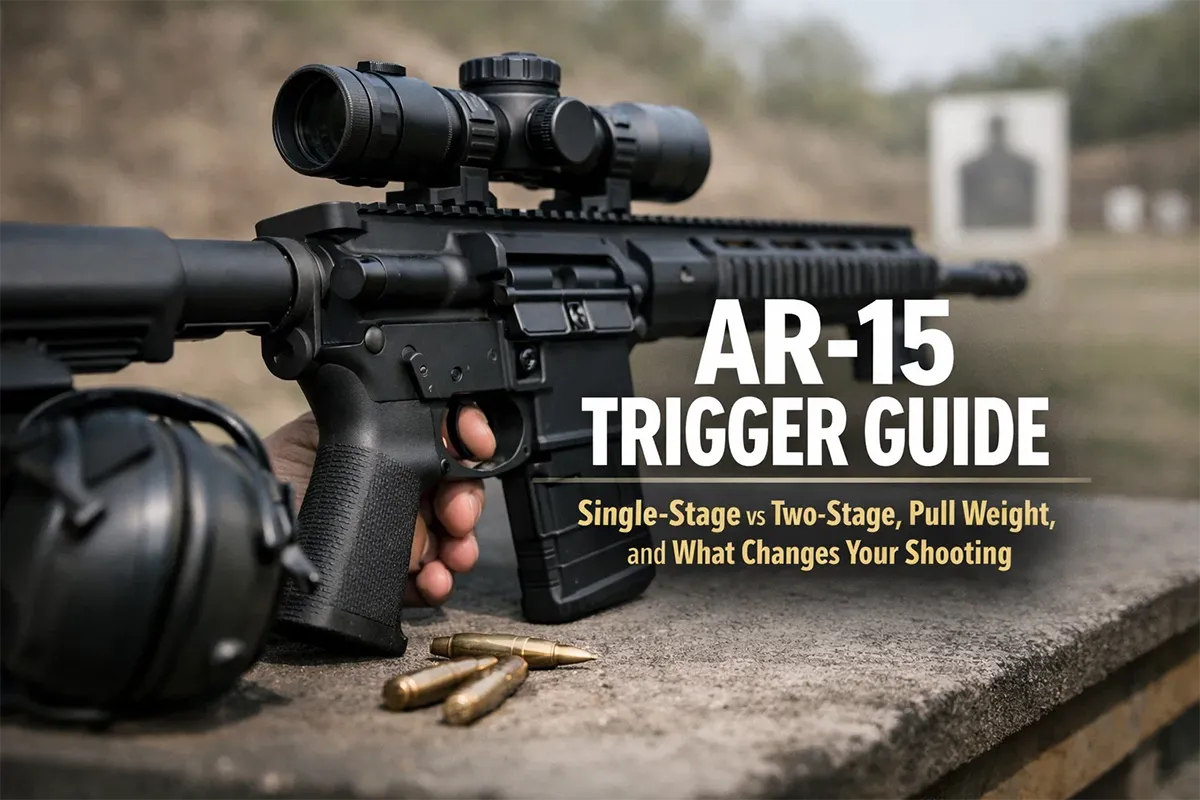
If you’re researching an AR-15 trigger in 2026, you’re usually trying to solve a very specific problem: your rifle runs fine, but your groups, split times, or “clean break” consistency aren’t where you want them. The tricky part is that triggers feel personal—and online opinions often skip the stuff that actually matters for your use (range, hunting, competition, or general-purpose).
This deep dive breaks down single-stage vs two-stage triggers, what pull weight really does (and doesn’t) do, how reset affects speed, and how to pick a trigger that matches your training style. You’ll leave with a simple checklist and a few “safe bets” for research paths, without chasing hype or numbers that don’t translate on the firing line.
AR-15 Trigger Basics: What You’re Actually Changing
An AR-15 trigger is a set of internal parts (typically trigger, hammer, disconnector, and springs) that controls sear engagement—the point where the hammer is held back and then released to fire. When you swap triggers, you’re mainly changing:
- Break: How cleanly the shot releases (crisp vs “creepy”).
- Take-up: How much movement happens before the break.
- Reset: How far the trigger must move forward to re-engage for the next shot.
- Consistency: Whether each press feels the same at different speeds and under stress.
- Pull weight: The force required to fire (often given as a single number or as two numbers for two-stage triggers).
Notice what’s not on that list: “makes the rifle more accurate by itself.” A better trigger can help you use the accuracy you already have—because it reduces the chance you’ll disturb the sights during the press—but it won’t magically fix poor fundamentals or a wobbly shooting position.
Single-Stage vs Two-Stage: The Decision That Matters Most
This is the fork in the road for most buyers.
Single-stage triggers have one continuous press to the break. Ideally they feel like: smooth movement → crisp break → short reset. Single-stage triggers are popular for:
- Fast shooting where you want a simple “press, reset, press” rhythm.
- General-purpose rifles where you don’t want to think about stages.
- Some competition styles that reward speed and a predictable reset.
Two-stage triggers have a first stage (take-up) and a second stage (the final wall/break). They’re popular for:
- Precision and practical accuracy because you can “prep” the first stage, confirm sights, then break the shot.
- Hunting where a controlled press can matter more than raw split speed.
- DMR-style builds (designated marksman rifle) and “do-it-all” carbines.
A useful mental model: two-stage triggers can feel like taking up slack on a good bolt-gun trigger before you hit the wall. Single-stage triggers can feel like a clean, direct switch. Neither is “better”—they just reward different habits.
Pull Weight: Lighter Isn’t Always “Better” (It’s Just Different)
Pull weight affects how easy it is to break the shot without moving the rifle. But going too light can introduce problems for real-world use: gloves, cold hands, high heart rate, awkward shooting positions, or imperfect finger placement.
Instead of chasing the lowest number, match the weight to your role:
- General-purpose / training carbine: A moderate pull you can run safely and consistently at speed.
- Precision / DMR: Often benefits from a lighter, more defined break—especially if you’re shooting from supported positions.
- Hunting: Usually best as “clean and predictable” rather than ultra-light, because field conditions aren’t a square range bench.
If you’ve ever surprised yourself with a “whoops, that went off sooner than expected” shot during dry fire, that’s your sign to stop going lighter and start going cleaner.
Reset and Overtravel: Speed Lives Here
People talk about “fast triggers,” but what they often mean is reset length and feel. A short, tactile reset makes it easier to run controlled pairs and faster strings without slapping the trigger. Overtravel (movement after the break) also matters: less overtravel often feels “snappier” and can reduce how much the rifle moves during the shot.
Here’s the catch: a super-short reset can encourage riding the reset and getting lazy with fundamentals. That can be fine for certain drills—but it can also hide bad trigger control. If your goal is skill-building, choose a trigger that’s consistent and predictable first, then worry about shaving milliseconds.
Drop-In vs Traditional: Compatibility and Maintenance Tradeoffs
You’ll see two common AR trigger formats:
- Traditional (component) triggers: Individual parts installed into the lower receiver. These often have long track records and broad compatibility.
- Drop-in cassette triggers: A self-contained module that pins into the lower. These can be very consistent from unit to unit and simplify installation.
Drop-ins can be great—just remember that tolerance stacking is real. Some lowers, pins, and safeties fit slightly differently. If you’re building a rifle from mixed parts, you want a trigger with a reputation for playing nice across many receivers.
If you’re still in the research phase for the host rifle, start at semi-auto rifles and narrow to AR-pattern options first. Your lower receiver, safety selector, and pins are part of the trigger “system,” whether you planned on that or not.
Use-Case Picks: Matching Trigger Feel to Real Jobs
Rather than naming a single “best” trigger (there isn’t one), here are the most common matchups that tend to make people happy:
- General-purpose carbine (training, drills, mixed shooting): A dependable single-stage with a clean break, or a balanced two-stage that isn’t too light.
- Precision / SPR / DMR builds: Two-stage triggers are the default choice for many shooters because they help you prep the shot, confirm the sight picture, and break cleanly.
- Competition leaning toward speed: Single-stage is common for a reason—simple press and predictable reset—but only if you can keep your trigger discipline tight.
- Hunting AR setups: A crisp, predictable trigger you can manage under stress and in odd positions. “Crisp” matters more than “light.”
One light quip, as promised: if your trigger feels like stepping on a pine cone, you’ll probably shoot like you’re stepping on a pine cone.
Accessory Spec Snapshot: AR Triggers (What You’ll Commonly See)
| Category | Compatibility | Materials | Weight | Dimensions | Features | MSRP |
|---|---|---|---|---|---|---|
| Single-stage (traditional) | AR-15 / AR-10 varies by model | Varies by SKU (tool steel common) | Varies by SKU (often ~3–6 lb class) | Standard AR FCG footprint | Direct press, often short reset | Varies widely |
| Two-stage (traditional) | AR-15 / AR-10 varies by model | Varies by SKU (tool steel common) | Varies by SKU (often two-stage totals ~3.5–5.5 lb class) | Standard AR FCG footprint | Prep + wall, controlled break | Varies widely |
| Drop-in cassette | AR-15 lowers; check pin size & safety fit | Varies by SKU (hardened internals common) | Varies by SKU (often ~3–5.5 lb class) | Cassette module footprint | Consistent feel, simpler install | Varies widely |
Note: Exact pull weights, materials, and pricing vary a lot by model and generation. Use the table above as a way to compare formats, not as a promise of exact numbers.
Brand Research Paths That Make Sense
If you want a shortcut to sanity, choose a trigger family with broad adoption and good long-term support. For many shooters, that means starting with proven names and then selecting a single-stage or two-stage variant that matches your job.
A common research starting point is Geissele, especially if you’re building a “serious use” carbine or a precision-leaning AR. Even if you don’t end up buying that brand, comparing others against a well-known baseline helps you interpret descriptions like “glass rod break” and “short reset” in a more grounded way.
Red Flags and Mistakes to Avoid
- Buying by pull weight alone: A heavier but cleaner trigger often beats a lighter trigger with creep for practical shooting.
- Ignoring your safety selector fit: Some triggers interact differently with certain selectors. If you’re mixing brands, verify compatibility.
- Chasing “race” features for a defensive/training rifle: Ultra-light, ultra-short setups can be fantastic—when your handling habits are dialed. If they’re not, you’ll build bad reps.
- Not testing reset under realistic cadence: Dry fire slowly and quickly. Some triggers feel great at one speed and odd at another.
- Assuming your buddy’s favorite will be your favorite: Finger length, grip angle, and shooting style change the experience more than people admit.
Research Checklist: Pick the Right Trigger Without Overthinking It
- Define the rifle’s job: training/general purpose, precision/DMR, competition speed, hunting, or mixed.
- Choose feel type: single-stage (simple) or two-stage (prep + wall).
- Pick a sensible weight range: prioritize control and consistency over “lightest possible.”
- Decide format: traditional parts vs drop-in cassette based on your tolerance for fitment variables.
- Confirm compatibility: lower receiver, pins, safety selector, and any unique receiver tolerances.
- Plan a dry-fire test routine: slow presses, reset drills, and a few realistic cadence strings (with strict safety habits).
Do those steps and you’ll end up with a trigger that supports your shooting instead of distracting from it—which is the whole point.