
AR-15 Barrel Length 5.56: Picking 10.3 vs 11.5 vs 14.5 vs 16 in 2026
January 27, 2026
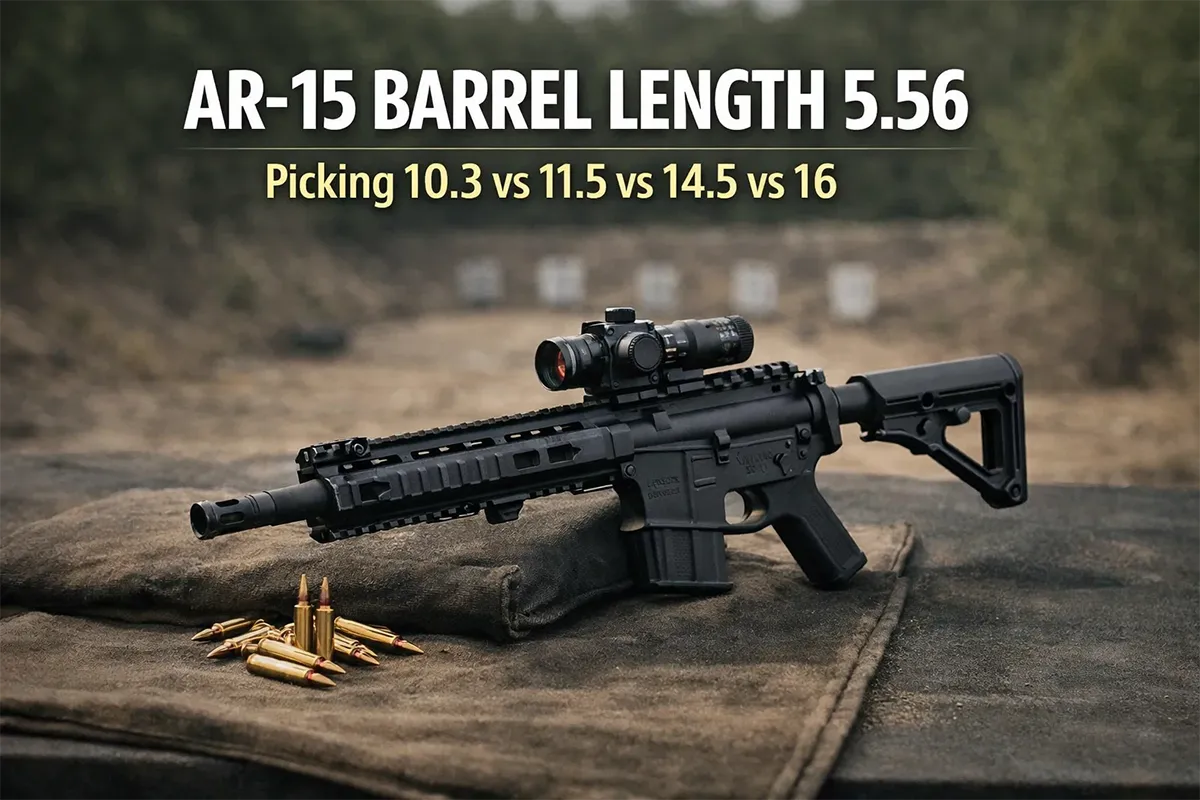
If you’re debating AR-15 barrel length 5.56, you’re not just picking a number—you’re choosing a balance of handling, velocity, reliability, and muzzle blast. In 2026, the most common “serious use” choices cluster around 10.3, 11.5, 14.5, and 16 inches. This deep dive explains what actually changes across those lengths, what to prioritize for your use case, and what to verify before you buy (or before you commit to a particular upper).
For most buyers, 16″ is the easiest, most flexible all-rounder. 14.5″ is the “balanced handling” pick if you’re okay with a more committed configuration. 11.5″ is often the sweet spot for compactness without going as harsh as the shortest setups. 10.3″ is the most compact of this group, but it’s also the most demanding on tuning, ammo selection, and shooter comfort.
One important note up front: barrel length can affect how a firearm is classified and what rules apply. This article is informational only—follow all federal/state/local laws and manufacturer guidance when researching configurations.
To browse platforms while you read, start here: Semi Auto Rifles.
What changes when you change AR-15 barrel length in 5.56
Barrel length affects four things you’ll feel immediately and two things you’ll notice over time:
- Handling: Shorter barrels move faster in tight spaces and feel less front-heavy, especially with a light rail.
- Velocity: In general, longer barrels produce higher muzzle velocity in 5.56 NATO/.223 Rem. More velocity can help certain expanding bullets perform as intended at longer distances.
- Blast and sound: Short barrels are noticeably louder and produce more flash and concussion. (Your friends on the line will notice, too.)
- Gas system behavior: Shorter barrels can create higher gas pressure at the system and a narrower “timing window.” That can make a rifle feel sharper and be more sensitive to ammo and suppressor use.
- Wear and maintenance: Higher gas and faster cycle speeds can increase parts wear if a setup isn’t well balanced.
- Practical accuracy at distance: Mechanical accuracy can be excellent across lengths, but longer barrels can make it easier to get consistent terminal performance and flatter holds at distance, depending on ammo.
The four barrel lengths most buyers compare
There are plenty of “in-between” options (12.5″, 13.7″, 18″), but these four are the most common short list because they map cleanly to real-world priorities.
| Barrel length | What it’s best at | Tradeoffs to expect | Typical notes to research |
|---|---|---|---|
| 10.3″ | Maximum compactness | Highest blast; most sensitive to gas/timing | Gas porting, buffer system, ammo choice, flash control |
| 11.5″ | Compact + more forgiving | Still loud; still “short-barrel behavior,” just milder | Reliability across ammo; suppressor friendliness; heat management |
| 14.5″ | Balanced handling + velocity | More committed setup depending on muzzle device choices | Overall length, muzzle device selection, general-purpose optic pairing |
| 16″ | Most flexible, easiest general use | Slightly longer in tight spaces | Weight distribution, rail length, do-it-all performance |
10.3-inch 5.56: who it fits (and who it frustrates)
A 10.3″ 5.56 AR-15 exists for one core reason: it’s compact. That matters for storage, maneuvering in confined areas, and carrying the rifle in and out of vehicles or tight terrain. If you’re building around that priority, 10.3″ can make sense.
But this length is also where 5.56 starts to feel “spiky” to many shooters: more concussion, more flash potential, and more sensitivity to how the rifle is gassed and how it’s set up. It’s not that 10.3″ can’t be reliable—it absolutely can. The point is that you’re more likely to be relying on the manufacturer’s specific recipe (gas porting, buffer setup, and overall tuning) to get a smooth result.
- Best for: Buyers who prioritize compactness above all and accept more blast and a narrower “comfort margin.”
- Not ideal for: High-volume range days, new shooters, or anyone who dislikes concussion.
- What to verify: Reputation for reliability with mixed ammo, and how the gun behaves with your intended muzzle device and/or suppressor plan.
Common model family to research (brand example): Daniel Defense (often associated with short-barrel formats).
11.5-inch 5.56: the “compact but livable” sweet spot
If you want a compact AR that still feels relatively forgiving, 11.5″ is the length many experienced shooters land on. That extra inch doesn’t sound like much, but it often helps with gas timing and overall behavior, especially when you’re trying to keep the rifle controllable and not overly harsh.
In practical terms, 11.5″ tends to be the choice for people who want a short, maneuverable rifle but still plan to shoot it a lot—training, drills, and regular range time. It can also be a strong candidate if you’re trying to keep a compact setup while maintaining more consistent performance across a wider range of ammo types.
- Best for: Compact setups that still see frequent practice.
- Tradeoffs: Still loud and concussive compared to 14.5/16; heat builds fast in short barrels.
- What to verify: How the rifle runs unsuppressed and suppressed (if that’s part of your research), and whether it stays controllable with your preferred ammo.
14.5-inch 5.56: balance, speed, and “feels right” handling
14.5″ is popular because it splits the difference: it’s noticeably handier than 16″ while retaining more velocity and a calmer shooting experience than the shortest barrels. Many shooters describe 14.5″ as the point where an AR starts to feel “fast” and “balanced” without giving up the general-purpose character of the platform.
The main thing with 14.5″ is commitment. Depending on how you approach overall length and muzzle devices, you can end up with a configuration that’s less “mix and match” than a typical 16″ setup. That’s not a deal-breaker—just a reminder to decide whether you want a rifle you can easily reconfigure later, or one you’re happy leaving as-is.
- Best for: A “one rifle” that emphasizes handling without giving up general performance.
- Tradeoffs: Less casual reconfiguration, depending on setup choices.
- What to verify: Overall length with your chosen muzzle device, rail length, and intended optic.
Brand rabbit hole worth exploring: Colt.
16-inch 5.56: the easiest answer (for most people)
If you want the simplest path to a general-purpose 5.56 rifle, 16″ is still the default for good reasons. It’s flexible, widely supported, and typically less finicky. It’s also easier to tailor to multiple roles: training, range use, general property defense, and even entry-level competition or varmint duty (with appropriate ammo and optics).
16″ also tends to be more forgiving with ammo selection and can feel less punishing over long sessions. If you’re new to the AR platform, or if you want something you can buy once and grow into, 16″ is the length that most often avoids regrets.
- Best for: First ARs, do-it-all rifles, and anyone who values flexibility.
- Tradeoffs: Slightly longer in tight spaces compared to 14.5/11.5/10.3.
- What to verify: Total weight (barrel profile matters) and whether the rifle balances where you like it.
Ammo and terminal performance: what to keep realistic
Velocity differences matter most when you’re trying to push distance or when you’re relying on a specific bullet design to expand reliably. Two buyers can look at the same barrel length and reach different conclusions because they’re using different ammo types and have different realistic distances.
Practical takeaway: if you’re going short (10.3–11.5), it’s smarter to treat ammo choice as part of the system. If you’re going 14.5–16, you generally have more margin and more options that work well across distances people actually shoot in typical training and home-defense contexts.
Suppressor research (high level) and why barrel length matters
Short barrels tend to push more blast and pressure into a suppressor system. That can change how gassy the rifle feels and how much heat the can sees in rapid strings. None of that means “don’t do it”—it just means shorter setups benefit from thoughtful component choices and realistic expectations.
If suppressor use is part of your research plan, prioritize rifles known for smoother gas behavior and confirm that your chosen barrel length is commonly paired with suppressed use. (A quick sanity check: if the only reviews you can find say “it’s brutal,” believe them.)
How to choose: match barrel length to your primary job
Here’s a practical way to decide without overthinking it:
- Choose 16″ if you want one rifle that’s easy to own, easy to feed, and easy to adapt over time.
- Choose 14.5″ if you want a “feels great” general-purpose rifle and you’re comfortable committing to a more specific setup.
- Choose 11.5″ if compact handling is a priority but you still want a rifle you’ll shoot often.
- Choose 10.3″ if maximum compactness is the main goal and you accept higher blast and a narrower comfort/reliability margin.
Research checklist before you buy (or before you pick an upper)
- Write down your realistic distance. Most users overestimate how far they’ll shoot in practice.
- Decide what you value more: compact handling, or comfort and flexibility.
- Confirm the rifle’s reputation for reliability with mixed ammo—especially for 10.3/11.5.
- Check weight and balance. Barrel profile and rail length can matter as much as barrel length.
- Plan your optic. A general-purpose 16″ may pair well with different optics than a compact 10.3.
- Think about blast management. Shorter barrels benefit more from smart muzzle device choices (without turning range day into a percussion concert for everyone around you).
- Keep legality in mind. Barrel length can change classification and rules; verify locally and federally before committing.
Want to compare more rifles by category and start filtering by platform? Browse: Semi Auto Rifles.