
SIG P385 vs P320: Compatibility, Features, and Buyer Fit
October 30, 2026
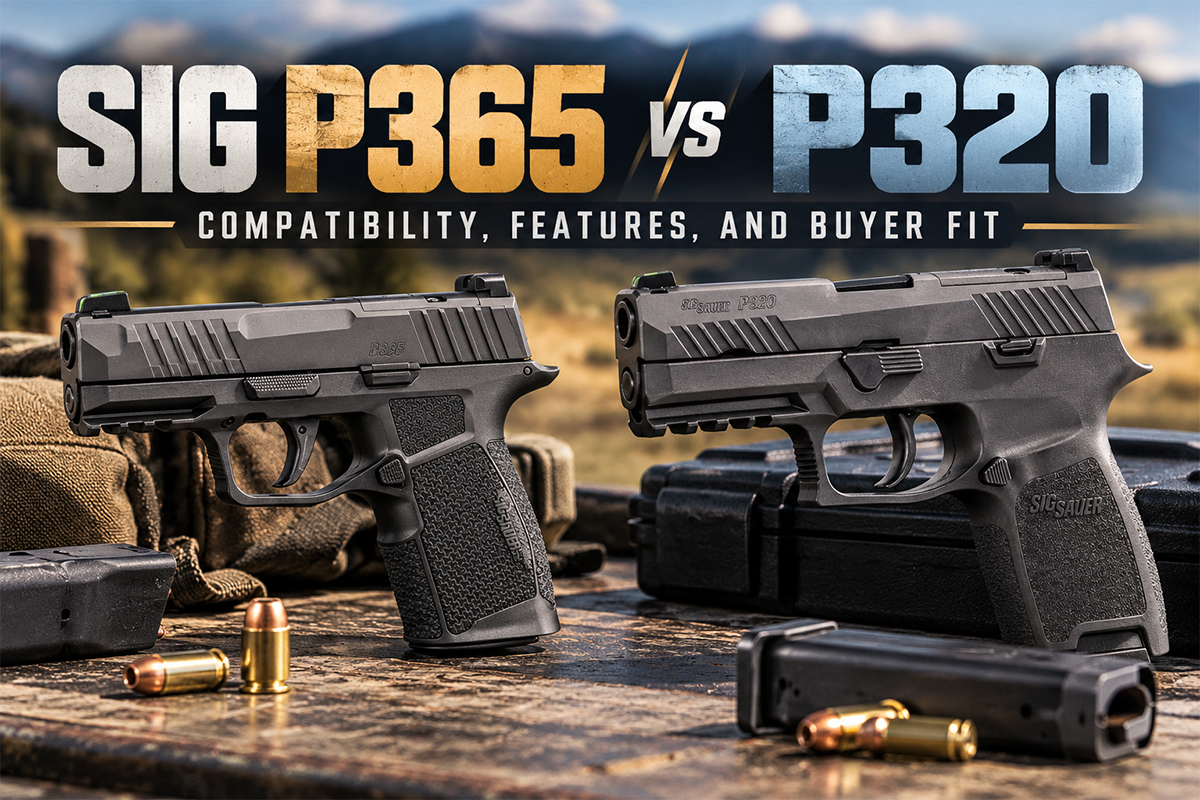
The SIG P385 vs P320 question starts with a simple fact: these are separate pistol platforms, even though they share some magazines. SIG announced the P385 on September 22, 2026, with a new fire control unit, low bore axis, recoil-dampening grip system, and five launch configurations. The P320 remains in SIG’s catalog with a much larger parts, caliber, and accessory ecosystem.
For most buyers, the decision is not about replacing one name with another. It is about choosing between a new recoil-focused 9mm design and a mature modular family. Existing P320 owners should also separate magazine compatibility from full parts compatibility before planning a switch.
Quick answer: Choose the P385 if its lower bore axis, adjustable MagStrap grip, ambidextrous controls, and SIG-LOC PRO optic system match your needs. Choose the P320 if you value its established selection of sizes, calibers, grip modules, slides, and compatible equipment. Handle and test the exact model before deciding.
SIG P385 vs P320 at a Glance
Both are modular, striker-fired pistols available in duty-size and carry-oriented forms. The representative carry configurations below show how close their basic dimensions can be. Specifications vary across SKUs, especially within the long-running P320 family.
| Platform | Action | Caliber | Barrel/Weight | Capacity | OAL | MSRP/Street |
|---|---|---|---|---|---|---|
| P385-CARRY | Striker-fired, new removable FCU | 9mm | 4 in / 28.94 oz with magazine | 17 and 21-round magazines included; 10-round SKU available | 7.22 in | Varies by SKU and availability |
| P320 Carry | Striker-fired, removable P320 FCU | Varies by SKU; includes 9mm | 3.9 in / about 25.9 oz with magazine | 17 rounds in representative 9mm configuration | About 7.2 in | Varies widely by model and package |
The P385-CARRY is 1.32 inches wide and 5.64 inches high in its standard configuration. Its listed weight is slightly higher than the representative P320 Carry specification. Numbers alone do not reveal grip shape, balance, trigger reach, or recoil feel, so a hands-on comparison still matters.
What P320 Parts Work With the P385?
SIG identifies only a few cross-platform parts. Standard P320 magazines work in the P385. P-Series dovetailed iron sights and the P320 AXG magwell are also listed as compatible. Older P320 magazines with rounded basepads require removal of the P385’s metal magwell, according to SIG.
- Magazines: P320 magazines are supported, subject to the older rounded-basepad note.
- Iron sights: P-Series dovetailed sights can cross over.
- Magwell: The P320 AXG magwell is compatible.
- Holsters: P320 and P365 holsters are not compatible with the P385.
- Major components: The FCU, grip module, slide, and barrel are specific to the P385 platform.
This distinction can prevent an expensive assumption. A familiar magazine does not make the P385 a P320 conversion project. Budget for a P385-specific holster and confirm the exact magazine basepad, light, and optic combination before ordering support gear.
How the P385 Changes Grip Fit and Recoil Control
The P385’s MagStrap system changes more than a conventional backstrap. SIG says it can alter grip circumference, trigger reach, and grip length without replacing the whole module. Small, medium, and large options measure 1.95, 2.15, and 2.25 inches around the backstrap and front finger groove.
SIG also built its Recoil Dampening System into the grip module. The company claims at least 20 percent less muzzle rise, depending on the P385 model, while the MACH3D version is claimed to exceed 30 percent. Those are manufacturer figures, not a guarantee that every shooter will record the same result.
The P320 approaches fit through its broad selection of complete models and replaceable grip modules. That established catalog can be valuable if you already know which P320 grip, slide length, and control layout work for you. The P385 offers a fresh system, but its aftermarket is still developing.
Optics, Trigger Design, and Controls
All announced P385 models are optics-ready. SIG-LOC PRO supports direct mounting for RMR and DPP footprints without an added adapter plate. P320 optic support depends on the particular slide and generation, so buyers should confirm the cut rather than rely on the P320 name alone.
The P385 introduces a flush-faced Trigger Block. SIG describes it as a redundant drop-safety mechanism that moves with the trigger while staying nearly level with the trigger face. Optional manual-safety variants are planned, and the pistol has ambidextrous slide catches, magazine releases, and safety controls when fitted.
The P320 has its own internal safety system and is available in many control configurations. Trigger feel and control placement should be judged on the exact pistols under consideration. Dry handling at a qualified retailer can reveal more than comparing broad platform labels.
Which Platform Fits Which Buyer?
In a practical SIG P385 vs P320 decision, the P385 makes the strongest case for a buyer starting fresh. Its design centers on lower bore placement, adjustable grip geometry, broad-handed controls, and current optic mounting. P320 magazine compatibility may reduce the cost for someone who already owns reliable magazines.
The P320 can make more sense when existing equipment already fits the job. Owners may have proven holsters, spare components, familiar grip modules, and training time invested in the platform. It also offers more caliber and configuration choices than the launch-stage, 9mm-only P385 family.
- Consider the P385 for a new 9mm setup, adjustable grip dimensions, lower bore axis, or direct-mount optic flexibility.
- Consider the P320 for its mature ecosystem, wider configuration range, existing holster support, or compatibility with equipment you already trust.
- Wait for more evidence if long-term durability data, broad replacement-parts access, or independent high-round-count testing is central to your decision.
Readers can compare additional semi-auto pistols and browse the SIG Sauer brand catalog on GunGenius. Availability, compliant magazine capacity, and included equipment can vary by state and SKU.
SIG P385 vs P320 Research Checklist
- Record the exact SKU, barrel length, safety configuration, sights, and included magazines.
- Confirm that your P320 magazines have compatible basepads for the intended P385 magwell setup.
- Select a holster made for the exact P385 or P320 configuration, including any mounted light or optic.
- Verify the slide’s optic footprint and whether mounting hardware is included.
- Compare grip circumference, trigger reach, control access, and concealment with your normal shooting grip.
- Test function with the intended magazines and ammunition before relying on either pistol for a serious role.
- Check current manufacturer guidance because launch specifications and accessory support can change.
Common Questions About the Two Platforms
Is the P385 replacing the P320?
SIG says no. The company states that the P320, M17, and M18 will remain available and supported. The P385 is a separate platform developed over several years, not an announced recall or exchange program.
Can a P320 FCU fit in a P385?
No. The P385 uses a newly designed serialized FCU. SIG lists P320 magazines, P-Series dovetailed sights, and the P320 AXG magwell as the limited compatible items, while other major parts remain platform-specific.
Which one is better for concealed carry?
That depends on the exact model, body type, holster, and clothing. The P385-CARRY and P385-COMPACT target concealed use, while several P320 compact and carry models serve the same role. Compare total height, loaded weight, grip shape, and holster availability rather than the family name.
The final SIG P385 vs P320 choice should follow verified fit and function, not launch excitement. Meaningful new design ideas and limited P320 crossover define the P385. In contrast, the P320 answers with a deep, proven catalog. Either can be the better research target when its specific configuration matches the intended use.
SIG P385 vs P320: Compatibility, Features, and Buyer Fit
September 30, 2026

The SIG P385 vs P320 question starts with a simple fact: these are separate pistol platforms, even though they share some magazines. SIG announced the P385 on September 22, 2026, with a new fire control unit, low bore axis, recoil-dampening grip system, and five launch configurations. The P320 remains in SIG’s catalog with a much larger parts, caliber, and accessory ecosystem.
For most buyers, the decision is not about replacing one name with another. It is about choosing between a new recoil-focused 9mm design and a mature modular family. Existing P320 owners should also separate magazine compatibility from full parts compatibility before planning a switch.
Quick answer: Choose the P385 if its lower bore axis, adjustable MagStrap grip, ambidextrous controls, and SIG-LOC PRO optic system match your needs. Choose the P320 if you value its established selection of sizes, calibers, grip modules, slides, and compatible equipment. Handle and test the exact model before deciding.
SIG P385 vs P320 at a Glance
Both are modular, striker-fired pistols available in duty-size and carry-oriented forms. The representative carry configurations below show how close their basic dimensions can be. Specifications vary across SKUs, especially within the long-running P320 family.
| Platform | Action | Caliber | Barrel/Weight | Capacity | OAL | MSRP/Street |
|---|---|---|---|---|---|---|
| P385-CARRY | Striker-fired, new removable FCU | 9mm | 4 in / 28.94 oz with magazine | 17 and 21-round magazines included; 10-round SKU available | 7.22 in | Varies by SKU and availability |
| P320 Carry | Striker-fired, removable P320 FCU | Varies by SKU; includes 9mm | 3.9 in / about 25.9 oz with magazine | 17 rounds in representative 9mm configuration | About 7.2 in | Varies widely by model and package |
The P385-CARRY is 1.32 inches wide and 5.64 inches high in its standard configuration. Its listed weight is slightly higher than the representative P320 Carry specification. Numbers alone do not reveal grip shape, balance, trigger reach, or recoil feel, so a hands-on comparison still matters.
What P320 Parts Work With the P385?
SIG identifies only a few cross-platform parts. Standard P320 magazines work in the P385. P-Series dovetailed iron sights and the P320 AXG magwell are also listed as compatible. Older P320 magazines with rounded basepads require removal of the P385’s metal magwell, according to SIG.
- Magazines: P320 magazines are supported, subject to the older rounded-basepad note.
- Iron sights: P-Series dovetailed sights can cross over.
- Magwell: The P320 AXG magwell is compatible.
- Holsters: P320 and P365 holsters are not compatible with the P385.
- Major components: The FCU, grip module, slide, and barrel are specific to the P385 platform.
This distinction can prevent an expensive assumption. A familiar magazine does not make the P385 a P320 conversion project. Budget for a P385-specific holster and confirm the exact magazine basepad, light, and optic combination before ordering support gear.
How the P385 Changes Grip Fit and Recoil Control
The P385’s MagStrap system changes more than a conventional backstrap. SIG says it can alter grip circumference, trigger reach, and grip length without replacing the whole module. Small, medium, and large options measure 1.95, 2.15, and 2.25 inches around the backstrap and front finger groove.
SIG also built its Recoil Dampening System into the grip module. The company claims at least 20 percent less muzzle rise, depending on the P385 model, while the MACH3D version is claimed to exceed 30 percent. Those are manufacturer figures, not a guarantee that every shooter will record the same result.
The P320 approaches fit through its broad selection of complete models and replaceable grip modules. That established catalog can be valuable if you already know which P320 grip, slide length, and control layout work for you. The P385 offers a fresh system, but its aftermarket is still developing.
Optics, Trigger Design, and Controls
All announced P385 models are optics-ready. SIG-LOC PRO supports direct mounting for RMR and DPP footprints without an added adapter plate. P320 optic support depends on the particular slide and generation, so buyers should confirm the cut rather than rely on the P320 name alone.
The P385 introduces a flush-faced Trigger Block. SIG describes it as a redundant drop-safety mechanism that moves with the trigger while staying nearly level with the trigger face. Optional manual-safety variants are planned, and the pistol has ambidextrous slide catches, magazine releases, and safety controls when fitted.
The P320 has its own internal safety system and is available in many control configurations. Trigger feel and control placement should be judged on the exact pistols under consideration. Dry handling at a qualified retailer can reveal more than comparing broad platform labels.
Which Platform Fits Which Buyer?
In a practical SIG P385 vs P320 decision, the P385 makes the strongest case for a buyer starting fresh. Its design centers on lower bore placement, adjustable grip geometry, broad-handed controls, and current optic mounting. P320 magazine compatibility may reduce the cost for someone who already owns reliable magazines.
The P320 can make more sense when existing equipment already fits the job. Owners may have proven holsters, spare components, familiar grip modules, and training time invested in the platform. It also offers more caliber and configuration choices than the launch-stage, 9mm-only P385 family.
- Consider the P385 for a new 9mm setup, adjustable grip dimensions, lower bore axis, or direct-mount optic flexibility.
- Consider the P320 for its mature ecosystem, wider configuration range, existing holster support, or compatibility with equipment you already trust.
- Wait for more evidence if long-term durability data, broad replacement-parts access, or independent high-round-count testing is central to your decision.
Readers can compare additional semi-auto pistols and browse the SIG Sauer brand catalog on GunGenius. Availability, compliant magazine capacity, and included equipment can vary by state and SKU.
SIG P385 vs P320 Research Checklist
- Record the exact SKU, barrel length, safety configuration, sights, and included magazines.
- Confirm that your P320 magazines have compatible basepads for the intended P385 magwell setup.
- Select a holster made for the exact P385 or P320 configuration, including any mounted light or optic.
- Verify the slide’s optic footprint and whether mounting hardware is included.
- Compare grip circumference, trigger reach, control access, and concealment with your normal shooting grip.
- Test function with the intended magazines and ammunition before relying on either pistol for a serious role.
- Check current manufacturer guidance because launch specifications and accessory support can change.
Common Questions About the Two Platforms
Is the P385 replacing the P320?
SIG says no. The company states that the P320, M17, and M18 will remain available and supported. The P385 is a separate platform developed over several years, not an announced recall or exchange program.
Can a P320 FCU fit in a P385?
No. The P385 uses a newly designed serialized FCU. SIG lists P320 magazines, P-Series dovetailed sights, and the P320 AXG magwell as the limited compatible items, while other major parts remain platform-specific.
Which one is better for concealed carry?
That depends on the exact model, body type, holster, and clothing. The P385-CARRY and P385-COMPACT target concealed use, while several P320 compact and carry models serve the same role. Compare total height, loaded weight, grip shape, and holster availability rather than the family name.
The final SIG P385 vs P320 choice should follow verified fit and function, not launch excitement. Meaningful new design ideas and limited P320 crossover define the P385. In contrast, the P320 answers with a deep, proven catalog. Either can be the better research target when its specific configuration matches the intended use.