
.22 LR Bolt Action Rifle in 2026: How to Choose the Right One for Training, Small Game, and Long-Term Value
March 23, 2026
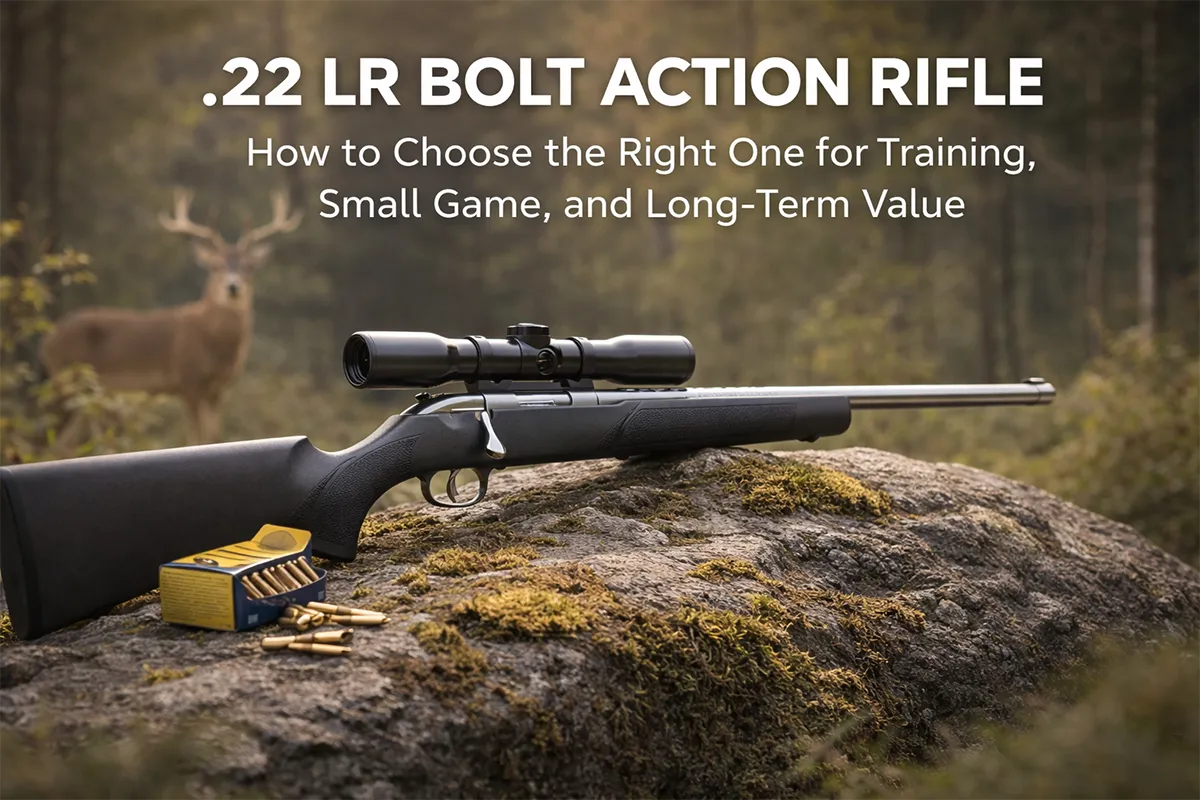
If you are researching a .22 LR bolt action rifle in 2026, you are usually trying to solve a practical problem: you want a rifle that is affordable to shoot, easy to live with, and useful for real skill-building instead of just casual noise. That can mean a first rifle, a small-game setup, a training rifle that helps sharpen fundamentals, or a long-term “always worth owning” gun that stays relevant even after the rest of the safe gets more expensive. This guide is built around that decision.
A good .22 LR bolt gun still matters because it teaches the basics without much drama. Recoil is minimal, ammunition is typically lighter on the wallet than centerfire loads, and the manual cycling of the bolt slows the process down in a helpful way. That matters for newer shooters, but it also matters for experienced ones. A rimfire bolt gun has a way of exposing sloppy trigger press, inconsistent follow-through, and shaky positional shooting. It is not flashy, but it is honest, which is often more useful.
Some are light and simple, built for carrying in the field. Others lean into precision-style stocks, heavier barrels, and accessory compatibility. The smartest way to sort them is to decide what job matters most before you get distracted by cosmetic extras.
Why a .22 LR Bolt Action Rifle Still Makes Sense in 2026
The biggest advantage is training value. A bolt action rifle requires the shooter to run the gun deliberately between shots. That encourages better pacing and tends to reduce the “spray first, think later” habit that can creep into more casual rimfire shooting. You can focus on sight picture, breathing, body position, and clean trigger work without fighting recoil or burning through ammunition at a silly pace.
It also makes sense as a field rifle. For small game, pest control where lawful, or general property use, a .22 LR bolt gun is light, portable, and usually easy to maintain. Many models are slim enough to carry comfortably for hours, and their moderate report makes them more pleasant for extended practice than most centerfire rifles.
Then there is the long-term ownership angle. A centerfire rifle often gets bought for a specific purpose. A .22 LR bolt rifle tends to stick around because it covers so many roles well enough to remain useful even after your collection changes. It may become the teaching rifle, the camp rifle, the backyard-practice stand-in where lawful, or the one you hand to a friend who wants to learn without getting rattled.
Start With Use Case, Not Just Price
Many buyers begin by sorting from lowest to highest price, which is understandable but not always helpful. The better starting point is use case. If the rifle is mainly for fundamentals and range practice, you may want a model with a comfortable stock, good iron sights or a friendly optics setup, and a trigger that feels predictable. If the rifle is for small game, portability and handling rise in importance. If you want a precision-style trainer, barrel profile, stock shape, and mounting options deserve closer attention.
That is where seemingly small differences matter. A lightweight sporter-style rifle carries beautifully but may feel less stable from a bench or bipod. A heavier precision-oriented rimfire may shoot wonderfully from supported positions but feel less lively in the field. Neither one is “better” in a vacuum. They are just solving different problems.
Spec Table: Common .22 LR Bolt Action Rifle Lanes
| Platform | Action | Caliber | Barrel/Weight | Capacity | OAL | MSRP/Street |
| Light field rifle | Bolt action | .22 LR | Varies by SKU; often light with sporter barrel | Varies by magazine system | Usually compact to mid-length | Varies by brand and trim |
| General-purpose trainer | Bolt action | .22 LR | Often moderate barrel profile and moderate weight | Varies by magazine system | Mid-length | Varies by stock and sight package |
| Precision-style rimfire | Bolt action | .22 LR | Often heavier barrel and higher overall weight | Varies by detachable magazine | Mid to long | Usually higher with chassis or premium stock features |
| Youth or compact model | Bolt action | .22 LR | Shorter length of pull; lighter overall package | Varies by SKU | Compact | Varies by configuration |
Barrel, Stock, and Trigger: The Three Features That Shape the Experience
Barrel profile influences both balance and shooting behavior. A thinner sporter barrel keeps the rifle easy to carry and gives it the classic “walk-around rifle” feel. A heavier barrel usually adds steadiness and can make the rifle feel calmer during slow, deliberate shooting. For a field gun, lighter often wins. For a range trainer or precision-focused rimfire, more weight can be a real benefit.
Stock design changes more than comfort. The comb height, length of pull, and forend shape affect how naturally your eye lines up behind sights or an optic. Traditional stocks still make a lot of sense for hunting and general use. More vertical grips, flatter forends, and adjustable features make more sense when the rifle is expected to spend time on bags, bipods, or barricades.
Trigger quality is often the difference between “fine” and “surprisingly good.” Rimfire rifles do not need match-grade triggers to be useful, but they do benefit from a clean break and consistent pull. A rough or heavy trigger can make a beginner think the problem is their skill when the rifle is doing them no favors. A better trigger does not replace practice, but it makes practice more honest.
Magazine Design and Optics Compatibility Matter More Than They Used To
Older rimfire buying advice often focused almost entirely on accuracy and basic reliability. Those still matter most, but magazine design and optics compatibility deserve real attention now. A detachable magazine that is easy to load and easy to seat cleanly improves day-to-day use more than many buyers expect. A rifle that accepts scope bases or ships ready for optics can also save hassle if your goal is a trainer that mirrors your centerfire setup more closely.
This is one of the biggest dividing lines between classic-feeling rifles and newer rimfire trainers. Some buyers want a simple wood-stocked rifle with irons and a low-power scope. Others want a modern .22 that behaves like a cheap-to-feed stand-in for their centerfire precision or hunting rifle. Be honest about which camp you are in, because that answer narrows the field fast.
Brand Differences Worth Researching
Savage is worth close attention in this category because it has long been associated with practical accuracy, broad model variety, and user-friendly rimfire options that cover both beginner and enthusiast lanes. Buyers often end up comparing lighter hunting-oriented rifles against heavier target-style variants within the same brand because the spread is wide enough to support very different priorities.
CZ-USA is equally relevant for buyers who want a more refined feel, strong fit-and-finish, and a reputation for rimfire rifles that punch above their price class in terms of shootability. The appeal here is often not just accuracy, but overall feel: stock shape, action smoothness, and the sense that the rifle was built to be kept for a long time rather than replaced quickly.
Ruger also deserves a look, especially for buyers who value straightforward ownership, broad aftermarket awareness, and accessible entry points. Even when a buyer starts with one brand in mind, cross-shopping these three usually makes the tradeoffs clearer. One may feel handier, one may feel more polished, and one may feel more adaptable. That comparison is where good decisions usually happen.
Research Checklist Before You Buy
- Decide whether the rifle is mainly for field carry, training, or precision-style rimfire work.
- Check overall weight before assuming a heavier barrel will still feel convenient.
- Look at stock shape and length of pull, especially for younger or smaller shooters.
- Pay attention to trigger feel, not just advertised features.
- Compare magazine design and ease of loading.
- Confirm how easy it is to mount the optic setup you actually plan to use.
- Cross-shop at least one classic-style rifle and one more modern trainer before deciding.
The Bottom Line on a .22 LR Bolt Action Rifle in 2026
A .22 LR bolt action rifle in 2026 is still one of the smartest buys in the firearms world because it keeps solving real problems well. It is affordable to train with, useful in the field, and excellent for building fundamentals that carry over to larger rifles. More importantly, it rewards careful shooting instead of covering up bad habits with speed and recoil tolerance.
The best one is not necessarily the cheapest or the fanciest. It is the rifle that fits your actual use, balances the way you want it to, and makes you want to keep shooting it. That may be a trim sporter, a practical all-around trainer, or a heavier rimfire built to mimic a precision setup. Whatever lane you choose, this is one of the few categories where buying thoughtfully almost always pays off for years.