
SHOT Show 2026 Gun Releases: What Actually Matters (and How to Research the “New Hotness”)
January 26, 2026
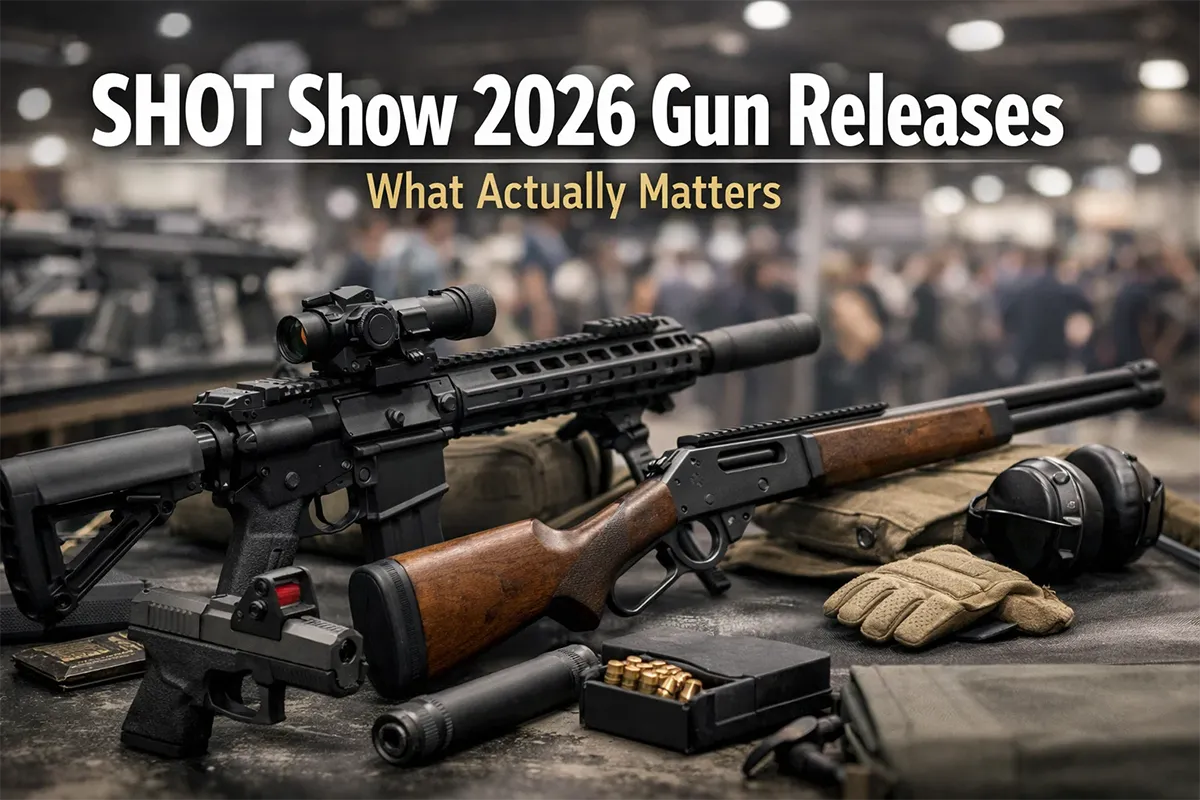
SHOT Show 2026 gun releases can be noisy—lots of “new,” not all of it meaningful. The smart move is to sort announcements into a few practical buckets (carry pistols, suppressor-ready setups, modernized lever guns, and “do-everything” AR-style rifles), then use a simple checklist to compare what fits your use case and budget.
SHOT Show is where the industry tries to set the tone for the year. That doesn’t mean every launch is a must-have, or even easy to find right away. What it does mean: you’ll see patterns. When multiple brands independently push the same features at the same time, that’s usually the real story.
This deep dive focuses on what to look for in SHOT Show 2026 gun releases—the practical trends that affect how a firearm carries, shoots, mounts accessories, and holds up over time. You’ll leave with a “research checklist” you can use on GunGenius pages, plus a few solid comparison anchors so you’re not shopping in a vacuum.
The big picture from SHOT Show 2026 gun releases
Instead of trying to memorize every booth announcement, focus on the “why” behind the releases. In 2026, the signals buyers typically care about fall into a handful of categories:
- Carry guns keep getting easier to shoot well (better triggers, better optics mounting, better recoil control in small frames).
- Factory optics-ready is no longer “premium”—it’s baseline. The question is which footprint, which height sights, and how well it’s executed.
- Suppressor-ready features migrate downward from enthusiast models into mainstream SKUs (threaded barrels, taller sights, tuned reliability).
- Lever guns keep modernizing with rails, better stocks, and practical calibers—not just nostalgia.
- AR-style rifles get more “mission-specific” (lighter, shorter, better muzzle devices, improved controls), while still aiming for broad compatibility.
None of these trends is brand-exclusive, so you can use them to evaluate anything new that drops after the show—whether it’s a flagship model or a quieter “line refresh.”
Trend 1: optics-ready isn’t enough—execution is everything
“Optics-ready” can mean anything from a clean, durable mounting system to a rushed plate stack that sits too tall and loosens over time. In 2026, the difference between a good and bad optics-ready pistol is often hidden in the details:
- Direct-mount vs. plates: Direct mounting can be lower and simpler, but plates provide flexibility. Either can be excellent—or annoying—depending on machining and hardware quality.
- Co-witness options: Many shooters want backup irons. If the pistol needs extra-tall sights to see over the optic, that changes holster fit and snag potential.
- Footprint choices: Some pistols lock you into one pattern. Others support multiple footprints. Neither is “wrong,” but your optic choices (and costs) change.
If you’re researching new semi-auto pistols, start here: Semi-auto pistols. Then compare a few established optics-ready families to whatever new model caught your eye, such as popular lines from SIG Sauer, Glock, Smith & Wesson, or Springfield.
Trend 2: carry pistols keep adding “shootability” features
The micro-compact 9mm era changed expectations: people want small pistols that don’t punish them at the range. So the 2026 playbook often looks like this:
- Compensated or ported variants: Cuts or comps can reduce muzzle rise. The tradeoffs are louder blast, more flash, and sometimes stricter ammo preferences for reliability.
- Better grip geometry: Subtle changes (beavertail shape, palm swell, texture) can matter more than a marketing bullet point.
- More flexible “size ladder” lineups: Same platform, multiple slides and grip modules—so you can tune concealment vs. control.
When you’re comparing “new carry launch” vs. “proven carry staple,” focus on the boring stuff: how it fits your hand, how it runs with your intended ammo, and whether the support ecosystem (mags, holsters, spare parts) exists yet. Early in a product’s life, accessories can lag behind—even if the pistol is genuinely good.
Trend 3: suppressor-ready moves from niche to normal
Suppressors aren’t just for specialized builds anymore. More shooters are pairing a suppressor with a home-defense carbine, a range pistol, or a hunting rifle to reduce blast and improve comfort. The 2026 release vibe reflects that, with more factory-ready options.
What “suppressor-ready” should mean (ideally): a threaded barrel, an optic/sight setup that still works with the added height/length, and reliability that doesn’t get picky once you add backpressure (especially on semi-autos).
What it sometimes means in practice: “we added threads.” That’s not bad—just incomplete. If a new SHOT Show 2026 model is pitching suppressor use, look for details about recoil spring tuning, gas regulation (on rifles), and whether the company acknowledges point-of-impact shift and maintenance realities.
Trend 4: lever actions keep getting a practical makeover
Lever guns aren’t only for cowboy vibes anymore. The modern lever trend is about usability: optics mounting, better stocks, sling points that make sense, and calibers people actually want for hunting and property defense roles.
If your SHOT Show short list includes a “tactical” lever gun, sanity-check these points:
- Mounting surface: Is there a stable rail, or are you relying on improvised solutions?
- Stock ergonomics: A good cheek weld and length-of-pull options matter if you plan to run an optic.
- Loading gate and tube behavior: Smooth loading and consistent feeding are the difference between fun and frustrating.
Browse the category here: Lever-action rifles. If you want brand starting points, check lineups from Henry, Marlin, Winchester, and Ruger (who has influenced modern lever availability in recent years).
Trend 5: AR-style rifles go “purpose built,” but compatibility still rules
Every year brings new AR-style rifles, and 2026 is no different. The theme you’ll keep seeing is “purpose built”: lighter setups for run-and-gun, shorter configurations for tight spaces, accuracy-leaning builds for distance, and feature packages that bundle what people used to add aftermarket.
The trap: a rifle can be purpose built and proprietary. That’s fine if it’s done well, but it can complicate maintenance and upgrades. If you’re comparing new SHOT Show releases in the AR space, put a star next to:
- Parts compatibility: Standard pattern parts are easier to support long-term.
- Gas system choices: Especially relevant if you plan to suppress the rifle.
- Controls and ergonomics: Ambidextrous controls are great, but check whether they add complexity or snag points.
Start broad here: Semi-auto rifles. Then filter by brand if you already trust a manufacturer’s track record—examples include Daniel Defense, Aero Precision, Colt, and Ruger.
Quick spec table: how to compare SHOT Show announcements without getting lost
Use this as a “first pass” filter. If a new release doesn’t improve something you care about, it probably isn’t worth chasing—at least not at launch.
| Platform | What’s often “new” at SHOT | What to verify before you buy | Best fit for |
|---|---|---|---|
| Micro-compact 9mm | Optics-ready, comps/ports, new grip modules | Reliability with your ammo, optic footprint, holster support | Concealed carry, training |
| Duty-size pistol | Better triggers, improved mounting systems, updated textures | Durability, sight options, magazine availability | Home defense, duty/competition crossover |
| AR-style rifle | Lighter rails, better controls, tuned muzzle devices | Parts compatibility, gas system behavior, accuracy expectations | General-purpose carbine, sport shooting |
| Lever-action rifle | Rails, modern stocks, “practical” variants | Feeding smoothness, optic mounting stability, sling setup | Hunting, property use, range fun |
Comparisons: how to anchor a “new for 2026” pick against proven options
When a new SHOT Show 2026 model drops, the temptation is to compare it against the marketing claims. A better method is to compare it against “known quantities” in the same role. Here are simple anchor comparisons you can use:
- Carry pistol anchor: Compare to well-established micro-compact families (example anchor pages you can reference as you research: SIG Sauer P365 and Springfield Hellcat). Focus on shootability and support ecosystem, not just capacity.
- “Do-everything” carbine anchor: Compare a new AR-style rifle to mainstream, serviceable configurations rather than boutique builds (example anchors: Daniel Defense DDM4 and Ruger AR-556). Ask: what’s improved that you’ll actually notice?
- Modern lever anchor: If you’re looking at a new rail-equipped lever, compare it to a traditional baseline from a major maker, then decide whether the modernization solves a real problem for you (example anchor: Henry Big Boy).
Those internal links are meant as research starting points, not endorsements. The best “new release” is the one that fits your intended role with minimal drama—and that often means valuing mature magazines/holsters/parts as much as the firearm itself.
Research checklist: 9 questions to ask before chasing a SHOT Show 2026 release
- What problem does it solve? Smaller carry? Better recoil control? Easier optic mounting? If you can’t answer this in one sentence, it may be a refresh, not a leap.
- What’s the “support cost”? New mags? New holster fit? Proprietary parts? Early adopters pay this cost more than the MSRP suggests.
- Which optic footprint is supported? This can lock you into specific optics and price tiers.
- Are sights usable with an optic? If you want backups, confirm sight height options.
- What’s the real size and weight? Marketing photos lie. Dimensions and loaded weight drive comfort and performance.
- How does it handle recoil? Porting/comps can help, but may increase blast and maintenance.
- Does it suppress well (if relevant)? Threaded barrel is step one. Reliability and tuning matter more.
- What’s the availability timeline? Some “announced at SHOT” items ship quickly; others drift. Plan around what you can actually buy.
- What are the boring reliability signals? Proven design lineage, reputable QA, and consistent parts availability beat flashy features.
What to watch next after the show
After SHOT Show, the market often clarifies fast: early reviews hit, first production runs ship, and real-world feedback highlights what marketing skipped. If you’re researching a 2026 release, a smart approach is to bookmark the category it lives in and revisit as new variants appear and availability stabilizes.
To keep your search organized, browse the bigger buckets on GunGenius and narrow from there:
- Handguns (carry, duty, and range pistols)
- Rifles (AR-style, lever, bolt, and more)
- Shotguns (home defense, hunting, sporting)
If you only take one thing from SHOT Show 2026 coverage, let it be this: a “new release” is just a bundle of tradeoffs. Your goal isn’t to buy what’s new—it’s to buy what’s right for your role and your tolerance for early-adopter quirks. (And yes, the most “exciting” launch is often the one that becomes boringly reliable six months later.)