
Beretta 1301 vs Benelli M4: Picking the Right Semi-Auto Defensive Shotgun
January 30, 2026
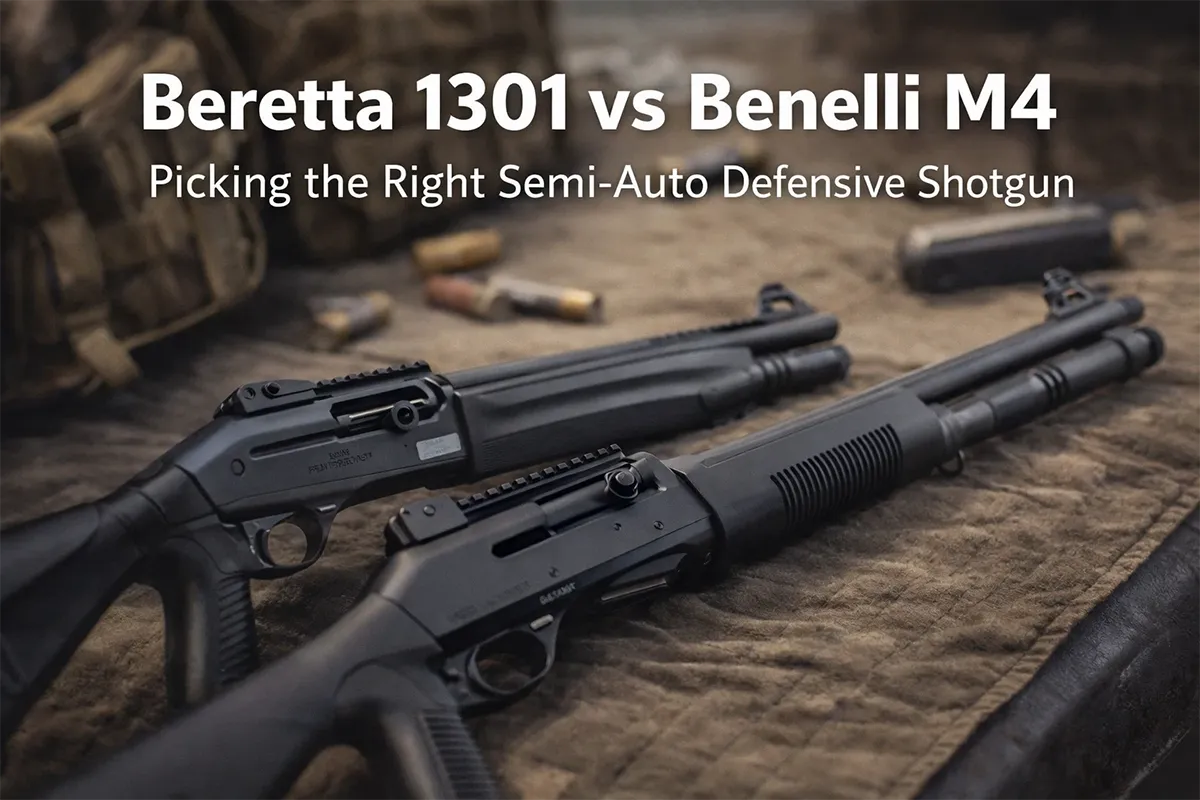
If you’re deciding between Beretta 1301 vs Benelli M4, you’re really choosing your “operating system” (gas vs. inertia), your tolerance for weight, and how much you value fast cycling versus “set it and forget it” ruggedness. This deep dive breaks down what matters for home defense, training, and practical shooting—so you can research the right shotgun without getting lost in forum noise.
Semi-auto shotguns are having a moment because they solve a real problem: they let you run a 12 gauge with less felt recoil and faster follow-up shots than most pump guns, especially when you’re practicing regularly. But “semi-auto” isn’t one thing. The Beretta 1301 family and the Benelli M4 represent two proven approaches, and the Mossberg 940 Pro Tactical sits in a “value-forward, modern features” lane. The right answer depends on your use case, not the comment section (sadly).
Before we get specific, two quick definitions:
- Gas-operated (typical of the 1301 and 940): a small amount of gas from the fired shell cycles the action. This often softens recoil and can be very fast-cycling, but it may need more routine cleaning if you shoot a lot.
- Inertia-operated (Benelli-style systems; the M4 is a bit of its own thing): the gun uses recoil forces and internal movement to cycle. Inertia guns are famously clean-running, but recoil impulse can feel sharper than gas in otherwise similar setups.
If you want to browse the broader field as you read, start with the category page for semi-auto shotguns, then drill into brands like Beretta, Benelli, and Mossberg.
The Trend: Why Semi-Auto Defensive Shotguns Are Getting More Practical
What’s changed isn’t that semi-autos are “new.” It’s that more people are willing to train with them, and manufacturers are building configurations that come ready for modern setup out of the box: shorter barrels, better sights, improved loading ergonomics, and accessory mounting options for lights and slings.
For home defense, that matters because your setup needs to be repeatable under stress: a consistent sight picture, a light that stays put, and controls you can run without thinking. For practical shooting (like 3-gun or general range drills), it’s about cycling speed, recoil control, and how quickly you can load. A shotgun that’s “reliable” but miserable to practice with is a paperweight with a good reputation.
Key Specs Snapshot
| Platform | Action | Caliber | Barrel / Weight | Capacity | OAL | MSRP / Street |
| Beretta 1301 (Tactical variants) | Gas | 12 ga | Typically 18–19″ / varies by SKU | Often 5+1 to 7+1 (varies) | Varies by SKU | Varies by trim and market |
| Benelli M4 | Semi-auto (Benelli-style system) | 12 ga | Typically 18.5″ / heavier build | Often 5+1 (varies by configuration) | Varies by SKU | Varies; commonly higher-priced |
| Mossberg 940 Pro Tactical | Gas | 12 ga | Typically 18.5″ / varies | Often 7+1 (varies) | Varies by SKU | Varies; commonly mid-tier |
Note: Exact numbers vary by sub-model and state-compliant configurations. Treat specs as “configuration-dependent,” then confirm the exact SKU you’re researching.
Beretta 1301 vs Benelli M4: What You’re Actually Choosing
Most comparisons get stuck on brand loyalty. A more useful way to think about it: you’re choosing how the gun behaves when you shoot it fast, how it behaves when it’s dirty, and how it fits the way you plan to use it.
1) Recoil feel and speed
Gas guns (like many 1301 and 940 variants) often feel “softer” in recoil because the operating system bleeds off some energy to cycle the action. That can help you stay on target for quicker follow-up shots—especially with full-power buckshot and slugs.
The Benelli M4 is famous for running hard and running reliably, but many shooters describe the recoil impulse as more “direct” compared to a comparable gas gun. That doesn’t mean it’s painful; it means you may notice a different push, especially over long practice sessions.
2) Maintenance reality
If you shoot a lot—classes, weekly range sessions, drills—gas systems usually reward routine cleaning. Not obsessive cleaning, just the kind of “wipe, brush, re-lube” maintenance that keeps carbon from becoming a personality trait.
Inertia-style systems are often praised for staying cleaner because they don’t route gas into the same parts of the operating system. The tradeoff can be load sensitivity or technique sensitivity in some designs (for example, how the gun is shouldered), though this varies by model and setup. The practical takeaway: if you’re the type who hates cleaning, your research should include a realistic look at your own habits.
3) Ergonomics: the “you’ll feel it every reload” factor
For defensive use, ergonomics show up in simple questions:
- Can you load it quickly without biting your thumb or fighting the loading port?
- Can you run the safety and bolt controls with the hand size you actually have?
- Does it balance well with a weapon light and sling attached?
In practical shooting, ergonomics can matter as much as reliability because loading is often the limiting skill. A shotgun that loads smoothly and consistently can feel “faster” than a shotgun that technically cycles fast but slows you down every time you top off.
How the Mossberg 940 Pro Tactical Fits Into This
It’s tempting to treat the Mossberg 940 Pro Tactical as “the cheaper one,” but that’s not the most helpful lens. A better lens is: it’s often positioned as a modern, feature-forward gas semi-auto that aims to deliver a lot of practical performance without climbing into the price territory of the most premium options.
If you want a defensive semi-auto you’ll actually train with, this is where the 940 can shine: you can put budget into a reliable light, a sling, dummy shells for practice, and a case of ammo. The shotgun is only half the system; the practice is the other half.
Use-Case Recommendations
Home defense (primary goal: repeatable, controllable, low-fuss)
For home defense, prioritize:
- Reliability with your chosen defensive load (test buckshot and slugs you can actually buy and keep stocked).
- A durable weapon light setup (positive ID matters more than almost any accessory choice).
- Simple sighting you can pick up fast in low light (good irons or a robust optic solution, depending on the model).
Many people end up favoring a gas semi-auto here because recoil management encourages practice and quicker follow-ups. But if your personal “confidence factor” leans toward the M4’s reputation and you’re willing to train with it, that’s a valid decision. The best defensive shotgun is the one you can run at 2 a.m. with your heart rate in your throat.
Training classes and high round counts (primary goal: shootability + uptime)
If you’re planning to attend a shotgun class, the deciding factors often become heat, friction, and loading. Gas guns can feel smoother over long strings, while inertia-style guns may feel cleaner-running. Either way, bring spare consumables (like an extra sling mount, basic tools, and lube) and learn the basic field-stripping steps before class day.
3-gun and practical shooting (primary goal: load fast, cycle fast, don’t choke)
Competition rewards consistency. If you’re leaning this direction, pay attention to:
- Loading port design and how friendly it is to quad-load or strong-hand loading techniques.
- Controls you can hit without breaking your grip.
- Balance with an extended tube and match-ready setup.
In this lane, the “best” shotgun is the one that matches your loading style and runs your match ammo reliably. A slightly less expensive shotgun that you can afford to practice loading with every week can outperform a premium shotgun you rarely shoot.
Model Pages to Compare on GunGenius
To keep your comparison clean, line up the models side-by-side:
- Beretta 1301 Tactical (start here if you want a fast-cycling gas defensive semi-auto)
- Benelli M4 (start here if you want a proven, duty-oriented platform and don’t mind extra weight)
- Mossberg 940 Pro Tactical (start here if you want modern features and value)
Research Checklist: What to Verify Before You Buy
- Exact SKU configuration: barrel length, sights, stock style, and capacity can change the whole feel of the gun.
- Ammo compatibility: confirm it runs the loads you’ll actually use (buckshot/slugs for defense; your chosen target loads for practice).
- Light and sling mounting: plan attachment points before you buy accessories.
- Support ecosystem: availability of replacement parts, magazines/tubes (where applicable), and common wear items.
- Training plan: budget for a class or structured practice—semi-autos reward reps.
What to Watch Next
Over the next month, keep an eye on two things: (1) SKU expansions—manufacturers often refresh tactical lines with small changes that matter (sights, controls, included tubes), and (2) accessory trends—especially robust light mounts and “shootability” upgrades that don’t compromise reliability. If you’re unsure where to start, continue browsing semi-auto shotguns and filter down by brand and intended use.
One last practical note: whichever platform you choose, buy a couple of boxes of the exact defensive load you plan to rely on and test it. The goal isn’t to torture-test—it’s to confirm function and build confidence. Confidence is a feature you earn, not something that ships in the box.