
Small-Frame .308 Rifles: What to Buy (and What to Skip) in 2025
December 22, 2025
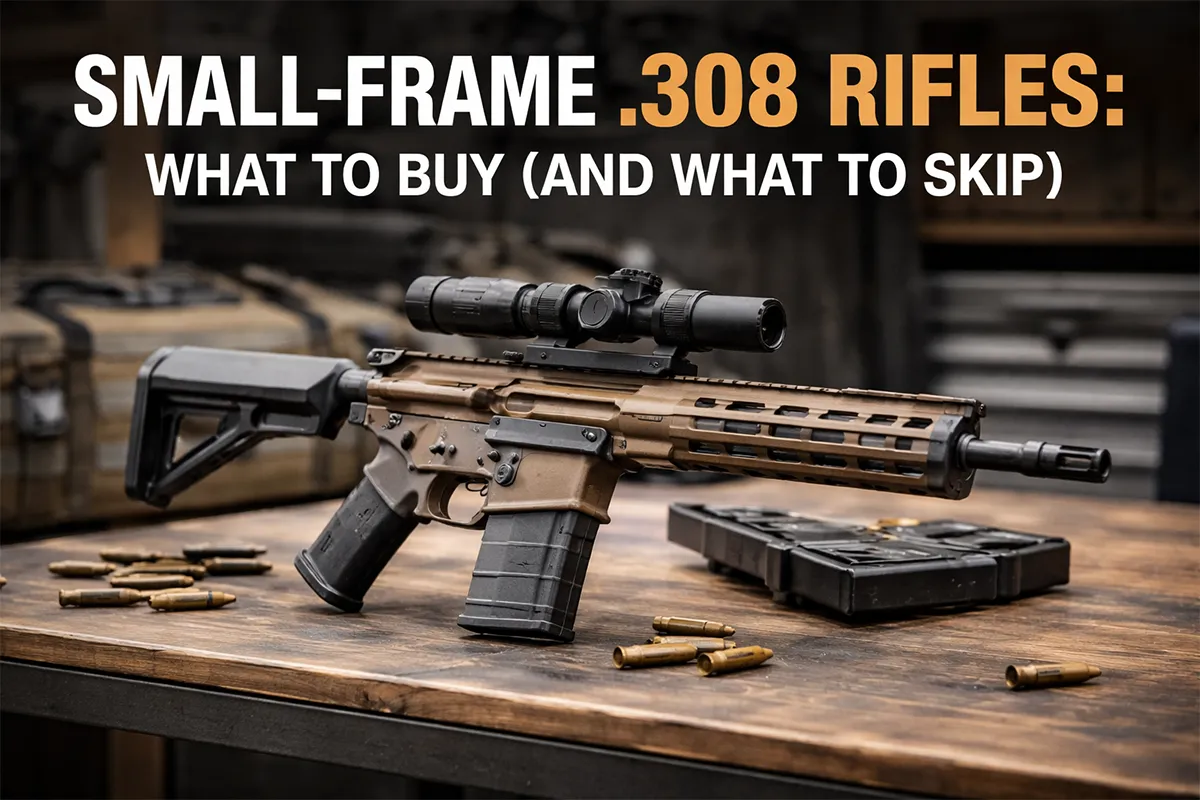
Small-frame .308 rifles give you .308/7.62 performance in a package that carries and handles closer to a 5.56-size rifle—but the best picks are the ones that manage gas, heat, and parts compatibility without turning “lightweight” into “finicky.”
On December 21, 2025, small-frame .308 rifles are firmly in the “serious option” category—not just a novelty. The appeal is obvious: hunters want a lighter semi-auto that still hits like a traditional .308, and range shooters want an easier-to-carry 7.62 that doesn’t feel like a boat anchor. The catch is that physics still shows up to the party.
Why small-frame .308 rifles are trending
Classic AR-10–style rifles can be excellent, but many land in the 8.5–10+ lb “before optic” reality. A true small-frame approach aims to pull that weight back toward “general-purpose carbine” territory while keeping SR-25/AR-10 magazine compatibility and common 7.62 NATO / .308 Win. chambering.
That combination matters if you’re:
- Hunting on foot and want faster follow-ups than a bolt gun (where legal and appropriate).
- Building a do-most-things rifle that can run range days, property use, and seasonal hunting roles.
- Recoil-sensitive but still committed to .308/7.62—because a lighter rifle can feel sharper if the gas system isn’t tuned well.
What “small-frame” actually means (and why it matters)
“Small-frame” isn’t a universal standard like “AR-15.” In practice, it usually means the manufacturer reduced receiver/bolt-carrier dimensions and/or redesigned internal geometry to shave weight and bulk—while still feeding from common .308-pattern magazines. That’s good for carry and handling, but it can create two buyer traps:
- Parts assumptions: Not every “.308 AR” part is drop-in across brands. Treat compatibility claims carefully—especially around bolts, barrels, and gas parts.
- Gas/recoil management: Less mass can mean a snappier cycle if the system is overgassed or under-buffered.
Quick spec snapshot: popular 16–20″ options
| Platform | Action | Caliber | Barrel length / Weight | Capacity | Overall length | MSRP / Street |
|---|---|---|---|---|---|---|
| Ruger SFAR (Model 5610) | Semi-auto | 7.62 NATO / .308 Win | 16.10″ / 6.8 lb | 20 | 37.25″ | $1,329 MSRP |
| Ruger SFAR (Model 5611) | Semi-auto | 7.62 NATO / .308 Win | 20″ / 7.3 lb | 20 | 41.25″ | $1,329 MSRP |
| SIG 716i TREAD | Semi-auto | 7.62 NATO | 16″ / 8.5 lb | 20 | 37″ | Varies |
| S&W M&P10 Sport OR | Semi-auto | .308 Win / 7.62×51 | 16″ / 8.0 lb | 20+1 | 34.25″ collapsed / 37.5″ extended | Varies |
Buyer checklist: what to prioritize
If you’re comparing rifles in this class, focus less on hype and more on these practical checkpoints:
- Weight (unloaded) and balance: Light is great—until the muzzle gets whippy or the recoil impulse feels harsh.
- Gas system features: An adjustable gas block/regulator can be a big quality-of-life upgrade, especially if you plan to change ammo types frequently.
- Magazine pattern: SR-25/AR-10 pattern compatibility makes life easier for spares and troubleshooting.
- Barrel length choice: 16″ favors handling; 18–20″ favors velocity and a steadier feel. Pick based on your typical distances and carry needs.
- Handguard and mounting: M-LOK and a solid top rail keep optics/light/sling setups straightforward.
- Trigger and controls: A clean trigger helps more than most “tactical” add-ons when you’re trying to shoot tight groups with .308.
How to choose between 16″ and 20″
For most people, this is the decision that actually determines happiness long-term.
16-inch small-frame .308 rifles
Best if you prioritize carry comfort, quick handling, and “one rifle for a lot of chores.” Expect more blast and a brisker recoil feel (especially with certain loads), but a well-tuned system can keep it very manageable.
20-inch small-frame .308 rifles
Best if you want a steadier rifle for field positions, a bit more velocity, and a calmer overall shooting experience. It’s also easier to “shoot well” from a bench or bipod when the rifle has a little more length and weight out front.
Optics pairing: keep it simple and role-driven
Pick the optic based on what you realistically do most:
- 0–200 yards, fast handling: a durable red dot can be surprisingly effective and keeps the rifle light.
- General-purpose range + hunting: a practical low-power variable optic (LPVO) or a lightweight 2–10x class scope often makes more sense than chasing maximum magnification.
- Precision-leaning setup: prioritize a stable mount and repeatable turrets over extra features you won’t use.
Where to research and compare on GunGenius
If you want to compare weights, barrel lengths, and features across the field, start in Semi Auto Rifles and filter down to what matches your use case.
For brand-level browsing, the quickest jump-in points are Ruger, SIG SAUER, and Smith & Wesson.
If you’re specifically shopping the “small-frame” idea, treat the catalog like a spec comparison tool: weigh the rifle, then weigh the system (gas, mags, and support) right alongside it.
What to watch next
Over the next month, expect more “lighter, more modular” messaging as brands chase the same buyer: someone who wants .308 authority without committing to a heavy, bench-first rifle. Keep an eye out for incremental updates like improved gas adjustability, lighter handguards, and more factory “ready-to-mount” configurations that don’t require immediate parts swaps.