
9mm Pistol Caliber Carbine Guide: Blowback vs Delayed (and What to Buy in 2026)
February 5, 2026
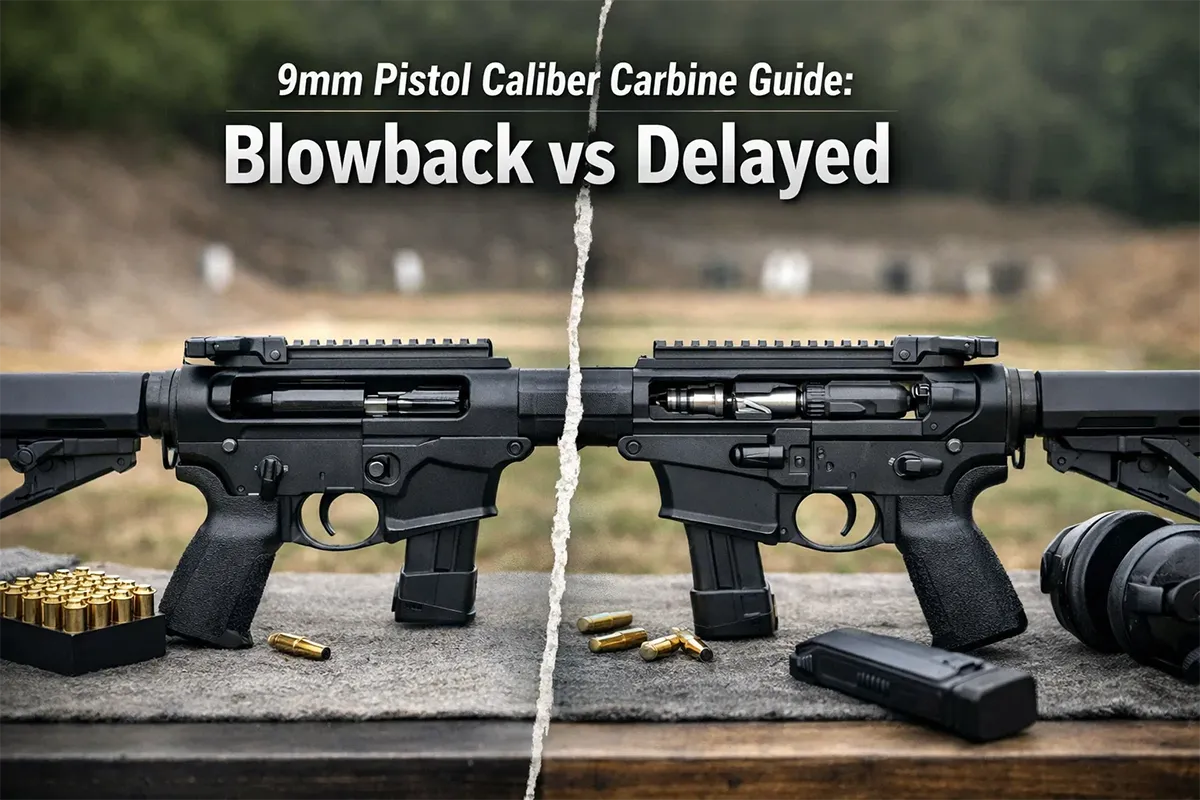
A 9mm pistol caliber carbine (PCC) can be a low-recoil, high-practice platform—especially if you share ammo with a 9mm handgun. Your biggest “make-or-break” decision is the operating system: simple direct blowback (cheap, common, a bit snappy) vs delayed systems (smoother, often better suppressed, usually pricier). This guide helps you pick the right setup and research the models that fit your use case.
PCCs live at the intersection of convenience and capability. They’re easy to shoot well, often accept common magazines, and can be configured from “range toy” to serious training tool. But the internet tends to lump them all together. In reality, a PCC’s action type (how it cycles) drives recoil feel, reliability with different ammo, suppressor friendliness, and even how dirty it runs.
What a 9mm Pistol Caliber Carbine Is (and Isn’t)
A 9mm PCC is a shoulder-fired firearm chambered in 9x19mm that feeds from a detachable magazine. Most are semi-auto and use simple controls. Compared to a 5.56 rifle, you’ll typically get less blast and recoil, and you may find indoor range rules friendlier to pistol calibers. Compared to a handgun, you usually get better stability, easier optics mounting, and faster learning for new shooters.
What it isn’t: a magic “one-gun solves everything.” 9mm is still 9mm. Velocity gains from longer barrels vary by load, and terminal performance depends heavily on ammo choice and realistic distances. Think of a PCC as a practice-friendly and control-friendly platform that can mirror your handgun ecosystem.
9mm Pistol Caliber Carbine Operating Systems: Blowback vs Delayed
In plain English, the action controls how hard the bolt slams back and forth. That “mass moving around” is most of what you feel as recoil in many 9mm PCCs. Here are the main types you’ll see while researching.
- Direct blowback: The most common system. There’s no mechanical delay—just bolt mass and recoil spring resistance. It’s simple and affordable, but the bolt is typically heavy, which can feel “thumpy,” especially with hotter loads or when suppressed.
- “Dead blow” or buffered blowback: Still blowback, but tuned with weights/buffers to reduce bolt bounce and smooth cycling. This can noticeably improve feel without changing the basic design.
- Delayed blowback (multiple flavors): Uses mechanical leverage (radial delay, roller delay, etc.) to slow initial bolt movement. Often feels softer and can be less gassy with a suppressor, but adds cost and complexity.
- Gas piston (rare in 9mm): A few premium designs use a closed-bolt, piston-driven approach. These can feel exceptionally smooth and handle suppression well, but they’re usually the most expensive lane.
If you only remember one thing: direct blowback usually wins on price and simplicity, while delayed/gas systems often win on shootability (especially when you add a suppressor). Physics is rude like that.
The Real-World Tradeoffs That Matter
Specs are helpful, but your day-to-day experience comes down to a few practical questions.
1) Recoil impulse and sight bounce
Many first-time buyers assume “9mm = no recoil.” The cartridge is mild, but a heavy blowback bolt moving quickly can create a sharp pulse that bounces your dot. Delayed systems typically reduce that “mass slam” feeling, making rapid strings easier to keep tidy.
2) Suppressor behavior and gas
Suppressors add backpressure. On many direct-blowback PCCs, that can increase bolt speed and send more gas and debris back toward the shooter. Delayed systems (and some well-tuned blowback designs) can mitigate this. If “future suppressor host” is on your checklist, put extra weight on the operating system and muzzle thread compatibility.
3) Magazine ecosystem and feed reliability
Feeding 9mm from a double-stack pistol magazine isn’t the same as feeding rifle cartridges from a straight-in AR magwell. Some PCCs are famously tolerant; others are picky about magazine brand, follower design, or bullet profile. If you want “boring reliable,” research what mags the platform is happiest with and budget to buy several identical magazines.
4) Parts and support
AR-style 9mm builds are a rabbit hole—in a good way if you like tuning, and a frustrating way if you want plug-and-play. Purpose-built PCCs can be simpler to live with, while AR-pattern PCCs can be easier to customize once you understand the quirks (buffers, bolt ramps, magazine geometry, ejector alignment, and so on).
Quick Spec Table: Popular 9mm PCC Research Targets
These are common reference points shoppers compare. Exact specs vary by SKU, trim, and state-compliant variants, so treat this as a “start here” table—not the final word.
| Firearm | Platform | Action | Caliber | Barrel/Weight | Capacity | OAL | MSRP/Street |
| Ruger PC Carbine | Carbine | Blowback (tuned) | 9mm | ~16″ / ~6.8–7.3 lb | Varies (often 10–17+) | ~34–36″ | Varies by SKU |
| CZ Scorpion 3+ Carbine | Carbine | Blowback | 9mm | ~16″ / ~6.8–7.0 lb | Often 20+ | Varies w/ stock | Varies by SKU |
| SIG MPX (9mm) | Modular | Gas piston | 9mm | Varies by model | Varies | Varies | Varies by SKU |
| CMMG Banshee (9mm) | AR-style | Delayed (radial) / varies | 9mm | Varies by SKU | Varies (often 10–33) | Varies | Varies by SKU |
| Aero Precision EPC-9 | AR-style | Blowback | 9mm | Varies by build | Varies | Varies | Varies by build |
Model-by-Model: What Each One Is Best At
Instead of chasing “the best PCC,” match a platform to your priority. Here’s the short, practical way to think about a few common choices.
Ruger PC Carbine (Ruger)
The PC Carbine is a top “first PCC” pick because it’s straightforward, widely supported, and commonly offered with features that matter (like takedown capability on many variants and threaded muzzle options on some SKUs). It’s also known for playing nicely with popular magazine ecosystems depending on the included magwell setup.
Who it’s for: the buyer who wants a dependable, mainstream 9mm carbine for range time, training, and general utility without building a platform from scratch.
CZ Scorpion 3+ Carbine (CZ-USA)
The Scorpion line is a “PCC classic”: compact layout, lots of aftermarket, and a design that’s easy to run once you set it up the way you like. Expect typical blowback behavior—reliable and simple, with recoil feel driven more by bolt mass than cartridge energy.
Who it’s for: the shooter who wants a compact, modern PCC format with tons of accessories and doesn’t mind the normal blowback “thump.”
SIG MPX (SIG Sauer)
The MPX sits in the premium lane. Where many PCCs rely on heavy blowback bolts, the MPX’s gas-piston approach is often praised for smoothness and controllability. It’s a serious option for shooters who value performance and refinement more than bargain pricing.
Who it’s for: competition-minded shooters, serious trainers, and anyone prioritizing recoil feel and suppressor-friendly behavior over upfront cost.
CMMG Banshee (9mm) (CMMG)
CMMG’s 9mm options are often researched because they can land in that “best of both worlds” zone: AR-style ergonomics with a delayed-style approach on many models, aiming for a smoother impulse than plain blowback. Depending on the exact SKU, you’ll see different barrel lengths, braces/stocks, and magazine approaches, so verify the model name carefully.
Who it’s for: AR-savvy users who want a 9mm platform that can feel more refined than typical blowback while keeping familiar controls.
Aero Precision EPC-9 (Aero Precision)
The EPC-9 represents the AR-pattern PCC world: modular, customizable, and widely supported—but also more dependent on correct parts pairing (buffer system, bolt, magazine choice). If you enjoy tailoring a setup to your preferences, this lane can be very rewarding. If you want “open box, shoot forever,” it can take more homework.
Who it’s for: tinkerers and AR builders who want to control every detail, from trigger to handguard to muzzle device.
Compatibility Notes That Save You Money
- Magazine standard: Don’t assume “takes Glock mags” (or any other mag) until the exact SKU confirms it. Buy a few quality mags and test them before you stockpile.
- Thread pitch: Many 9mm barrels are threaded, but not always the same pitch. Match your muzzle devices and any suppressor mounts to the barrel’s thread spec.
- Optics mounting: Most modern PCCs accept a red dot easily, but the height over bore and stock/brace geometry can affect cheek weld. Plan your optic and mount as a system.
- Aftermarket vs proprietary: AR-pattern PCCs can share some AR parts, but 9mm bolts/buffers/mag setups are their own ecosystem. Purpose-built PCCs often use more proprietary components.
A Short Research Checklist (Print This Before You Shop)
- Decide your priority: lowest cost, smoothest shooting, best suppressor host, or most modular.
- Choose the action: direct blowback (simple) vs delayed/gas (usually smoother).
- Pick your magazine ecosystem and stick to it.
- Confirm barrel length, overall length, and whether the muzzle is threaded (and to what spec).
- Plan your optic height and stock/brace setup so the gun fits you.
- Budget for the unsexy stuff: magazines, spare parts, a case, and enough ammo to validate reliability.
Where to Browse Next on GunGenius
If you’re still narrowing it down, start broad and then go brand-by-brand. Browse the PCC-friendly options under Semi Auto Rifles, then compare common makers like Ruger, CZ-USA, SIG Sauer, CMMG, and Aero Precision.