
357 vs 44 Lever Action Rifle: How to Pick the Right Magnum for Your Needs
January 23, 2026
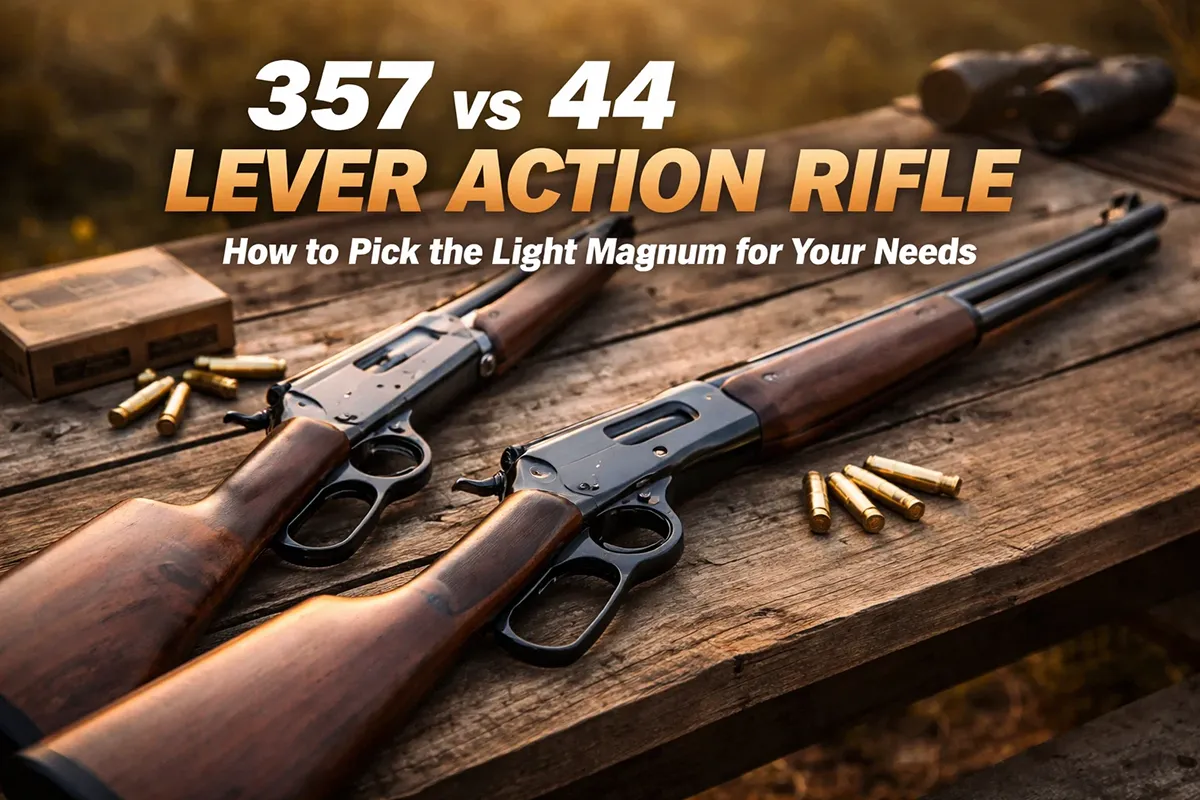
If you’re stuck between a 357 vs 44 lever action rifle, you’re really choosing a “system” more than a single gun: cartridge cost and availability, recoil, magazine capacity, and what ranges you’ll realistically shoot. Both .357 Magnum and .44 Magnum shine in handy lever guns, especially inside 150 yards. This deep dive breaks down the real-world tradeoffs, what to look for in rifle specs, and which cartridge tends to fit which shooter.
Choose .357 Magnum if you want softer recoil, cheaper practice, and higher capacity (often) with strong performance using the right loads. Choose .44 Magnum if you prioritize heavier bullets, bigger wound channels at close range, and you don’t mind more recoil and higher ammo costs.
Why this choice matters in a lever gun
Lever-action rifles amplify what you like (and dislike) about a cartridge. A longer barrel can add velocity, and a stocked rifle usually makes recoil feel more manageable than the same cartridge in a handgun. At the same time, a tubular magazine and a lightweight carbine format make you notice differences in feeding, overall length (OAL), and how “snappy” a load feels on target.
Most buyers are shopping this category for one (or more) of these roles: a woods rifle for deer-sized game at modest ranges (where legal), a ranch/truck gun, a simple defensive long gun, or a companion rifle to a revolver in the same caliber. The good news: both cartridges work. The better news: the “right” one becomes obvious once you match the cartridge to your realistic distances and tolerance for recoil and ammo cost.
Browse the broader category here: Lever Action Rifles.
357 vs 44 lever action rifle: quick decision guide
- Pick .357 Magnum if you want: lower recoil, lower cost per shot (typically), more comfortable high-volume range days, and often a couple extra rounds in the tube.
- Pick .44 Magnum if you want: heavier bullets, excellent close-range authority, and you’re okay with more recoil and cost.
- If you already carry a revolver in one of these calibers, matching your rifle to your handgun can simplify ammo logistics—especially for travel, field use, or “one ammo can” planning.
Key specs that change the experience
When you compare models, pay attention to these rifle details more than the marketing name:
- Barrel length: 16–20 inches is common. Short barrels carry easily; longer barrels can add velocity and a steadier sight picture.
- Weight: A heavier rifle usually feels softer with .44 Magnum. Featherweight carbines are fun… until you start touching off full-power loads.
- Magazine capacity: Tube capacity varies by barrel length and cartridge. .357 often holds more rounds than .44 in the same model.
- Sights & optics mounting: Some models come drilled/tapped for optics. If you want a low-power optic or a micro red dot, confirm mounting options before you fall in love.
- Twist rate and bullet compatibility: Most factory rifles handle common bullet weights well, but extreme heavy-for-caliber bullets can be a special case.
- Feeding reputation: Lever guns can be load-sensitive. Some prefer certain bullet shapes or overall lengths—especially with shorter actions.
Side-by-side: what you usually get from each cartridge
| Factor | .357 Magnum in a lever rifle | .44 Magnum in a lever rifle |
|---|---|---|
| Recoil feel | Light to moderate; easy to shoot fast | Moderate to heavy (load-dependent); benefits from rifle weight |
| Practice cost | Often lower (especially with .38 Special options) | Often higher |
| Versatility | Can also run .38 Special in many guns | Some rifles also run .44 Special |
| Typical capacity | Often higher in the same barrel length | Often lower in the same barrel length |
| Best fit | High-volume range, training, smaller-stature shooters, “do-it-all” woods use | Close-range hunting emphasis, hog/brush country, max punch inside typical lever distances |
| Downside | Less bullet mass and frontal area than .44 | More recoil and cost; can be overkill for casual range days |
Performance reality check (without the hype)
In a rifle, both cartridges gain velocity compared to typical handgun barrels. That can improve expansion reliability for hunting-style bullets and can flatten trajectory a bit—though neither is a “laser beam” at distance. Inside 100 yards, the practical differences are less about raw numbers and more about shot placement, bullet construction, and how confidently you can run the gun.
.357 Magnum is usually easier to shoot well, especially for newer shooters or anyone who wants fast follow-up shots. It’s also the friendlier choice for long practice sessions. And if your rifle accepts .38 Special, you unlock a soft-shooting, low-cost training path that makes a lever gun feel like the world’s most charming recoil therapy.
.44 Magnum brings weight and diameter advantages. With appropriate loads, it’s well known for strong close-range results on deer-sized game (where legal) and can be a reassuring pick in thick cover where shots are short and angles can be less than perfect. The tradeoff is that full-power .44 loads can be loud, sharp, and tiring in a light carbine—so the “best” .44 lever gun is often the one that’s heavy enough to be pleasant.
Use cases: who tends to be happier with .357
Choose .357 Magnum if your priority is a lever gun you’ll actually shoot a lot. These are the most common .357-friendly use cases:
- Training and skills building: Low recoil helps you stay honest about fundamentals (and you’re more likely to practice).
- Range fun without punishment: A .357 lever gun can be a “one rifle” that friends and family enjoy, too.
- Paired with a .357 revolver: One caliber for both can simplify field carry and resupply.
- Short-range hunting (where legal): With the right bullets and realistic distances, .357 can be effective—especially from a rifle.
Use cases: who tends to be happier with .44
Choose .44 Magnum if you’re buying primarily for close-range hunting or you want maximum “thump” in a traditional lever format. Common .44-leaning use cases:
- Brush/woods hunting: Heavier bullets can hold momentum well through tougher angles (still: shot placement rules).
- Hog-focused setups: Many hunters prefer the larger bullet and weight for stout animals at short ranges.
- “One rifle, serious load” mindset: If you don’t plan on shooting 300 rounds in a day, the recoil/cost penalty matters less.
- Paired with a .44 revolver: Same ammo, same manual of arms ecosystem.
Model families to research (and what to look for)
Instead of chasing a single “best” rifle, start with proven model families and choose the features you care about (barrel length, finish, sight setup, and stock style). Here are common starting points for U.S. buyers:
- Henry Big Boy / Big Boy Steel — smooth actions, lots of variants; weight can be your friend in .44. Explore: Henry and the model page: Henry Big Boy.
- Marlin 1894 — classic pattern, often chosen for a “modern classic” woods rifle setup. Explore: Marlin and the model page: Marlin 1894.
- Winchester 1892-style rifles — historical design with lots of modern takes and finishes. Explore: Winchester and the model page: Winchester 1892.
- Rossi R92 — budget-friendly entry point with plenty of real-world fans; inspect fit/finish and function carefully. Explore: Rossi and the model page: Rossi R92.
Tip: when comparing rifles in the same family, pay attention to weight and sight setup first. A heavier .44 with good sights can be easier to shoot well than a super-light .44 that looks great on paper but beats you up in practice.
Compatibility and ammo notes you should not skip
Lever guns can be picky in ways semi-autos often aren’t. Before you commit, keep these “research first” points in mind:
- Feeding and bullet shape: Some rifles run best with round-nose flat-point (RNFP) or specific hollow point profiles. If you plan to use a particular defensive or hunting load, search for owner reports with that bullet style.
- .38 Special in .357 rifles: Many .357 lever guns handle .38 Special, but not all loads behave the same. If .38 is a big reason you’re buying, confirm your model’s track record.
- .44 Special in .44 rifles: Similar story: many will run it, but confirm reliability with your intended loads.
- Point of impact shifts: Light .38s and full .357s can hit different places. Same for .44 Special vs .44 Magnum. Plan on confirming zero (and holds) with the load you’ll actually use.
Practical comparisons: what most buyers end up preferring
If your lever gun will spend most of its life on the range, in classes, or as a “grab it and go” utility rifle, .357 tends to win because it’s simply easier to live with. Shooters practice more, shoot faster, and often shoot more accurately under time pressure.
If the rifle’s primary job is close-range hunting and you don’t mind paying (and feeling) more per trigger press, .44 tends to win because it delivers more bullet weight and diameter. That doesn’t replace good marksmanship—but it can increase your margin when conditions are less than perfect.
There’s also a middle path: some .44 owners end up practicing with softer .44 Special loads (where reliable), then save magnum loads for hunting season. Some .357 owners practice with .38 Special and keep a proven .357 hunting/defensive load on hand. Either way, you’re building a routine that matches your budget and tolerance.
Research checklist before you buy
- Define your max distance (and be honest). Most people buy these for inside 150 yards.
- Pick your priority: recoil/volume (.357) or heavier bullet emphasis (.44).
- Choose a rifle weight you’ll enjoy shooting. If you hate the recoil, you won’t practice.
- Confirm sight and optic options for the exact SKU you want.
- Read reliability notes for your intended bullet style and load type.
- Check capacity and legal hunting rules in your state (and in the places you travel). This is informational only—verify locally.
- Plan your ammo strategy (practice load vs “serious” load) and budget accordingly.
If you want to keep browsing, start with the category page again and filter by caliber and barrel length: Lever Action Rifles.