
.223 Wylde Barrel in 2026: When It Makes Sense, When 5.56 Is Smarter, and What to Look For
February 27, 2026
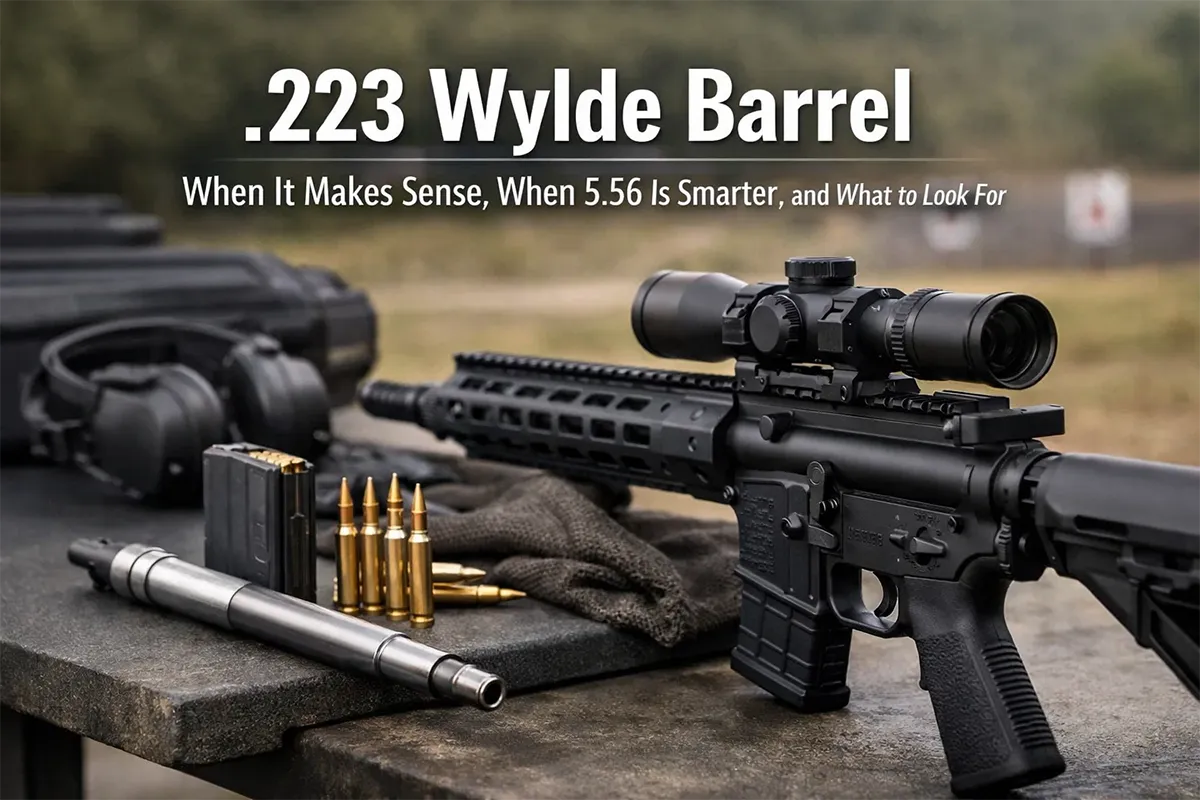
TL;DR: A .223 Wylde barrel is usually a great “one rifle for range + practical use” choice because it’s designed to handle 5.56 NATO ammo while often delivering more consistent accuracy with .223/5.56 match loads. But if your priority is maximum reliability with the widest variety of cheap 5.56, or you’re building a hard-use carbine first and a group-size machine second, a quality 5.56 NATO chambered barrel can still be the simpler, safer bet.
This deep dive breaks down what .223 Wylde actually is (and isn’t), how it compares to .223 Rem and 5.56 NATO chambers, and what barrel details matter more than the chamber name: twist rate, gas system length, barrel steel, lining/coatings, and how you plan to feed the rifle. The goal is to help you buy the right barrel for your AR without paying for “match” features you won’t use.
What Is a .223 Wylde Barrel (In Plain English)
.223 Wylde is a chamber design for AR-pattern rifles that aims to split the difference between two common standards: .223 Remington and 5.56 NATO. The practical promise is straightforward: safe use with 5.56 NATO plus better consistency with match-style .223/5.56 loads than many general-purpose 5.56 chambers.
That doesn’t mean every .223 Wylde barrel is magically more accurate than every 5.56 barrel. Barrel quality, ammo choice, and shooter consistency still dominate. Think of .223 Wylde as a chamber spec that can support accuracy—if the rest of the system is built for it.
.223 Rem vs 5.56 NATO vs .223 Wylde: The Practical Differences
All three are closely related, and the cartridges look similar enough to cause constant confusion. What matters for buyers is how the chamber handles pressure and bullet “jump” (how far the bullet travels before engaging the rifling).
- .223 Remington chamber: Often optimized around .223 pressures and can be tighter in ways that may favor accuracy. It’s not the default choice if you plan to run a steady diet of 5.56 NATO.
- 5.56 NATO chamber: Built to handle 5.56 NATO safely and reliably, often with a little more “forgiveness.” Many duty-style barrels live here for a reason.
- .223 Wylde chamber: Designed to safely run 5.56 while often tightening up some geometry that can improve consistency with match ammo.
Here’s the simple buyer takeaway: if you want an AR that eats almost any 5.56 you feed it and you don’t care about squeezing the smallest groups, 5.56 NATO is hard to argue with. If you want a “do-most-things-well” AR that you’ll shoot for groups sometimes and train with other times, .223 Wylde is often the sweet spot.
When a .223 Wylde Barrel Is the Right Choice
A .223 Wylde barrel tends to make the most sense when you’re building (or buying) an AR that lives in the middle: not a pure bench gun, not a pure “abuse it” rifle, but something you want to shoot well and often.
- You shoot match or heavier loads: If you gravitate toward 69–77 grain ammo for accuracy, Wylde is commonly chosen for that lane.
- You want one rifle for training + groups: Carbine drills one day, slower accuracy work the next.
- You care about consistency more than absolute velocity: Chamber choice isn’t a “velocity upgrade,” but it can support stable accuracy with good ammo.
- You’re building an SPR/Recce-style AR: These builds often prioritize practical accuracy without going full benchrest.
If you’re still shopping the host rifle, it helps to start at Semi Auto Rifles and narrow to AR-pattern models first. Then decide whether your use-case points to Wylde or 5.56 for the barrel.
When 5.56 NATO Is Smarter (Even If Wylde Sounds “Better”)
“Wylde” has become a shorthand for “more accurate,” so it’s easy to assume it’s always the upgrade. But there are scenarios where a straightforward 5.56 NATO chamber is the better fit.
- This is a hard-use training carbine: If you’re burning bulk ammo and prioritizing reliability, durability, and parts commonality, a quality 5.56 barrel is a great default.
- You mostly shoot inexpensive 55gr ball: Wylde won’t hurt, but you may not see meaningful gains if your ammo choice and shooting cadence aren’t accuracy-focused.
- You want maximum “runs no matter what” tolerance: Chamber geometry is only one part of reliability, but many proven duty barrels are 5.56 for good reasons.
In other words: if your barrel budget is fixed, you’re often better off buying a higher-quality 5.56 barrel than a lower-quality Wylde barrel. Quality wins.
What Matters More Than Chamber: 5 Barrel Specs That Actually Change Results
If you remember one thing from this article, make it this: barrel specs and manufacturing quality affect your experience more than the stamp on the chamber. Here are the specs that most directly show up on targets and during training.
1) Twist rate
Twist rate is how fast the rifling spins the bullet (like 1:7 or 1:8). Heavier, longer bullets generally prefer faster twist. If you want to shoot 69–77 grain ammo with confidence, 1:7 or 1:8 is commonly chosen. If you mostly shoot lighter loads, you still can run them in faster twist—just don’t expect twist rate alone to turn budget ammo into match ammo.
2) Gas system length
Gas system length affects recoil impulse, reliability margin, and how “smooth” the rifle feels. On many common barrel lengths, a mid-length system is often preferred for balance, but the best setup depends on barrel length, port sizing, buffer, and how you run the gun. A well-tuned 5.56 barrel can feel better than a poorly gassed Wylde barrel, and vice versa.
3) Barrel steel and finish
In broad terms: chrome-moly/CMV-style steels are commonly associated with durability; stainless barrels are commonly associated with accuracy potential. Coatings and lining (like chrome lining or modern nitride-type finishes) can improve corrosion resistance and service life. The “best” depends on whether you prioritize high round count durability, peak accuracy, or a balance.
4) Barrel profile
Profile influences weight and heat behavior. Lighter profiles carry better and feel faster, but heat up sooner. Heavier profiles can stay more consistent through longer strings, but make the rifle more front-heavy. If your AR already wears a light, sling, and other gear, a heavy barrel can push it from “fun” to “workout.”
5) Crown and overall build quality
Small manufacturing details—crown quality, concentricity, chamber finish, and consistency—often matter more than marketing labels. This is why reputable makers tend to deliver predictable performance regardless of whether the chamber is 5.56 or Wylde.
Ammo Reality: What You’ll Actually See on Paper
Most shooters don’t test ammo in a way that isolates barrel differences. We mix lots, shoot off bags one day and offhand the next, and call it “data.” That’s normal—just keep expectations realistic.
- Bulk 55gr ball: Great for reps. Usually not the best yardstick for judging chamber benefits.
- Quality 62–77gr loads: Where a well-made Wylde barrel often shows its strengths in consistency.
- “It liked this one box” effect: ARs can be picky. Buy a few small quantities of different loads before you stock up.
If your plan is “mostly bulk ammo, occasional nicer ammo,” you can still benefit from Wylde—but you’ll feel the difference most when you actually feed it ammo that’s capable of showing the difference.
Accessory Spec Table: AR-15 Barrels (What to Compare)
| Category | Compatibility | Materials | Weight | Dimensions | Features | MSRP |
|---|---|---|---|---|---|---|
| AR-15 barrel (.223 Wylde) | AR-15 / 5.56 bolt; verify gas length & extension | Varies by SKU (CMV or stainless common) | Varies by profile | Varies by SKU (length, gas system, journal) | .223 Wylde chamber; twist rate varies; finishes vary | Varies widely |
| AR-15 barrel (5.56 NATO) | AR-15 / 5.56 bolt; verify gas length & extension | Varies by SKU (CMV common) | Varies by profile | Varies by SKU (length, gas system, journal) | 5.56 chamber; twist rate varies; lining/finish varies | Varies widely |
Brand Research Paths That Make Sense in 2026
If you want to reduce guesswork, start by comparing barrel offerings from makers with strong AR ecosystems and consistent spec sheets. Two easy research anchors:
- Aero Precision for widely used AR parts and builds where value and compatibility matter.
- Daniel Defense as a reference point for hard-use AR patterns and proven configurations.
Even if you don’t buy from either, using common baselines makes it easier to compare twist rates, profiles, and gas lengths without getting lost in buzzwords.
A Simple Buying Checklist for a .223 Wylde Barrel
- Define the job: training carbine, practical accuracy (SPR/Recce), or “mostly bench.”
- Pick barrel length first: then choose gas system length that fits that barrel length and your recoil goals.
- Choose twist for your ammo plan: if you want heavier match loads, lean toward 1:7 or 1:8.
- Decide durability vs accuracy bias: CMV-type durability vs stainless accuracy potential (varies by maker).
- Choose a profile you’ll actually carry: don’t build a rifle you hate holding.
- Plan your ammo test: buy a few small boxes of different loads before committing to a case.
If you follow that checklist, you’ll end up with the right barrel for your use—even if you never once argue about chambers on the internet. (A surprisingly healthy lifestyle choice.)