
22 Magnum Revolver in 2026: How to Choose the Right One for Trail Carry, Varmint Use, and Low-Recoil Field Work
April 6, 2026
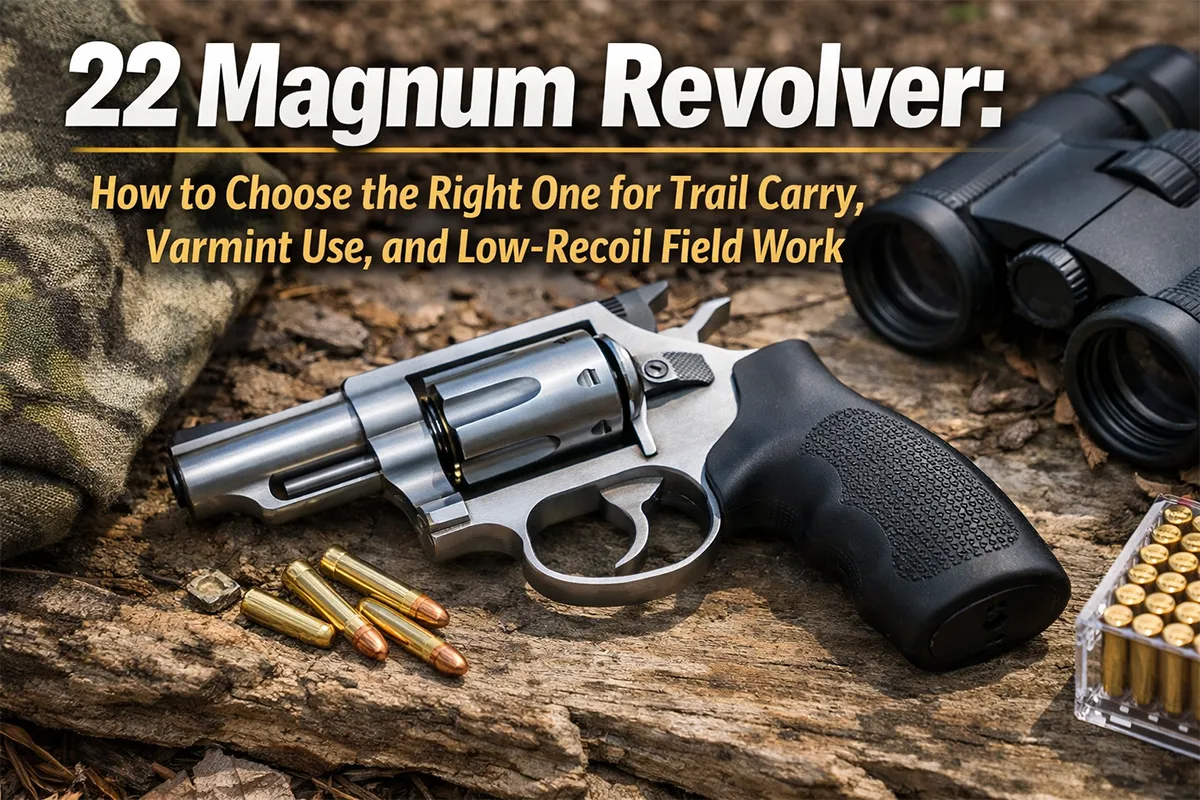
If you are researching a 22 Magnum revolver in 2026, you are probably trying to solve a fairly specific problem. You want more reach and more energy than a .22 LR revolver usually gives you, but you may not want the blast, recoil, weight, or cost of stepping up to a .357 Magnum or larger centerfire wheelgun. This guide covers what the platform does well, where it makes sense, and how to choose the right size, barrel length, and feature set for the way you actually plan to use it.
As of April 6, 2026, the category still appeals to a practical kind of buyer. A .22 Magnum revolver, more properly a revolver chambered in .22 WMR or .22 Winchester Magnum Rimfire, fills a narrow but useful lane. It can make sense for trail carry, small-varmint work, camp use, and relaxed range sessions where you want more pop than .22 LR without moving into heavier-recoiling magnum territory. It is not the universal answer for every handgun role, but that is also why it remains interesting.
Before comparing brands, it helps to define the platform. A revolver stores cartridges in a rotating cylinder rather than a detachable magazine. In plain English, that means simple loading, visible chamber status, and a manual of arms many shooters still find reassuring. Browse the broader revolvers category first, then narrow the field by size, sights, and intended use rather than by caliber alone.
Why a 22 Magnum Revolver Still Makes Sense
The biggest reason is balance. A .22 Magnum revolver offers a middle ground between light rimfire plinkers and full-power defensive or hunting revolvers. Compared with .22 LR, .22 WMR generally gives you more velocity and a little more authority, especially from longer barrels. Compared with centerfire magnums, it is easier to shoot comfortably for longer sessions and often easier for newer or recoil-sensitive shooters to manage.
The second reason is purpose. This is a category for people who like field utility. A compact .22 Magnum revolver can ride easily on a belt or in a pack, handle informal pest-duty roles where lawful, and still be pleasant enough for range practice. A longer-barreled version can lean more toward small-game or varmint work, especially when paired with good sights. It is a niche, but a useful niche.
The third reason is simplicity. A revolver does not ask much from the shooter in terms of ammunition tuning, slide manipulation, or magazine upkeep. That does not make it magically better. It just makes it straightforward. For some owners, that matters more than capacity or fast reloads. A handgun that is easy to understand and easy to verify can be very appealing in a field or camp role.
22 Magnum Revolver vs .22 LR and .357 Magnum
This is the real buying question. Against a .22 LR revolver, the .22 Magnum usually wins on downrange performance and practical field usefulness. It feels less like a pure trainer and more like a working rimfire. The tradeoff is ammunition cost, louder report, and often more muzzle flash, especially from short barrels. A tiny .22 Magnum snub can be handy, but it can also be surprisingly flashy and sharp for such a small gun.
Against a .357 Magnum revolver, the .22 Magnum wins on recoil control, carry comfort, and range friendliness for many shooters. It also lets you enjoy the revolver experience without signing up for heavier recoil or a much heavier gun. The tradeoff is clear: it is not a substitute for a centerfire magnum when the role truly calls for one. It is better understood as a lighter, easier-to-live-with field revolver, not a mini hand cannon pretending to be something else.
That leaves the category in a useful middle lane. If .22 LR feels a little too soft for your intended use and .357 Magnum feels like more gun than you want to practice with, the .22 Magnum revolver becomes one of the cleaner answers in the market.
| Format | Typical Barrel / Size | What It Usually Does Well | Main Tradeoff |
| Small-frame .22 Magnum revolver | Usually short barrel, easy-carry format | Trail carry, kit gun use, low-bulk packing | More blast and harder sights in a small package |
| Mid-size field revolver | Usually 3–5 inch barrel class | Best balance of portability and shootability | Less compact than pocket-size options |
| Longer-barreled rimfire revolver | Usually 6 inches or more | Better sight radius, steadier field shooting | Bulkier to carry all day |
| Convertible-style option | Varies by SKU | Added flexibility if .22 LR cylinder option exists | Not every buyer needs the extra complexity |
What Changes the Experience Most
Barrel length is the first big factor. Short barrels carry better, but they also make the cartridge feel louder and less settled. Longer barrels usually help the round feel more useful, give the sights more room to work, and make the gun easier to shoot well. If your main role is pack carry or trail use, a shorter revolver makes sense. If your main role is small-game or varmint work, longer barrels usually make more practical sense.
Sight quality matters more than many buyers expect. A rimfire field revolver is only as useful as its sights let it be. Fixed sights can be fine on a dedicated short-range carry gun, but adjustable sights are often worth prioritizing if you want the revolver to do real field work. Ammunition can vary, and being able to tune point of impact is more helpful here than on many casual buyers’ guides admit.
Grip size is another major divider. Small grips make a revolver easier to carry, but they can make it slower to shoot accurately, especially in double action. Larger grips usually improve control and comfort, which matters if you actually plan to practice instead of just admire the idea of practice. The smarter buy is usually the one you can hold consistently, not the one that disappears most neatly into a catalog description.
Action style matters too. Single-action revolvers can be enjoyable, precise, and mechanically simple, but they are slower to reload and slower to fire shot-to-shot because the hammer must be cocked manually each time. Double-action revolvers let you fire with a longer trigger press or thumb-cock the hammer for a lighter single-action shot. For a flexible field gun, many buyers will prefer double action. For pure range enjoyment or traditional flavor, single action still has its fans.
Brands and Approaches Worth Researching
If you want the broadest starting point, look at Ruger. Ruger’s revolver lineup is often where buyers begin when they want durable field guns, practical rimfires, and a mix of traditional and modern formats. The appeal is usually long-term usefulness. These are often the options people research when they want a revolver that gets carried, not just collected.
Smith & Wesson is worth comparing if you want a more classic double-action path with a long history in field and kit-gun style revolvers. For many shoppers, the draw is a familiar trigger style, mature ergonomics, and established revolver DNA. If you care about how a revolver feels in the hand and during repeated double-action presses, this brand often belongs on the short list.
Taurus can make sense for buyers who want to keep cost under control while still getting into the category. That does not automatically make it the best route for every shooter, but it is a relevant lane for people who want a practical rimfire revolver without paying for premium finishing or brand prestige. Value matters in a cartridge category that often invites lots of range use.
You can also keep an eye on Charter Arms if your priorities lean toward light weight, easy packing, and straightforward field utility. The theme across these brands is not that one is objectively “best.” It is that each tends to emphasize a slightly different answer to the same question: how much revolver do you want to carry, and how much revolver do you want to shoot?
Who This Category Fits Best
A 22 Magnum revolver fits buyers who want a field-friendly handgun with manageable recoil, simple operation, and more practical punch than a .22 LR plinker. It can make sense for trail carry, ranch or camp chores, and range use for shooters who enjoy revolvers but do not want to step up to a heavier centerfire setup. It also fits buyers who value portability and ease of use more than raw handgun power.
Where it fits less well is for shoppers who want one handgun to cover every possible role. This is not the best choice for everyone, and it does not need to be. It is strongest when bought for a clear job. Once you know that job, the category becomes much easier to shop intelligently.
Research Checklist Before You Buy
- Decide carry-first or shoot-first. That choice usually determines barrel length and frame size.
- Prioritize sights. Adjustable sights are often worth it on a field-oriented rimfire revolver.
- Check grip fit carefully. Small grips carry well, but larger grips often shoot better.
- Think about action type. Double action is more flexible; single action is more specialized and traditional.
- Be honest about ammunition cost. .22 Magnum is useful, but it is not .22 LR-cheap.
- Buy for the real role. A trail gun, a kit gun, and a small-varmint revolver are not always the same thing.
The practical takeaway is simple: the best 22 Magnum revolver is usually the one that matches your real use case instead of your imagined one. If you want a light trail companion, go compact. If you want a steadier field revolver, lean toward a mid-size or longer-barreled option. If you want more comparison points, keep browsing the revolvers category and narrow the field by makers like Ruger, Smith & Wesson, Taurus, and Charter Arms.