
2025 Firearms Year in Review: Trends, Standouts, and What’s Next
December 31, 2025
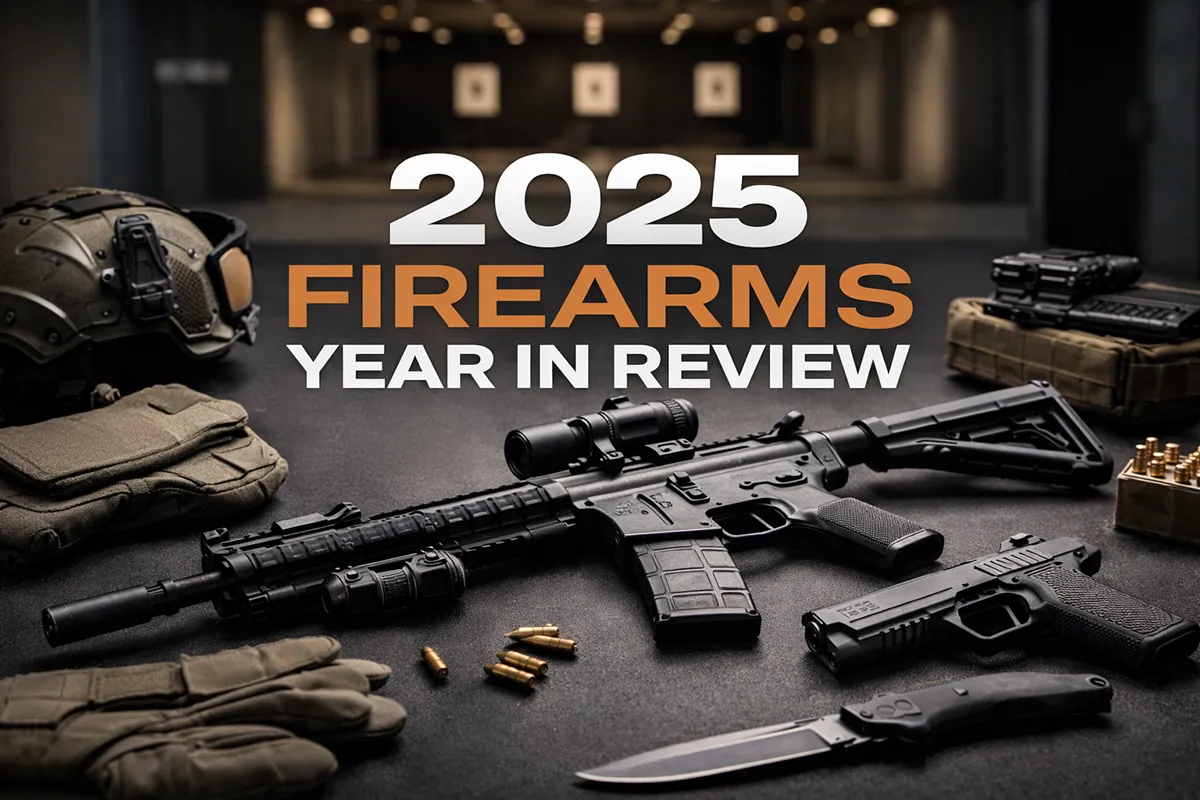
Our 2025 Firearms Year in Review spotlights the categories and brands U.S. shooters searched and compared most on GunGenius, what specs consistently won attention, and what we expect to heat up first in 2026. If you want the short version: 9mm pistols stayed king, practical optics-ready features trickled into nearly every price tier, and hunters leaned hard into lighter, suppressed-friendly rifles.
On December 31, 2025, we wrapped our 2025 Firearms Year in Review to help you quickly navigate what mattered and why. Rather than hype, we focused on the research patterns we see every day: what readers explored across core categories like handguns (from subcompacts to competition-ready full sizes) and platform staples such as semi-auto rifles.
2025 Firearms Year in Review: The Trend
Handguns: In 2025, the modern carry pistol continued to consolidate around three expectations: optics-ready slides, usable stock night-sight options (or at least improved steel sights), and reliable 12–20+ round capacities in packages you can actually conceal. The “micro-compact” wave matured—many buyers prioritized shootability over the smallest possible footprint, opting for slightly taller grips that preserve control without printing in everyday carry.
Rifles: The semi-auto rifle category stabilized around modularity and accessory-readiness. Out of the box, buyers want free-float handguards with real estate for lights and pressure switches, out-of-spec tolerances are a turn-off, and barrel lengths that balance maneuverability with ballistic performance (think 13.7–16 inches for 5.56). Bolt guns saw renewed interest as hunters chased lighter, suppressor-ready builds with threaded muzzles and smooth actions that don’t break the bank.
Shotguns: From clays to turkey blinds, the year favored reliable semi-autos with user-friendly controls and chokes—while pump-action stalwarts remained popular thanks to proven durability and value. Backcountry and truck-gun setups leaned into shorter overall lengths (where legal) and accessory rails for white light mounting.
Brands to watch: Legacy names still dominated research clicks—think Smith & Wesson and Ruger—while performance-forward specialists and value disruptors kept the competition honest. If there was a theme, it was that features we used to call “custom” became table stakes around the $400–$1,200 bands.
Spec Highlights & Standouts
- Optics readiness everywhere: Optic-cut slides and included plates were the default expectation on carry pistols. It reduced total setup cost and time while encouraging more shooters to try red dots for faster sight acquisition and low-light confidence.
- Threaded barrels & suppressor-friendly SKUs: Hunters and home defenders alike gravitated toward factory-threaded barrels. Even buyers without cans appreciated the flexibility for brakes and comps as recoil-management options.
- Better triggers out of the box: Whether two-stage on rifles or clean striker-fired pulls on pistols, “that’ll do” triggers became “this is actually good.” Less tinkering, more range time—no complaints here.
- Weight reduction without fragility: Carbon-wrapped barrels and skeletonized components drew attention, but the real winners paired weight savings with durability and realistic pricing.
- Accessory ecosystems: Picatinny and M-LOK everywhere made it easy to grow a platform over time—think lights, slings, and LPVOs (low-power variable optics) for rifles, or weapon lights and closed-emitter dots for pistols.
Comparisons
Carry pistols: The choice often boiled down to capacity, shootability, and optics mounting. Shoppers cross-shopped polymer striker-fired mainstays with newer metal-frame takes aiming for flatter recoil and smoother recoil impulse. Many readers compared compact and micro-compact siblings in the same families to find the grip length and slide mass that fit their hands and holsters best.
AR-pattern rifles: Mid-tier, feature-complete rifles drew interest by bundling cold-hammer-forged or nitrided barrels, reliable coatings, and ambidextrous controls at approachable prices. Shoppers tended to shortlist models offering proven reliability plus small quality-of-life wins (QD sockets where you want them, ejection port flaps that seal well, and gas systems that play nicely with suppressors).
Hunting bolt guns: The comparison matrix skewed toward sub-MOA guarantees, stock ergonomics (adjustable combs and LOP), and out-of-the-box weight that won’t punish you on a long stalk. Threaded muzzles and smooth feeding from reliable mags increasingly separated “good enough” from “buy once, cry never.”
For deeper category browsing, start with the big buckets and drill into platforms you care about: All guns & firearms → semi-auto pistols, bolt-action rifles, or semi-auto shotguns.
What to Watch Next (Early 2026)
Carry optics get tougher and tidier: Expect more closed-emitter micro dots and cleaner mounting footprints that reduce plate stacks. As manufacturers standardize, zeroing and durability headaches should keep trending down.
Balanced-length rifle builds: Feature-rich 13.7–14.5-inch configurations (pinned/welded for legal length where applicable) will keep bridging the gap between indoor handling and outdoor velocity. Factory-tuned gas and buffer combos will matter more as suppressor use rises.
Hunting rifles shed ounces, not accuracy: Sub-7 lb rigs with smart stocks and sensible barrel profiles will continue to multiply, as hunters refuse to trade their shoulders to save their legs. We’ll also see more factory packages pairing solid glass with proven actions, a boon for new hunters who just want a “buy-and-go” kit.
Training-forward accessories: Expect steady growth in dry-fire aids, recoil-reduction comps, and duty-grade weapon lights trickling into budget tiers. When practice is easier, people practice more—that’s the point. (Range snacks still not included.)
Want to browse by maker instead? Jump into the brand index—start with heavy hitters like Smith & Wesson, Ruger, and SIG Sauer—then drill down to specific models.
Wherever you land—handguns for EDC, a new bolt rifle for the season, or a shotgun for clays—you’ll find deep category breakdowns and spec filters on GunGenius to compare platforms side-by-side before you decide.